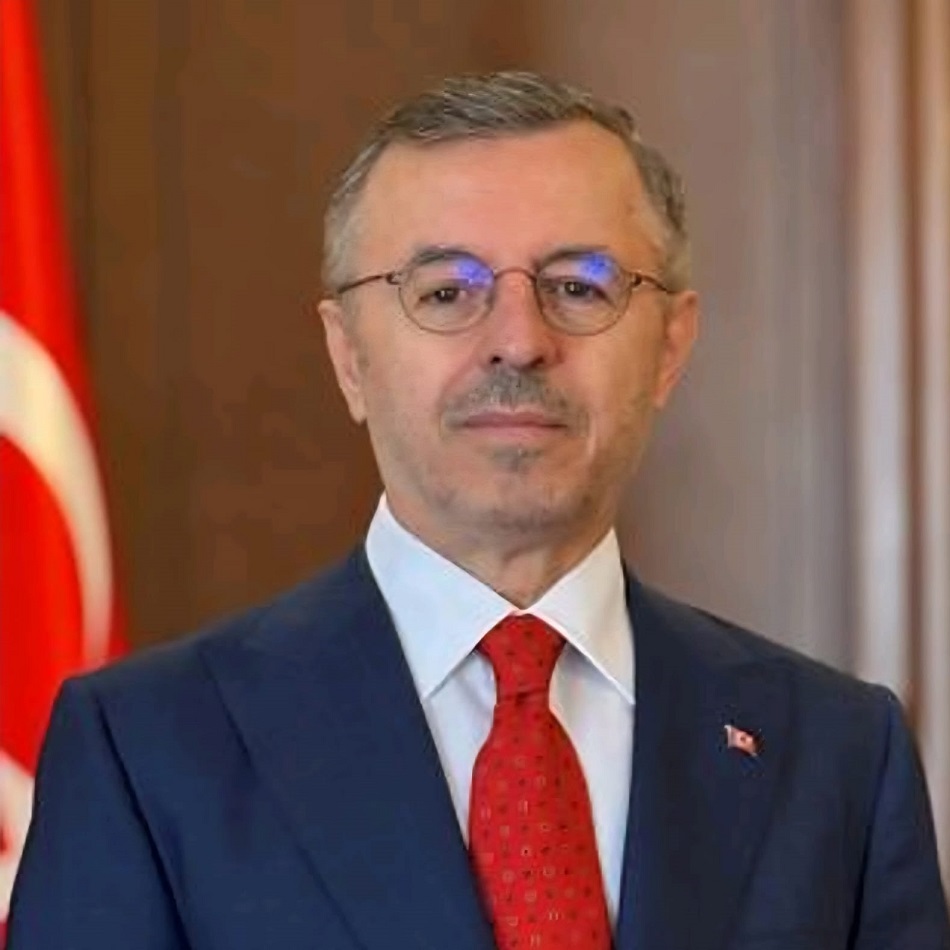
In this interview, we had the privilege of speaking with H.E. Mr. Lütfullah Göktaş, Ambassador of the Republic of Türkiye to the United Arab Emirates. We are grateful for his time and for sharing his thoughtful perspectives on the evolving Türkiye–UAE relationship. The conversation offers valuable insights into strategic partnership, digital trade, investment, and technological cooperation, while highlighting how shared visions and complementary economic strengths are shaping a deeper and more resilient bilateral framework.
UAE–Türkiye Strategic Outlook
The UAE and Türkiye have deepened their economic relationship significantly in recent years. How does the UAE view Türkiye as a partner in digital trade and the new economy?
I can approach this question from both perspectives because the viewpoints of Türkiye and the UAE are quite similar. Both nations view each other as beacons of stability in a volatile region. This alignment is not limited to the political sphere; it extends to financial, commercial, and investment sectors, where Türkiye and the UAE support one another’s endeavors and complement their respective future visions.
His Excellency President Recep Tayyip Erdoğan and His Highness President Sheikh Mohamed Bin Zayed Al Nahyan agreed to elevate Türkiye-UAE relations to the level of strategic partnership in 2023. The first meeting of the “High-Level Strategic Council” convened in Ankara last July, resulting in the signing of seven agreements, primarily in the fields of investment and economics.
The signing of the Comprehensive Economic Partnership Agreement (CEPA) in 2023 stands as the most robust testament to the flourishing relations between Türkiye and the UAE. Facilitated by the favorable environment created by this agreement, our bilateral trade volume doubled in 2023, exceeding $20 billion. In the following years, as UAE Minister of Foreign Trade His Excellency Thani Al Zeyoudi has stated, bilateral trade figures have reached even higher milestones, surpassing $40 billion.
Bilateral investments have become another cornerstone of our developing economic ties. Turkish companies have undertaken 149 projects worth $17.7 billion, making the UAE the 10th most important country globally for Turkish international contracting services.
These figures serve as concrete evidence of the complementary and mutually beneficial nature of the Turkish and Emirati economies. Our strategic partnership, expanding across commercial, investment, and financial fields, generates fruitful outcomes not only for our two nations but for the wider region and beyond as well. Rooted in the mutual benefit of the two countries and strategic visions of His Excellency President Erdoğan and His Highness President Sheikh Mohamed, our collaboration paves the way for a stable and secure future in a world where volatility and uncertainty have become the new norm.
What distinguishes Türkiye as an attractive destination for UAE investors and tech-driven companies?
Türkiye’s attractiveness for UAE investors lies in the rare convergence of scale, capability, and strategic geography—a combination that few markets currently offer in one package.
Türkiye is one of the largest consumer markets in its wider region, with over 85 million people, high digital adoption, and a consumption profile that supports rapid scaling of platforms, marketplaces, and digital services. For UAE investors accustomed to building regional champions, Türkiye provides both a substantial domestic base and a springboard to adjacent markets.
Türkiye has evolved into a production-plus-technology economy, rather than a purely consumption-driven one. Unlike many emerging markets, Türkiye combines advanced manufacturing, strong industrial supply chains, and a growing software and digital services layer. This allows UAE tech-driven companies not only to sell into Türkiye, but to build, test, and export from Türkiye, particularly into Europe, MENA, and Central Asia.
Thirdly, cost-efficiency with sophistication is a major differentiator. Türkiye offers globally competitive engineering, product, and operations talent at costs that remain attractive compared to Western Europe or even parts of Eastern Europe. For UAE investors facing rising global tech costs, Türkiye represents a market where capital can be deployed more efficiently without sacrificing quality or execution speed.
Another critical factor is geostrategic positioning. Türkiye sits at the intersection of multiple trade corridors and time zones, enabling near-real-time operational overlap with Europe, the Gulf, and Asia. For UAE companies building cross-border platforms—whether in e-commerce, fintech, logistics, or SaaS—this makes Türkiye an ideal operational and regional coordination hub.
Finally, there is a strategic alignment of long-term visions. UAE investors increasingly favor partnerships that deliver technology transfer, ecosystem development, and regional integration rather than short-term financial returns. Türkiye’s policy focus on high-value foreign direct investment, digitalization, and export-oriented growth resonates strongly with this approach.
In summary, Türkiye stands out not because it offers a single advantage, but because it brings together scale, talent, industrial depth, and regional reach in a way that aligns naturally with the UAE’s ambition to build globally competitive, tech-enabled platforms.
CEPA & Digital Market Integration
How do you see CEPA transforming bilateral e-commerce flows, especially by lowering barriers and enabling faster cross-border transactions?
The Türkiye-UAE Comprehensive Economic Partnership Agreement (CEPA) represents a key driver in accelerating bilateral e-commerce. By reducing regulatory and operational barriers, simplifying customs processes, and enhancing transparency, CEPA lowers the cost and complexity of cross-border online trade. This is especially impactful for small and medium-sized enterprises and digital startups, enabling them to access each other’s markets more easily while benefiting from Türkiye’s strong production and e-commerce capabilities and the UAE’s role as a global logistics and fintech hub.
At the same time, CEPA facilitates faster and more secure cross-border transactions by improving trade facilitation, logistics efficiency, and digital trade frameworks. Clearer rules on electronic payments, data flows, and consumer protection help build trust and encourage businesses to scale their operations with confidence. Beyond increasing transaction volumes, the agreement lays the foundation for a deeper digital partnership, positioning Türkiye and the UAE to strengthen regional e-commerce connectivity and jointly expand into third markets.
UAE Investments in Türkiye
Türkiye investments in UAE continue to grow across different sectors. What long-term strategic priorities guide these investments?
I can name multiple priorities. Nevertheless the most significant ones are: Strengthening the mutual development in the fields not only crucial for today, but also for the future; empowering the stability to foster a fertile environment for our business people to grow, cooperate and support our industries to innovate products for the benefit of the third parties; and last but not least, collaborate in the future technologies that will generate outcomes beneficial not only for Türkiye and the UAE, but also for the whole world.
In this respect, I can proudly state that we have already made significant progress towards these objectives. Currently, there are multiple data center projects in which UAE initiatives are investing in Türkiye. Simultaneously, Turkish companies are undertaking the Dubai Metro Blue Line project. DP World and AD Ports are leveraging Türkiye’s strategic location by collaborating with their Turkish partners on long-term logistics investments. Additionally, our multilateral cooperation with Iraq and Qatar on the “Development Road Project” elevates our solidarity to a playmaker position and is redefining the rules of global supply chain routes.
However, these are merely the first steps of our robust cooperation. We still have a long way to go and significant potential to fulfill in sectors such as tourism and hospitality, pharmaceuticals, manufacturing, food and agriculture, and advanced technologies and so on. Thanks to the cordial mutual relations between our Presidents, we are working diligently to pave the way for our business leaders, assisting them in carrying the flag of both nations in the field of economic diplomacy.
How do UAE companies perceive Türkiye’s digital infrastructure, talent pool, and entrepreneurial ecosystem?
UAE companies generally view Türkiye’s digital infrastructure as reliable, evolving, and capable of supporting long-term growth. The country has made steady progress in digital connectivity, payments systems, and technology adoption, which provides a supportive framework for modern business operations and cross-border collaboration.
Türkiye’s talent pool is widely recognized as one of its key strengths. The availability of well-educated, adaptable, and internationally experienced professionals contributes significantly to investor confidence. This human capital, combined with a strong culture of entrepreneurship, supports innovation and encourages the development of new business models and partnerships.
From the perspective of UAE companies, Türkiye’s entrepreneurial ecosystem reflects a growing maturity. It demonstrates not only creativity and ambition, but also an increasing capacity to scale and integrate with regional and global markets. This makes Türkiye a natural partner for UAE businesses seeking to expand their regional footprint through cooperation rather than competition.
E-Commerce Ecosystems & Private Sector Cooperation
What opportunities exist for collaboration between e-commerce platforms in the UAE and Turkish sellers looking to scale regionally?
The UAE’s advanced marketplaces, digital infrastructure, and logistics capabilities provide an ideal gateway for Turkish businesses to access wider regional markets, enabling faster entry, efficient fulfillment, and improved delivery performance. Through partnerships in areas such as seller onboarding, digital payments, marketing, data analytics, and shared fulfillment solutions, Turkish companies can scale more effectively while UAE platforms diversify their offerings with high-quality Turkish products. These collaborations go beyond immediate commercial gains, contributing to a more integrated and resilient regional e-commerce ecosystem that benefits both countries.
Innovation, Logistics & New Economy Sectors
With the rise of AI, last-mile delivery innovations, and digital logistics corridors, how do you see the next stage of UAE–Türkiye cooperation unfolding?
The next stage of cooperation between the United Arab Emirates and Türkiye will be shaped by a shared understanding that technology is a key enabler of sustainable economic partnership. As global trade becomes increasingly digital, both countries recognize the importance of aligning their strengths to support innovation, efficiency, and inclusive growth.
Artificial intelligence will sit at the center of this transformation. Ongoing data center investments by UAE players including G42’s Khazna, Gulf Data Hub’s Castle Investments and Damac’s Edgnex combined over USD 1 billion is a great testament of how AI will shape the future of this rapid transformation.
In this context, advances in artificial intelligence, digital logistics, and smart delivery solutions should be viewed not merely as technological developments, but as tools that deepen economic connectivity between our two nations. These technologies allow businesses—large and small—to operate more efficiently, reach new markets, and respond more effectively to changing consumer expectations.
The UAE and Türkiye are well positioned to complement one another. The UAE’s role as a regional logistics and digital commerce hub, combined with Türkiye’s strong production capacity and growing digital capabilities, creates a natural foundation for closer cooperation. Together, we can work toward trade corridors that are not only faster, but also more transparent, reliable, and resilient.
Importantly, this next phase of cooperation will be inclusive. By improving digital and logistics infrastructure, we are creating opportunities not just for major companies, but also for small and medium-sized enterprises to participate more actively in cross-border trade. This supports job creation, entrepreneurship, and long-term economic stability in both countries.
Looking ahead, UAE–Türkiye collaboration in digital trade and logistics reflects a broader commitment to partnership, openness, and shared prosperity. By continuing to engage in dialogue, align standards, and encourage collaboration between our private sectors, we can ensure that technological progress translates into tangible benefits for our economies and our people.
The next phase of UAE–Türkiye cooperation will focus on deeper technological and logistical integration. Advances in artificial intelligence create strong potential for joint efforts in areas such as enhanced customer experiences, while innovation in last-mile delivery through smart systems in warehousing and delivery models will improve efficiency and resilience. At the same time, developing digital logistics corridors with real-time data sharing and faster customs processes will further strengthen bilateral trade. By aligning standards and promoting public-private collaboration, Türkiye and the UAE can build seamless supply chains that connect multiple regions and position both countries as leaders in digital trade and smart logistics.
What role do events like WORLDEF Dubai 2026 play in bringing the two economies closer together in e-commerce, innovation, and investment?
They play an important role in strengthening ties between our two economies by creating a shared platform for collaboration in e-commerce, innovation, and investment. By bringing together policymakers, industry leaders, startups, and investors, these gatherings encourage the exchange of expertise, showcase new technologies, and help align strategic priorities. They also translate dialogue into tangible partnerships, offering Turkish companies greater access to regional capital and markets while enabling UAE stakeholders to engage directly with Türkiye’s dynamic digital and production ecosystems. In this way, such events function as strategic connectors that deepen bilateral cooperation and accelerate cross-border growth.