
WORLDEF ISTANBUL 2026 - Early Bird Registration Ends Soon

Register Now

AI and Omnichannel Transformation in Retail: A CIO Perspective from Grandiose

AI

Headquartered in the United Arab Emirates (UAE), Grandiose Supermarket offers an unforgettable multisensory experience within a unique grocery shopping environment. A premium-quality food and grocery retailer, Grandiose was founded in December 2016. Since then, it has redefined the supermarket experience in the UAE. Positioning itself as “the most loved neighborhood supermarket,” Grandiose continues to expand its reach through online ordering and exclusive promotions. We spoke with Grandiose Digital & Technology Director, Marcin Piekarczyk about the company’s mission and vision. Piekarczyk shared important insights on a wide range of topics, from artificial intelligence to omnichannel strategies.

A commercially minded omnichannel and marketing leader, Marcin Piekarczyk specializes in the development of retail, omnichannel, and e-commerce strategies for globally recognized brands, as well as executive management of retail brands and businesses. He has experience in digital transformation coaching aimed at transforming traditional retailers into fully hybrid business models. He is deeply passionate about customer experience. He has more than 16 years of proven experience working in dynamic environments and multinational cultures. He has experience managing omnichannel business models across eight different international markets.

How Does Technology Create Value?

Piekarczyk currently oversees digital and technology transformation across multiple food and retail brands with very different operational realities. When asked, “What are the core principles that guide your transformation strategy across such a complex ecosystem?”, Piekarczyk replied: “Rather than adopting technology for its own sake, we maintain a strong focus on outcomes and customer impact. Too often, organizations pursue the latest tools or platforms simply to appear technologically advanced, without clearly defining the problems they are trying to solve or fully understanding what customers, both internal and external, truly want and need.”

Stating that “For us, a successful transformation always starts with data and a deep understanding of the customer,” Piekarczyk continued: “Before introducing any new technology, we invest time in mapping customer journeys, identifying pain points, and understanding where friction exists across operations and experiences. Only once this foundation is clear do we evaluate technologies and select digital transformation initiatives that are purpose-built to address real needs.

Equally important is ensuring that the organization itself is ready for transformation. This begins with people and culture. In many cases, our role as a technology function goes beyond delivery; we also act as advisors and advocates for change, helping business units build a culture that embraces transformation. Technology only creates value when it is adopted, trusted, and effectively used by people across the organization.”

“We Are in the Early Stages of AI Applications”

Regarding the areas in which artificial intelligence delivers the fastest and most measurable value, Marcin Piekarczyk stated: “We are in the early stages of applying artificial intelligence across logistics and the supply chain. We are taking a selective and pragmatic approach. Today, we are testing specific use cases such as replenishment, assortment optimization, and demand forecasting. At this stage, it would be premature to overstate short-term impact or claim transformational results.

Our strategic priority is not rapid deployment, but building the foundations that will allow artificial intelligence to become a true competitive advantage over time. This includes significant investment in high-quality, well-governed data across products, vendors, and sales. Reliable and scalable data is a prerequisite for AI-driven decision-making at enterprise scale.”

He also added: “By focusing on data quality and governance today, we are enabling the business to move quickly and confidently as AI use cases mature. This approach ensures that future AI investments translate into sustainable performance improvements rather than isolated experiments with limited long-term value.”

“Data Is One of Our Highest Priorities”

Piekarczyk also responded to the question, “Many organizations struggle not with data availability but with data usability. How do you ensure that real-time data actually translates into better operational and commercial decisions?” as follows:

“Data is one of our highest priorities. Over the past few months, we have been intensely focused on data cleansing and establishing strong data governance practices across the organization. We have onboarded a dedicated data team, launched multiple data quality initiatives, and successfully implemented a Customer Data Platform for Grandiose. I consistently emphasize that data is the single most critical enabler of any digital transformation or artificial intelligence initiative.

Without trusted, well-governed, and accessible data, even the most advanced technologies cannot deliver meaningful or sustainable value. Our focus is not just on collecting data, but on ensuring that data is usable, reliable, and embedded into day-to-day decision-making across the business.”

“The Biggest Omnichannel Challenge Is Inventory Management”

From a CIO’s perspective, Piekarczyk also explained the most challenging back-end issues in making omnichannel truly work, particularly in high-frequency food and retail environments: “We operate in an extremely fast-paced and high-volume environment. We process thousands of orders every day across multiple touchpoints, including our app, website, aggregators, and more than 45 physical stores. In grocery retail, this complexity is further amplified by the wide range of vendors we work with, varying commercial terms, and the diversity of product categories, from fresh and ultra-fresh to prepared foods.

From both a back-end and customer-facing perspective, the single biggest omnichannel challenge is inventory management. Ensuring accurate and real-time inventory visibility across all sales channels is critical. Customers expect consistency; if a product is visible online, it must be available. Preventing customers from encountering out-of-stock items on digital platforms is essential to delivering a reliable omnichannel experience and maintaining long-term customer trust.”

“We Apply Artificial Intelligence Only When It Makes Sense”

Marcin Piekarczyk answered the question, “How do you balance process maturity with AI-driven automation to avoid increasing digital complexity rather than reducing it?” as follows: “The answer to this question is quite simple: we apply artificial intelligence only when it makes sense. There is a growing tendency in the market to introduce artificial intelligence for the sake of artificial intelligence, rather than to solve real problems.

At Ghassan Aboud Holding and Grandiose, we always start by clearly defining the problem, then building a business case. Only after that do we decide whether artificial intelligence, or any other technology, is the right solution. I call this approach ‘AI with purpose.’ Strong process discipline must always come first; otherwise, technology increases complexity instead of reducing it.”

“Our Focus Is on Targeted Experiments in Areas Such as Demand Forecasting and Replenishment”

In response to a question about the role of technology and artificial intelligence in building resilience, risk anticipation, and continuity across logistics and inventory networks, given the vulnerabilities in global supply chains, Piekarczyk stated that technology and artificial intelligence play an important role in reducing risk across supply chains and said:

“They enable better anticipation of demand volatility and potential supply shortfalls, help identify risks earlier, and support the evaluation of alternative scenarios and workarounds before disruptions impact operations or customers. That said, we are still in the early stages of adopting advanced artificial intelligence capabilities in supply chain management. Today, our focus is on targeted experimentation in areas such as demand forecasting and replenishment, where value can be tested and measured pragmatically. More advanced applications, such as predictive risk modeling and dynamic network optimization, remain firmly on our radar as future opportunities, to be pursued as our data maturity and operational readiness continue to evolve.”

“Without In-House Technical Expertise, Even the Most Sophisticated External Resources Cannot Deliver Meaningful Value”

Piekarczyk also answered the question, “When implementing artificial intelligence and digital solutions, how do you decide between in-house development, third-party platforms, or strategic partnerships?” as follows: “There is no single right or wrong approach; it largely depends on overall strategy and how you manage your profit and loss structure. Regardless of the model, it is critical to have in-house technical expertise capable of understanding business requirements, defining needs, and evaluating architecture. Without this capability, even the most sophisticated external resources cannot deliver meaningful value.”

He continued: “In practice, we often adopt a hybrid model. Certain strategic artificial intelligence initiatives, such as the GrandChef project with Microsoft, are managed through close partnerships. At the same time, other operational and development work is handled in-house or outsourced depending on complexity and scale. This hybrid approach allows us to balance control, cost, speed, and innovation, while ensuring that core knowledge remains within the organization.”

  • Beyond cost savings, which KPIs or metrics best indicate that a digital or artificial intelligence initiative in logistics or operations is truly successful?

Marcin Piekarczyk: I typically focus on two key metrics. The first measures overall business impact, such as incremental revenue generation or cost savings achieved. The second evaluates the success of the initiative within the broader context of digital transformation, specifically adoption and usage. If a solution is not actively embraced and used by business units and stakeholders, then it has not truly succeeded, regardless of how advanced the technology may be.

  • Digital transformation ultimately depends on people. What skills and leadership capabilities do you believe are most critical for CIOs and technology leaders operating in logistics-heavy retail environments?

Marcin Piekarczyk: I would describe it as a combination of technical expertise and business acumen. A successful leader must understand the technical aspects of digital initiatives while also appreciating their impact on the business, the profit and loss structure, and overall profitability. Technical knowledge alone is not sufficient. In addition, strong influencing and change management skills are essential. Innovation is inherently about change, and people naturally resist change. Being able to guide, inspire, and align teams through transformation is just as important as delivering the technology itself.

  • Looking toward the next 3–5 years, which technological or artificial intelligence–driven shifts do you believe will have the greatest impact on logistics and supply chains in the Middle East?

Marcin Piekarczyk: We will see further automation across logistics and supply chains, starting with predictive demand planning and extending to increased automation in fulfillment centers. Companies that successfully combine artificial intelligence, real-time visibility, and advanced analytics with strong data foundations and operational discipline will gain a decisive advantage in efficiency, resilience, and customer experience.
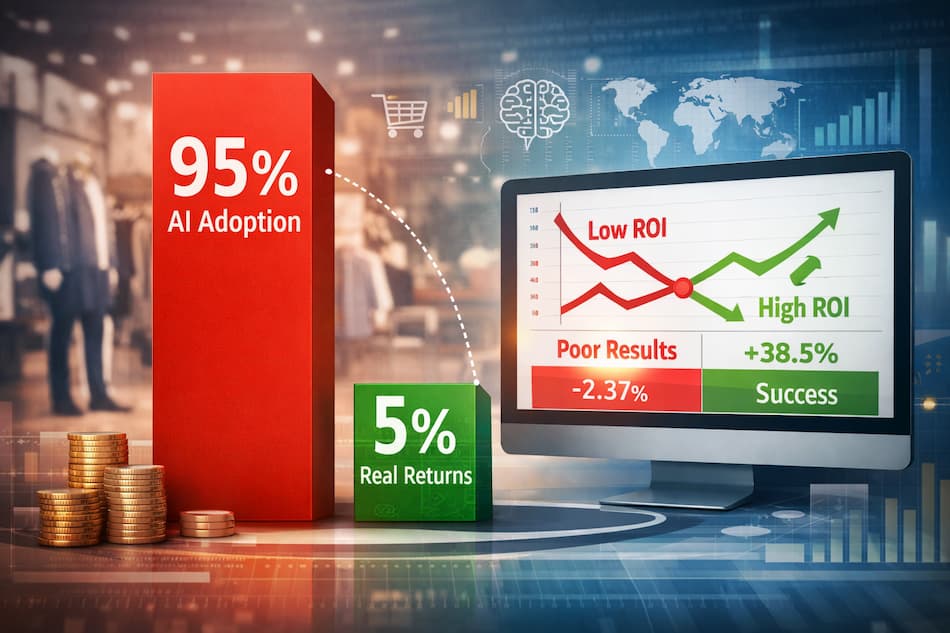

Global Retail Faces Harsh AI Reality as Only 5% See Real Returns Despite 95% Adoption

Global Retail Faces Harsh AI Reality as Only 5% See Real Returns Despite 95% Adoption

The global retail sector is entering a more pragmatic phase of AI adoption, as new research reveals a significant gap between experimentation and real business impact. A joint report by Voyado and Retail Economics shows that while 95% of companies have already tested AI in marketing or e-commerce, only 5% report clear and scalable returns.

The findings highlight a critical shift in the AI narrative-from rapid adoption to measurable performance-raising new questions about how retail businesses can turn AI investments into tangible results.

Data and Organizational Gaps Hold Back AI Performance

According to the report, the challenge is not access to AI tools, but the lack of strong data foundations and organizational readiness. Retail companies that achieve meaningful results typically rely on significantly more data sources and have more mature internal systems.

A major barrier remains internal capability. Around 58% of respondents identified skills shortages as the primary obstacle, while most of the top challenges were linked to organizational structure rather than technology itself.

This suggests that many retailers are still operating AI in isolated pilots rather than embedding it into core workflows.

AI Investment Set to Reshape the Retail Sector by 2030

Despite current limitations, the long-term impact of AI across the retail industry remains substantial. The report estimates that 39% of marketing and e-commerce budgets will be exposed to AI by 2030, representing approximately €14.9 billion annually.

Businesses are increasingly expecting AI to become a standard part of operations. Around 71% believe AI will be fully integrated into marketing workflows within two years, while 45% expect it to deliver measurable returns within the same timeframe.

The shift indicates that while adoption is already widespread, the next phase will be defined by execution-where only companies with strong data infrastructure and operational alignment are likely to capture real value.

Source: My Newsdesk

AI Reshapes Product Display in 2 Key Ways as Waddle Expands to U.S.

AI Reshapes Product Display in 2 Key Ways as Waddle Expands to U.S.

AI is taking on a more active role in e-commerce as South Korean startup Waddle expands into the U.S. AI is taking on a more active role in e-commerce as South Korean startup Waddle expands into the U.S. market with its commerce agent “Gentoo.”

Unlike traditional chatbots, Gentoo operates as a digital salesperson, engaging users in real time, identifying hesitation points, and guiding them toward purchase decisions.

This shift is redefining how products are displayed to users, turning static storefronts into more interactive and conversion-driven experiences.

From Static Pages to Intelligent Shopping Experiences

One of the biggest changes introduced by AI commerce is how online stores manage product display.

Instead of relying on fixed layouts and manual merchandising, Gentoo adapts how products are displayed based on user behavior and intent. It can initiate conversations, highlight relevant items, and guide users through complex product choices.

At the same time, the system functions as an AI store manager, helping retailers optimise both customer experience and overall display performance.

Closing the Conversion Gap

A long-standing challenge in e-commerce is the gap between browsing and purchasing. Many users explore products but leave before completing transactions.

Waddle addresses this through real-time conversational engagement, improving how products are displayed and discovered based on user needs.

This approach mirrors the experience of an in-store salesperson, bringing personalised guidance into digital environments while improving conversion rates.

Early Signals from the U.S. Market

Waddle’s expansion into the U.S. has already shown early traction. Within two months, the company secured 11 clients and engaged with more than 260 prospective customers.

The company also benefits from its collaboration with OpenAI, including winning a global hackathon and maintaining close ties with its developer ecosystem.

These milestones reinforce the growing demand for AI-driven commerce solutions.

Data and the Future of Product Display

According to the company, data is the key differentiator. Modern e-commerce environments combine text, images, video, and behavioral signals – requiring more than simple conversational responses.

By leveraging contextual data, Gentoo improves how products are displayed in real time, delivering more accurate recommendations and more relevant shopping experiences.

Looking ahead, trends such as “vibe shopping” suggest that product display will increasingly be shaped by emotion, mood, and overall experience – not just price or specifications.

Source: The Elec

For more global e-commerce, technology, and fintech news, explore the latest updates on WORLDEF.

The Role of AI and Human Balance in Recruitment Processes in MENA

AI

Digital transformation and artificial intelligence (AI) are reshaping workforce dynamics in the MENA region. Arda Atalay, LinkedIn’s Regional Director, evaluated the rise of new job roles, recruitment trends, and the impact of technology on recruitment processes in MENA’s digital economy for WORLDEF E-COMMERCE. Particularly, the sustained recruitment momentum and the use of artificial intelligence in the United Arab Emirates are creating a significant transformation in the region’s workforce strategies. Atalay also discussed how this transformation will adapt the workforce and shape new skill requirements. Arda Atalay’s vision provides an inspiring perspective on MENA’s digital future.

“Recruitment Momentum Continues Steadily in the UAE”

Arda Atalay, LinkedIn’s Regional Director

Arda Atalay referred to the structural changes brought about by the digital economy in the MENA region, stating, “The most visible structural shift is the increasing importance given to digital-centered roles, especially in markets like the UAE where recruitment momentum continues steadily. In November, recruitment in the UAE increased by 2.3% year-on-year, reinforcing the country’s position as one of the more resilient labor markets in EMEA–LATAM. This growth is driven by sectors at the heart of the digital economy and platform-based expansion.

The strongest demand is seen in Education (+15.7%), followed by Technology, Information and Media (+12.7%), Real Estate and Equipment Rental Services (+11.7%), and Retail (+10.7%). This table shows an increased demand for talent in both knowledge-based sectors and consumer-focused, e-commerce-driven ecosystems. As of November 2025, hybrid roles account for 17.9% of job listings in the UAE, but only 8.0% of applications,” he said.

“89% of C-Level Participants Trust Artificial Intelligence in the Workplace”

“As artificial intelligence, automation, and data analytics are integrated into daily operations, expectations for both leadership and mid-level talent are rising; mastery of AI is becoming a core competency for performance, decision-making, and competitiveness,” said Atalay, continuing, “In the UAE and Saudi Arabia, trust at the C-level leadership is notably high: 89% of C-level participants report feeling secure about using AI in the workplace. This shows that senior leaders are expected not only to understand AI but also to actively promote its adoption, using it to accelerate decision-making, improve strategic foresight, and enhance organizational efficiency.”

Atalay also shared, “At the mid-level, expectations are shifting from ‘awareness’ to practical competency. 86% of mid-level managers and professionals report feeling secure about using AI in the workplace; however, this confidence is more concentrated at the mid-level: 34% feel very secure, and 52% feel somewhat secure. This indicates that the workforce is generally interacting with AI, but deeper competencies are still being developed.”

“38% in the UAE are Learning In-Demand Skills like Artificial Intelligence”

Atalay noted a clear shift towards skill-focused mobility and cross-sector repositioning among job seekers in the UAE and Saudi Arabia, saying, “This reflects that talent flows in MENA are being shaped by digital transformation. In the UAE, 38% are learning in-demand skills like AI, 36% are enhancing their resumes and LinkedIn profiles; in Saudi Arabia, 29% are developing skills, and 27% are updating their professional profiles. In both markets, career strategies are expanding beyond traditional paths: 34% of job seekers in the UAE and 30% in Saudi Arabia are seeking jobs outside their current sectors.

Moreover, 32% in the UAE and 30% in Saudi Arabia are utilizing AI tools during their job search. Despite this, core behaviors remain important, such as networking (28% in the UAE; 24% in Saudi Arabia) and interview preparation (22% in both countries). In the UAE, there are signs of a shift in preferences post-pandemic; 25% of participants are considering face-to-face roles for the first time since COVID.”

“Access to Opportunities through Digital Networks is Becoming More Democratic”

Atalay mentioned that historically, recruitment in MENA has been based on both official qualifications (academic credentials and work experience) and personal relationships, stating, “However, with the transformation driven by AI, the evolution of roles is increasing the need for both AI and social skills, which has led to a growing focus on skills in recruitment processes. Notably, in both the UAE and Saudi Arabia, 74% of participants believe online professional platforms offer fairer opportunities. This indicates that digital networks are democratizing access to opportunities while preserving the relationship-building culture valued by professionals.”

Talent Intelligence, Search, and Strategic Growth

Atalay remarked, “More than 70% of HR professionals in the UAE and 80% in Saudi Arabia feel they need to make decisions faster than ever to succeed in their jobs. In contrast, 50% and 38%, respectively, say that decisions are accumulating faster than they can act on them.”

He added, “The need for speed does not eliminate the importance of thoughtful decision-making: Nearly half of HR leaders in the UAE and Saudi Arabia report spending more time on assessment than on execution. This shows they are balancing urgency with accuracy. Rather than becoming overwhelmed, HR teams in the region are turning this challenge into an opportunity. In both countries, around 80% are seeking AI training to manage the increased workload.

This indicates a strong appetite for tools that speed up routine tasks while leaving room for human judgment. In line with LinkedIn’s forecasts, the future of work is not about competition between humans and AI but collaboration between them. The real opportunity lies in creating a balanced partnership, and this is particularly evident in our region, where there is a strong focus on human decision-making and relationship-building skills while rapidly adopting AI tools.”

“Leaders Are Benefiting from AI in Recruitment Processes Without Losing the Human Touch”

“Atalay explained that the leaders he spoke with are using AI to accelerate and streamline recruitment processes, but without losing the human touch that defines the way we work.” He continued, “This is exactly why we developed LinkedIn’s newest talent agent, Hiring Assistant. This tool is designed to take over repetitive and time-consuming tasks that slow down recruiters, allowing them to focus on connecting, advising managers, and creating strong candidate experiences.

When introducing this tool to HR teams, I show how simple it is: once a job description and notes are uploaded, Hiring Assistant instantly turns it into role competencies and a candidate pool. It also incorporates past applications via the Recruiter System Connect and continuously learns from recruiter feedback. Over time, it adapts to the preferences, practices, and cultural nuances of each recruiter, instead of imposing a one-size-fits-all approach.”

“Talent is the Most Critical Competitive Advantage in Business”

Atalay concluded with this assessment: “In the MENA digital economy beyond 2026, competitiveness will depend on how well employees and organizations adopt and adapt to AI, prioritize continuous digital skill development, embrace flexible working models, and develop human competencies supported by data-driven workforce strategies.

The paradox I observe in the strong and resilient Gulf economies is not a challenge to overcome but a strength to build upon. While other regions debate whether to trust AI or intuition, we have already found the balance point. We are using technology to accelerate processes while maintaining the cultural depth that defines our way of working. Tools like LinkedIn Hiring Assistant show how this can be practically achieved.

The human-AI balance is crucial because talent decisions shape not only individual companies but also the growth of entire economies. It has become clear in recent years that talent is the most critical competitive advantage for businesses to win in the rapidly evolving business world. As global competition for skills intensifies, our ability to leverage AI without overlooking the human element could provide MENA with an advantage that few other regions can replicate.”

Business Faces 5 Rising Cybersecurity Threats as AI Traffic Surges

Business Faces 5 Rising Cybersecurity Threats as AI Traffic Surges

The rapid rise of artificial intelligence is fundamentally reshaping the internet and with it, the global cybersecurity landscape. According to the latest industry findings, AI-driven traffic is growing at an unprecedented pace, forcing business leaders to rethink how they manage digital trust and security.

In 2025, automated traffic expanded significantly, growing nearly eight times faster than human-generated traffic, signaling a major shift in how online activity is created and managed. At the same time, AI-driven traffic surged by 187% over the year, nearly tripling in volume and becoming the fastest-growing segment of internet activity.

How AI Traffic Is Transforming Business and Security

One of the most notable developments is the rise of AI agents-systems that no longer just browse the web but actively interact with it. These agents are now capable of performing complex tasks such as product discovery and even completing transactions, marking a new phase in digital commerce.

This shift is particularly important for business ecosystems, as AI-driven traffic is heavily concentrated in high-value industries. More than 95% of this activity is focused on sectors such as e-commerce, streaming and travel, where real-time data and frequent transactions create strong incentives for automation.

However, this rapid growth is also introducing new cybersecurity risks. The report highlights a sharp increase in malicious activity, including scraping attacks and account takeover attempts. In fact, scraping-related traffic alone is approaching 20% of total global traffic, nearly doubling compared to previous years.

At the same time, post-login account compromise attempts have surged dramatically, with hundreds of thousands of incidents detected per organization on average. These trends suggest that as AI becomes more capable, the line between legitimate automation and cyber threats is becoming increasingly difficult to distinguish-creating new challenges for business operations.

The Growing Challenge for Business in the AI Era

For business leaders, the implications are significant. As AI-driven automation becomes more common, organizations must adapt to a new reality where not all traffic is human-and not all automated activity is harmful.

This creates a critical challenge: identifying which AI interactions are beneficial, such as customer-facing automation, and which represent potential fraud or cyber threats. Traditional security approaches focused on blocking bots are no longer sufficient. Instead, companies are being pushed toward building “trust layers” that can differentiate between good and malicious automation.

Looking ahead, the continued growth of AI traffic is expected to further transform how businesses operate online – from customer engagement and marketing to fraud prevention and platform security. As AI systems become more autonomous, cybersecurity strategies will need to evolve just as quickly.

Ultimately, the rise of AI-driven traffic marks a turning point for the digital economy. For global business leaders, balancing innovation with security will be essential to navigating this new era of intelligent, automated internet activity.

Source: HUMAN Security

Business Enters a New Era as 2026 Marks the Rise of AI-Run E-Commerce Stores

Business Enters a New Era as 2026 Marks the Rise of AI-Run E-Commerce Stores

Artificial intelligence is moving beyond support tools and into full operational control, as a new generation of AI agents begins to manage entire e-commerce businesses. Emerging platforms like Genstore are introducing a model where autonomous AI systems can build, launch and operate online stores with minimal human involvement.

This shift marks a significant evolution in digital commerce. Instead of relying on fragmented tools for design, marketing, analytics and operations, AI agents now function as a coordinated “virtual team,” handling multiple roles simultaneously. These systems can generate storefronts, optimize product listings, manage campaigns and even support customer interactions.

According to industry insights, AI-native platforms are designed to remove the complexity that has traditionally slowed down e-commerce adoption. By analyzing product data, market trends and design patterns, AI can create a ready-to-sell store within minutes – dramatically reducing time to market.

How AI Agents Are Reshaping Business Operations

The key innovation lies in the concept of agent-based automation. Unlike traditional AI tools that assist with individual tasks, AI agents are capable of executing complete workflows across the e-commerce lifecycle.

These agents can take on specialized roles, such as product management, marketing execution and customer support. In practice, this means that what previously required a full team can now be handled through a single interface powered by conversational AI.

For business owners, this represents a major shift in how online stores are built and managed. Instead of focusing on technical setup and operational tasks, founders can concentrate on strategy, branding and growth while AI handles execution in the background.

At the same time, this transformation aligns with a broader trend across the industry. AI agents are increasingly being deployed not just to generate content, but to perform actions and complete transactions, signaling a move toward more autonomous digital ecosystems.

The Rise of Autonomous Commerce

The emergence of AI-managed stores introduces a new phase often described as AI-native commerce. In this model, automation is no longer an add-on but the foundation of the entire business structure.

Platforms like Genstore are positioning this as a step toward fully self-running commerce environments, where AI systems continuously optimize performance, adapt to market conditions and scale operations without constant human input.

This approach could significantly lower barriers to entry, particularly for small businesses and solo entrepreneurs. By reducing the need for technical skills, capital investment and operational experience, AI-driven platforms are making it easier to launch and manage online businesses at scale.

However, this shift also raises important questions about control, differentiation and long-term competitiveness. As more businesses rely on similar AI systems, maintaining unique brand identity and customer experience may become more challenging.

What It Means for Business Leaders

For business leaders, the rise of AI agents signals a fundamental change in how digital commerce will operate in the coming years. The focus is shifting from manual execution to orchestrating intelligent systems that can act independently.

While the benefits of speed, efficiency and scalability are clear, companies will also need to rethink governance, oversight and strategy in an environment where AI is increasingly making operational decisions.

Ultimately, the transition toward AI-run e-commerce stores reflects a broader transformation across industries: from human-led processes to AI-driven execution at scale. Businesses that adapt early to this shift may gain a significant competitive advantage in the evolving digital economy.

Source: Forbes

Global Strategy Is Breaking Old Rules as 6 Forces Reshape the Business Landscape

AI Market Transformation 2026 Brings 5 Critical ChangGlobal Strategy Is Breaking Old Rules as 6 Forces Reshape the Business Landscapees for Organizations Worldwide

Corporate strategy is entering a more volatile era in 2026, as global business leaders warn that uncertainty is no longer a temporary disruption but a permanent operating condition. According to insights shared at the World Economic Forum’s Industry Strategy Meeting in Munich, companies are being forced to rethink how they plan, invest and grow amid geoeconomic fragmentation, AI disruption, energy volatility and mounting workforce pressure.

The meeting brought together around 330 strategy leaders, alongside policymakers and academics, to discuss what serious strategy leadership now requires. Rather than simply naming the risks, participants focused on six urgent needs that are reshaping the corporate agenda in 2026.

Global Strategy Must Adapt to a New Baseline of Uncertainty

One of the clearest messages from the meeting was that the old foundation of corporate planning has eroded. Stable trade rules, predictable capital flows and relatively reliable multilateral structures can no longer be taken for granted. For many companies, uncertainty has become the baseline rather than the exception.

This shift is already changing how businesses design supply chains and allocate capital. Cost efficiency alone is no longer enough. Companies are increasingly prioritizing resilience, diversification and the ability to respond quickly to geopolitical shocks and tariff dynamics. Scenario planning, once treated as a periodic exercise, is now becoming a core strategic discipline.

AI Strategy Moves Beyond Pilots Toward Proven Business Value

AI was another major theme at the meeting, but the conversation has clearly evolved. In 2026, the challenge is no longer experimenting with AI tools. The focus is now on proving real business value.

Leaders argued that many organizations spent the last year running pilots and proofs of concept without generating meaningful returns. The next phase requires a more strategic approach, starting with business outcomes and redesigning processes around them. Executives also stressed that top-down vision alone is not enough. AI adoption must also be earned from the bottom up through trust, explainability and employee involvement.

This marks a broader shift in how AI is being positioned inside companies. Rather than being treated as an isolated innovation layer, AI is increasingly becoming part of the operational flow of work itself.

Digital Sovereignty Becomes a Competitive Question

Another major issue raised by strategy leaders was sovereignty. In practice, this goes far beyond regulation. It includes questions around where data is stored, whose infrastructure companies depend on, and whether proprietary business logic remains under enterprise control.

This debate is becoming especially important in Europe, where leaders pointed to the gap between innovation and large-scale commercialization. Rather than calling for isolation, participants emphasized the need for standards and regulatory frameworks that allow companies to use global technologies without losing control over critical systems and data.

Workforce Transformation Is Now a Leadership Challenge

The workforce transition also emerged as a central strategic issue. Participants repeatedly argued that the biggest barriers to AI deployment are not purely technical. They are organizational, cultural and psychological.

That means leaders must do more than introduce new tools. They need to build trust, reshape incentives and guide employees through a changing work environment. Discussions also highlighted the broader structural challenges of retraining, policy coordination and market signals that still reward labor reduction more than long-term transformation.

Energy Strategy and Long-Term Thinking Return to the Forefront

Energy volatility added another layer of pressure to the discussion. Participants highlighted grid infrastructure, transition planning and climate-related risk as central issues for long-term competitiveness. New investment decisions are increasingly being judged not only by growth potential, but also by resilience, affordability and alignment with sustainability goals.

At the same time, leaders stressed that strategy cannot become entirely reactive. Even in a fast-moving environment, companies still need long-term thinking. The challenge is balancing immediate disruptions with a broader view of industrial competitiveness, technological change and planetary boundaries.

Outlook for Global Strategy in 2026

The World Economic Forum’s Industry Strategy Meeting makes one thing clear: the rules of strategy have changed. In 2026, success depends less on operating in stable conditions and more on building organizations that can adapt continuously.

For global businesses, the new strategic agenda is no longer just about growth. It is about resilience, AI execution, workforce leadership, energy readiness and the ability to make decisions in a structurally uncertain world.

Source: World Economic Forum

AI Market Transformation 2026 Brings 5 Critical Changes for Organizations Worldwide

AI Market Transformation 2026 Brings 5 Critical Changes for Organizations Worldwide

Artificial intelligence is no longer an experimental technology but a core driver of organizational transformation, accelerating digital transformation across industries. According to the latest report by the World Economic Forum, companies across industries are moving beyond pilot projects and integrating AI into their core business models.

This shift marks a new phase where AI is not only improving productivity but fundamentally reshaping how organizations operate, compete and create value.

AI Moves from Experimentation to Enterprise-Wide Adoption

One of the key insights from the report is that AI adoption is accelerating across all business functions. Organizations are no longer using AI in isolated use cases but embedding it across customer experience, operations and decision-making processes.

This transition requires a broader transformation of operating models. Companies that successfully scale AI are those that align technology with strategy, data infrastructure and workforce capabilities.

Rather than focusing on short-term efficiency gains, leading organizations are redesigning workflows around AI from the ground up.

Workforce Transformation Becomes a Strategic Priority

AI is significantly changing the nature of work. Instead of replacing jobs entirely, it is reshaping tasks, requiring employees to adapt to new tools and ways of working.

The report highlights that organizations must invest in reskilling and upskilling to remain competitive. By 2030, a large share of jobs will be transformed by technology, making continuous learning a core requirement for the workforce.

Human-AI collaboration is emerging as the dominant model, where technology enhances human capabilities rather than replacing them.

From Tools to Systems: AI Redefines Operating Models

A major shift identified in the report is the transition from using AI as a tool to treating it as an integrated system.

Organizations are increasingly building AI-driven ecosystems that connect data, processes and decision-making. This requires a redesign of governance structures, workflows and internal coordination.

AI is becoming a foundational layer of business operations, influencing everything from supply chains to customer engagement.

Leadership and Strategy Drive AI Success

The report emphasizes that technology alone does not guarantee success. Leadership plays a critical role in defining how AI is adopted and scaled.

Organizations that achieve meaningful results are those where executives actively drive transformation, align teams and embed AI into long-term strategy.

AI transformation is not a technical upgrade – it is a leadership challenge that requires cultural and organizational change.

Responsible AI and Governance Gain Importance

As AI adoption grows, so do concerns around ethics, transparency and accountability.

The report highlights the importance of responsible AI deployment, ensuring fairness, inclusivity and trust. Organizations must implement governance frameworks that address risks while enabling innovation.

Responsible AI is increasingly becoming a competitive advantage rather than just a regulatory requirement.

Outlook: AI Becomes a Core Business Infrastructure

The findings make it clear that AI is evolving into a general-purpose technology that reshapes entire industries, similar to past innovations like electricity and the internet.

For organizations, the challenge is no longer whether to adopt AI, but how quickly they can transform to capture its full value.

Companies that successfully integrate AI into their operating models, workforce and strategy will be better positioned to compete in an increasingly digital and data-driven global economy.

Finland E-Commerce Market 2025: AI, Social Commerce and Global Competition Reshape the Industry

Finland E-Commerce Market 2025: AI, Social Commerce and Global Competition Reshape the Industry

Finland E-Commerce Market Reaches €5.6 Billion in 2025

Finland e-commerce market continues to expand, with total online retail spending reaching approximately €5.6 billion in 2025. The market grew by 4.8% year-on-year, confirming that digital commerce remains a core part of consumer behavior.

However, the nature of this growth is evolving. Rather than uniform expansion, the market is now driven by category-specific trends, shifting consumer habits and increasing global competition.

Finland E-Commerce Trends Show Strong Growth in Grocery, Health and Electronics

Growth within the Finland e-commerce ecosystem is not evenly distributed. Consumer electronics, cosmetics and health products, and grocery categories are leading the market.

Grocery e-commerce has reached a new level of maturity, with around 30% of consumers purchasing food or beverages online. This signals a structural shift where e-commerce is no longer limited to discretionary spending but is becoming embedded in everyday consumption.

In contrast, the fashion segment is facing pressure due to price competition from international platforms and the rise of second-hand commerce.

Top-Selling Categories in Finland E-Commerce Market

According to the report, the Finland e-commerce market is led by a small number of dominant product categories.

Consumer electronics is the largest category, accounting for approximately 23% of total online spending. It is followed by fashion (21%) and cosmetics and health products (17%), making these three segments the core of Finland’s e-commerce market

Other key categories include:

Food and beverages (13%)
Spare parts and DIY products (9%)
Home and interior products (8%)
Hobbies, leisure and pet products (7%)

This distribution shows that while traditional strong categories such as electronics and fashion continue to dominate, everyday consumption categories are gaining share.

In particular, the growth of groceries and health-related products indicates that Finland e-commerce is moving beyond occasional purchases toward more frequent, necessity-driven consumption.

Finland E-Commerce Platforms Face Rising Global Competition

Domestic platforms continue to dominate Finland e-commerce traffic. Local players such as K-Ruoka, Verkkokauppa.com and Tokmanni remain among the most visited platforms.

At the same time, international marketplaces including Temu, Amazon and AliExpress are increasing their presence. These platforms compete aggressively on pricing, assortment and mobile experience, making the competitive landscape more complex.

Cross-border e-commerce is also growing, with Finnish consumers increasingly purchasing from outside the European Union. This trend is intensifying pressure on local players to differentiate beyond price.

Social Media Becomes a Key Driver in Finland E-Commerce

One of the most important Finland e-commerce trends is the growing role of social media in the purchasing journey.

More than half of consumers now receive purchase inspiration from social platforms. This influence is expanding across all age groups, not just younger users.

A growing share of consumers are also making purchases directly through social platforms or through embedded links. This indicates that social commerce is becoming a core part of the e-commerce ecosystem.

AI Is Transforming Product Discovery in Finland E-Commerce

Artificial intelligence is emerging as a new layer in Finland e-commerce. Product discovery is increasingly shifting from traditional search engines to AI-driven systems.

This change requires businesses to rethink their visibility strategies. Structured product data, authentic customer reviews and machine-readable content are becoming critical for visibility.

E-commerce is moving toward AI-driven discovery models where recommendation systems play a central role.

Mobile Apps Are Reshaping Finland E-Commerce Behavior

Mobile apps are becoming increasingly important in Finland e-commerce. Adoption is particularly strong among younger consumers, who use apps for browsing, price comparison and purchasing.

Both local and international platforms are competing in this space, creating a hybrid ecosystem. Apps such as Vinted, Temu and AliExpress are gaining strong traction alongside domestic solutions.

Finland E-Commerce Outlook: Growth Continues but Market Becomes More Complex

The Finland e-commerce market is expected to continue growing in the coming years, but at a more moderate pace.

External factors such as logistics costs, global competition and geopolitical uncertainty are becoming more relevant for market performance.

More importantly, the structure of e-commerce is changing. The market is no longer defined only by digital adoption, but by platform competition, social influence and technological transformation.

Businesses operating in Finland e-commerce will need to adapt to this new reality. Success will depend on flexibility, strong positioning within digital ecosystems and the ability to integrate emerging technologies into the customer journey.

Alibaba Revenue Rises 1.7% but Misses Estimates as Profit Drops 66%

alibaba revenue rises 17percent but misses estimates as profit drops 66percent

Alibaba reported a modest 1.7% increase in quarterly revenue, reaching approximately 284.84 billion yuan ($41.28 billion), but the figure came in below analyst expectations. The results highlight continued pressure on China’s e-commerce sector, where consumer demand remains weak despite ongoing promotional efforts.

Heavy spending on discounts and faster delivery options has not been enough to significantly boost consumption. Ongoing concerns around income stability and the broader economic environment continue to weigh on consumer confidence, limiting the impact of major shopping campaigns.

Profit Declines Sharply Amid Rising Costs

While revenue showed slight growth, profitability declined sharply. Alibaba’s net income fell by 66.3%, reflecting rising operational costs and continued investments in logistics, pricing strategies, and user acquisition. The company, like many of its competitors, appears to be prioritizing market share over short-term profitability in an increasingly competitive landscape.

Cloud and AI Business Shows Strong Momentum

At the same time, Alibaba’s cloud business delivered strong results, with revenue growing 36% year-on-year. The growth is largely driven by increasing demand for artificial intelligence solutions and cloud infrastructure. As AI adoption accelerates, this segment is becoming a key pillar of the company’s long-term strategy.

Alibaba is also restructuring parts of its business to focus more heavily on AI-driven services. New initiatives are aimed at expanding its capabilities in digital assistants and enterprise solutions, signaling a broader shift beyond traditional e-commerce. However, while AI usage is growing, monetization and long-term user engagement are still developing.

Market Reaction and Outlook

Following the earnings release, Alibaba’s U.S.-listed shares fell more than 6%, reflecting investor concerns over weaker-than-expected performance and declining profitability. The reaction underscores the challenges the company faces as it navigates slower growth in its core business while investing in future technologies.

Alibaba’s latest results point to a transition phase. As its e-commerce engine faces pressure, the company is increasingly positioning itself around AI and cloud to support future growth.

Source: Reuters