WORLDEF ISTANBUL 2026 - Early Bird Registration Ends Soon

Register Now

China’s Streaming Giant Bets Big: 5 Risky Steps Toward AI-Made Films

China’s Streaming Giant Bets Big: 5 Risky Steps Toward AI-Made Films

China’s entertainment industry may be heading into its most radical transformation yet and it’s being driven by code, not cameras.

One of the country’s biggest streaming platforms, iQIYI, is now openly pushing toward a future where most of its films are created with artificial intelligence. Not assisted by AI. Created by it.

The idea sounds futuristic, but the strategy is already in motion.

Inside the company, new AI tools are being developed to handle everything from storytelling to visual production. Scripts, characters, scenes, tasks that once required entire creative teams-are increasingly being handed over to algorithms. The goal is simple: produce more content, faster, and at a fraction of the cost.

China Is Rewriting How Films Are Made

For streaming platforms, that promise is hard to ignore.

The business model of streaming has always depended on volume. More shows, more films, more reasons for users to stay subscribed. But traditional production is slow, expensive, and difficult to scale. AI changes that equation almost overnight.

Instead of months of production, content can be generated in significantly shorter cycles. Instead of large crews, smaller technical teams can manage output. In a market where competition is relentless, that kind of efficiency is not just attractive – it’s strategic.

China has already been testing the waters. AI-generated short dramas and micro-content have quietly exploded in popularity, flooding platforms with quick, algorithm-driven storytelling. Audiences didn’t reject it. In many cases, they consumed it at scale.

Now, the industry is taking the next step: turning those experiments into full-length films.

That’s where things get complicated.

Because while AI solves the problem of scale, it raises a different set of questions, ones the industry hasn’t fully answered yet. Who owns an AI-generated story? What happens to actors, writers, and directors when machines take over core creative roles? And perhaps most importantly, will audiences accept films that are built by systems rather than people?

There’s also a growing concern that speed could come at the cost of substance. When content becomes easier to produce, the risk isn’t just automation – it’s oversaturation. A flood of films that look polished but feel empty.

Still, momentum is clearly on AI’s side.

What’s happening in China rarely stays in China for long, especially in tech-driven industries. Streaming platforms globally are facing the same pressures: rising costs, constant demand, and shrinking attention spans. AI offers a solution that directly addresses all three.

Whether the rest of the world follows quickly or cautiously, one thing is becoming clear: filmmaking is no longer just a creative process. It’s becoming a technological one.

Source

Chinese Sellers Gain 1 Big Advantage on Russia’s Fast-Growing Shopping Platforms

Chinese Sellers Gain 1 Big Advantage on Russia’s Fast-Growing Shopping Platforms

Chinese sellers are expanding their presence across Russia’s fast-growing shopping platforms, as cross-border e-commerce between the two countries continues to strengthen. A new CGTN report published on April 19 highlights how Chinese merchants are finding new momentum in Russia’s online retail market, supported by rising demand, improving logistics, and a broader shift in regional trade patterns.

This trend reflects more than just marketplace growth. It shows how digital trade is becoming a practical bridge between neighboring economies at a time when supply chains, payment systems, and market access are being reshaped. Russian consumers are increasingly turning to large online marketplaces for price-competitive goods, while Chinese sellers are responding with a wider product range and faster fulfillment options.

Why Every Seller Is Targeting Russia’s E-Commerce Growth

One of the key reasons behind this growth is infrastructure. As cross-border logistics routes improve, Chinese products can reach Russian buyers faster and more reliably than before. Warehousing, customs processing, and marketplace integration are becoming more streamlined, helping sellers operate at greater scale. That operational progress matters because online retail success increasingly depends not only on product pricing, but also on delivery speed, inventory visibility, and customer trust.

The development also underlines the growing strategic role of shopping platforms in international commerce. Marketplaces are no longer just sales channels; they are becoming ecosystems that connect merchants, consumers, logistics providers, and payment networks. In the Russia-China corridor, that ecosystem is giving Chinese sellers a stronger foothold in a market that continues to adapt to new trade realities.

For the wider e-commerce industry, this story is another sign that regional digital trade corridors are becoming more influential. As businesses seek growth beyond traditional Western markets, neighboring high-demand markets with scalable marketplace infrastructure are attracting greater attention. Chinese sellers thriving on Russia’s shopping platforms is therefore not just a bilateral trade story. It is also a signal of how e-commerce is evolving into a more regional, resilient, and platform-driven model of global retail.

Source

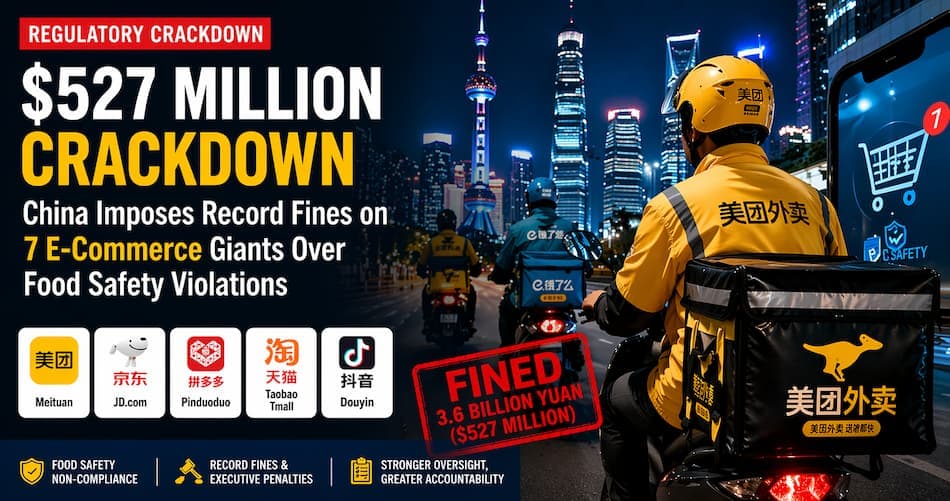
$527M Crackdown: China Imposes Record Fines on 7 E-Commerce Giants Over Food Safety Violations

$527M Crackdown: China Imposes Record Fines on 7 E-Commerce Giants Over Food Safety Violations

China has intensified its regulatory oversight of the digital commerce sector, imposing a massive 3.6 billion yuan ($527 million) fine on seven major e-commerce platforms in one of the most significant enforcement actions to date.

The penalties, announced by the country’s top market regulator, target leading platforms including Meituan, JD.com, Pinduoduo, Alibaba’s Taobao and Tmall, and ByteDance’s Douyin. The investigation revealed systemic failures in ensuring food safety compliance across their online delivery ecosystems.

Authorities found that these platforms failed to properly verify the licenses and qualifications of food vendors, while also neglecting essential consumer protection measures. The violations highlight growing concerns around the rapid expansion of online food delivery services and the risks associated with insufficient oversight.

Rising Pressure on Platform Accountability

This crackdown reflects a broader shift in China’s regulatory approach from rapid digital growth to strict enforcement and accountability. As online commerce continues to dominate consumer behavior, regulators are increasingly focused on platform responsibility rather than just merchant compliance.

In addition to the corporate fines, individual executives and food safety officers were also penalized, and platforms have been ordered to implement immediate corrective actions. Some services may face operational restrictions, including limits on onboarding new vendors until compliance standards are met.

The move comes amid a surge in consumer complaints related to online shopping and food delivery services. In 2025 alone, millions of complaints were filed, with food safety and service quality ranking among the top concerns.

A Clear Signal for the Global E-Commerce Industry

China’s latest enforcement sends a strong signal not only to domestic players but also to global e-commerce companies operating in or entering the Chinese market. Regulatory tolerance is narrowing, and compliance is becoming a core operational requirement rather than a legal formality.

For international businesses, the message is clear: platforms must actively monitor sellers, ensure transparency, and prioritize consumer protection at every stage of the value chain.

As one of the world’s largest e-commerce markets, China continues to shape global standards in digital commerce governance. This record fine underscores a new era where scale without compliance is no longer sustainable.

Source

26.2% Growth Signals Strong Momentum for J&T Express in Q1 2026

26.2% Growth Signals Strong Momentum for J&T Express in Q1 2026

Strong start to 2026 for J&T Express

Global logistics provider J&T Express has reported a 26.2% year-on-year growth in parcel volume for the first quarter of 2026, reflecting strong demand across key markets and continued expansion of its global logistics network.

During the reporting period, the company handled a total of 8.326 billion parcels, with average daily volumes reaching approximately 92.5 million shipments.

This performance highlights a solid start to the year, supported by increasing e-commerce activity and improved operational efficiency across regions.

Southeast Asia leads rapid expansion

One of the strongest contributors to this growth was Southeast Asia, where J&T Express continues to dominate the market. Parcel volume in the region surged by nearly 80% year-on-year, reaching 2.768 billion parcels in Q1.

The growth was driven by:

  • Strong demand from e-commerce platforms
  • Seasonal shopping peaks such as Ramadan
  • Continued investment in logistics infrastructure

The company also expanded its operational capacity, increasing line-haul vehicles and automated sorting systems to support rising demand.

Global markets accelerate beyond China

While China remains a core market, J&T Express is seeing rapid expansion in other regions. Non-China parcel volumes now account for over 35% of total shipments, indicating a shift toward a more globally diversified business model.

In emerging markets, including Latin America and the Middle East, parcel volumes more than doubled year-on-year. The company has been actively partnering with major e-commerce platforms such as TikTok, Temu, SHEIN, and AliExpress to capture cross-border growth opportunities.

Additionally, J&T expanded its network by adding new service outlets and sorting centers, further strengthening its international logistics capabilities.

E-commerce continues to drive logistics growth

The company’s performance reflects the broader momentum of global e-commerce, which continues to fuel demand for fast and efficient delivery solutions. As online retail expands, logistics providers like J&T Express are investing heavily in automation, infrastructure, and cross-border capabilities.

Industry trends suggest that Southeast Asia and emerging markets will remain key growth drivers in the coming years, supported by increasing internet penetration and digital adoption.

Outlook remains positive

J&T Express’ strong first-quarter results indicate continued growth potential for 2026. With a focus on operational efficiency, infrastructure expansion, and strategic partnerships, the company is well-positioned to capitalize on the next wave of e-commerce growth.

Source

Stay updated with global logistics and e-commerce insights on WORLDEF.

Global E-Commerce Gets a Boost as China Announces 5 Cross-Border Trade Measures

Global E-Commerce Gets a Boost as China Announces 5 Cross-Border Trade Measures

China has unveiled a new policy framework aimed at strengthening its e-commerce sector, with a particular focus on cross-border trade and global market expansion. The move reflects Beijing’s effort to balance domestic growth with increasing international pressures and competition.

The guidance, jointly issued by multiple government bodies including commerce, industry, and cyberspace regulators, outlines a coordinated approach to improving both regulation and promotion within the digital economy.

A Strategic Push for Global E-Commerce Integration

At the core of the policy is the ambition to better align China’s domestic e-commerce ecosystem with global markets. Authorities emphasized the need to integrate the digital and real economies while maintaining a balance between efficiency, fairness, and regulatory oversight.

This comes shortly after increased scrutiny from international partners, particularly the European Union, over issues such as product safety, market access, and competitive fairness.

5 Key Measures Driving China’s E-Commerce Strategy

The new guidance introduces several major initiatives shaping the future of China’s e-commerce landscape:

  • Pilot zones for cross-border e-commerce to test new policies and accelerate innovation
  • Development of international rules and standards to align with global trade practices
  • Expansion of Chinese platforms into overseas markets to strengthen global reach
  • Encouragement for companies to establish procurement bases abroad
  • Streamlined import channels for high-quality global products entering China

These measures aim to position China as a more integrated and competitive player in global digital trade.

Addressing Global Trade Tensions

The policy also reflects broader geopolitical dynamics. Recent discussions with EU lawmakers highlighted concerns about unsafe products and limited access for foreign businesses in China.

While the new framework does not directly address these disputes, it signals China’s willingness to improve coordination and potentially ease tensions through regulatory refinement and market openness.

What It Means for the Global E-Commerce Ecosystem

China remains the world’s largest e-commerce market, and its regulatory direction has a significant impact on global supply chains and digital trade flows.

By promoting cross-border e-commerce, improving standards, and encouraging international expansion, the country is reinforcing its role as a central hub in global online commerce.

However, experts suggest that while the policy is a positive step, it may not fully resolve deeper trade imbalances and regulatory concerns between China and its international partners.

Source: Reuters

3 Signals Show China’s Trade Momentum Strengthening as Global Markets Shift

3 Signals Show China’s Trade Momentum Strengthening as Global Markets Shift

China is reinforcing its position in global trade as officials highlight steady progress in foreign trade performance and continued efforts to strengthen economic resilience.

At a recent briefing by the State Council Information Office (SCIO), authorities emphasized that China’s trade activity remains stable, supported by strong industrial capacity and ongoing policy measures aimed at improving trade quality and structure.

The update reflects a broader strategy focused not only on maintaining trade volumes but also on enhancing value creation and long-term sustainability.

Trade Structure Shifts Toward Higher Value

China is increasingly prioritizing the quality of its trade over sheer volume. Officials highlighted improvements in the composition of exports, with a growing share of high-value and technology-driven products.

This transition signals a move toward more advanced manufacturing and innovation-led trade. At the same time, efforts are underway to promote more balanced import and export dynamics while strengthening global supply chain stability.

Cross-Border E-Commerce Remains a Key Driver

Cross-border e-commerce continues to play a central role in China’s trade strategy. Digital platforms and streamlined logistics systems are enabling businesses to access global markets more efficiently.

Authorities have emphasized ongoing improvements in trade facilitation, including customs processes and digital infrastructure, to support faster and more reliable international transactions.

As global demand for online commerce grows, China is further integrating digital trade into its broader economic framework.

What This Means for Global Markets

China’s latest signals point to a more structured and resilient global trade environment. While geopolitical and economic pressures remain, the country’s focus on innovation, diversification and digitalization is shaping the next phase of international commerce.

As previously highlighted in WORLDEF’s coverage of global trade trends, the future of cross-border trade is increasingly defined by efficiency, data-driven systems and strategic expansion.

China’s direction reflects this shift. Trade is no longer driven by scale alone, but by the ability to adapt to a more complex and competitive global landscape.

Source: SCIO

Alibaba Revenue Rises 1.7% but Misses Estimates as Profit Drops 66%

alibaba revenue rises 17percent but misses estimates as profit drops 66percent

Alibaba reported a modest 1.7% increase in quarterly revenue, reaching approximately 284.84 billion yuan ($41.28 billion), but the figure came in below analyst expectations. The results highlight continued pressure on China’s e-commerce sector, where consumer demand remains weak despite ongoing promotional efforts.

Heavy spending on discounts and faster delivery options has not been enough to significantly boost consumption. Ongoing concerns around income stability and the broader economic environment continue to weigh on consumer confidence, limiting the impact of major shopping campaigns.

Profit Declines Sharply Amid Rising Costs

While revenue showed slight growth, profitability declined sharply. Alibaba’s net income fell by 66.3%, reflecting rising operational costs and continued investments in logistics, pricing strategies, and user acquisition. The company, like many of its competitors, appears to be prioritizing market share over short-term profitability in an increasingly competitive landscape.

Cloud and AI Business Shows Strong Momentum

At the same time, Alibaba’s cloud business delivered strong results, with revenue growing 36% year-on-year. The growth is largely driven by increasing demand for artificial intelligence solutions and cloud infrastructure. As AI adoption accelerates, this segment is becoming a key pillar of the company’s long-term strategy.

Alibaba is also restructuring parts of its business to focus more heavily on AI-driven services. New initiatives are aimed at expanding its capabilities in digital assistants and enterprise solutions, signaling a broader shift beyond traditional e-commerce. However, while AI usage is growing, monetization and long-term user engagement are still developing.

Market Reaction and Outlook

Following the earnings release, Alibaba’s U.S.-listed shares fell more than 6%, reflecting investor concerns over weaker-than-expected performance and declining profitability. The reaction underscores the challenges the company faces as it navigates slower growth in its core business while investing in future technologies.

Alibaba’s latest results point to a transition phase. As its e-commerce engine faces pressure, the company is increasingly positioning itself around AI and cloud to support future growth.

Source: Reuters

JD.com Launches Joybuy Across 6 European Countries in Bold Expansion

JD.com launches Joybuy e-commerce platform in Europe to compete with Amazon

Chinese e-commerce giant JD.com has launched its new online retail platform Joybuy across six European countries, marking one of the company’s most significant international expansion moves to date. The rollout signals JD.com’s ambition to challenge established players such as Amazon in one of the world’s most competitive digital retail markets.

The platform debuted in the United Kingdom, Germany, France, the Netherlands, Belgium and Luxembourg, offering a broad assortment of products ranging from consumer electronics and home appliances to beauty items and groceries. At launch, the marketplace includes more than 100,000 products from global brands including Apple and Samsung.

JD.com Accelerates Global Expansion

The European launch comes as JD.com looks beyond its domestic market for growth. Competition in China’s e-commerce sector has intensified in recent years, pushing major platforms to explore new international opportunities.

By introducing Joybuy in Europe, JD.com is positioning itself as a direct competitor to Amazon while also expanding the global reach of both Chinese and international brands through its marketplace infrastructure.

Founded by billionaire entrepreneur Liu Qiangdong, JD.com has grown into one of the world’s largest online retailers. The company generated more than $150 billion in annual revenue and has built a reputation for its integrated logistics network and fast delivery capabilities.

Fast Delivery at the Core of the Strategy

A key feature of Joybuy’s European rollout is its focus on rapid delivery. JD.com plans to leverage its logistics infrastructure to provide same-day and next-day delivery services in major cities. Orders placed earlier in the day may arrive within hours, giving the platform a competitive advantage in markets where delivery speed is increasingly critical to consumer choice.

The company has invested heavily in logistics infrastructure across Europe, including dozens of warehouses and distribution centers that support its proprietary delivery network. This integrated supply chain approach has long been a defining feature of JD.com’s operations in China and is expected to play a central role in its European strategy.

Competing in Europe’s Crowded E-Commerce Market

Europe represents one of the most developed and competitive e-commerce markets globally. Amazon currently dominates much of the region’s online retail sector, while Chinese platforms such as Temu and Shein have also been expanding aggressively across Western markets.

JD.com hopes its combination of competitive pricing, global brands and fast delivery will help the company attract European consumers looking for alternatives to existing platforms.

Industry analysts note that the move could intensify competition in the region, particularly as global e-commerce companies continue to expand logistics networks and cross-border marketplaces.

A Long-Term Bet on Overseas Growth

The Joybuy launch represents JD.com’s largest overseas expansion initiative so far and highlights the company’s long-term strategy to reduce reliance on China’s domestic market.

If successful, the platform could become a major new channel for international brands while also giving Chinese merchants broader access to European consumers.

Source: Business Standard