WORLDEF ISTANBUL 2026 - Early Bird Registration Ends Soon

Register Now

AI Visibility Debate Deepens as 84% of Australian Marketers Disagree on Ownership

AI Visibility Debate Deepens as 84% of Australian Marketers Disagree on Ownership

Australian marketers are increasingly divided over who owns AI visibility, as businesses struggle to adapt to the rise of AI-driven search and discovery.

A recent study by Sefiani found that 84% of marketing and communications leaders disagree on ownership of AI visibility, highlighting a lack of clear responsibility across organisations.

At the same time, 91% of respondents said they are already changing strategies to better influence how brands appear in AI-generated answers. However, only 16% reported having an integrated approach, with responsibilities split across data, brand, communications and performance teams.

Fragmentation Risks Undermining AI Visibility Strategies

The lack of alignment is creating operational challenges. Around 77% of leaders said internal silos caused major issues over the past year, including inconsistent messaging and slower response times.

More critically, one in four organisations reported incorrect or outdated brand information appearing in AI-generated responses, raising concerns about reputational risk in AI-led environments.

This shift reflects a broader transformation in how discovery works. AI tools are moving beyond traditional search, forcing companies to rethink how their information is structured and distributed.

Budget allocation is also evolving. Nearly half of respondents said they have assigned 5% to 10% of marketing budgets to AI visibility, while another 30% are investing up to 20%. Most of this spend is being redirected from traditional digital and brand channels.

Industry experts warn that AI visibility is no longer tied to a single channel. Instead, it depends on consistency across content, media coverage, social signals and search authority. Without alignment, fragmented strategies can weaken how brands appear in AI-generated outputs.

As AI continues to reshape digital discovery, the debate is shifting from search rankings to a more complex question: who controls how a brand is represented inside AI systems.

Source

ASEAN Digital Economy Set for Breakthrough: 1 Regional Pact Could Unlock $2 Trillion Growth

ASEAN Digital Economy Set for Breakthrough: 1 Regional Pact Could Unlock $2 Trillion Growth

Southeast Asia is moving closer to a landmark agreement that could redefine the future of e-commerce and digital trade across the region.

As the Philippines leads ASEAN in 2026, negotiations are accelerating around the ASEAN Digital Economy Framework Agreement (DEFA) – a comprehensive regional pact designed to harmonize digital trade rules, reduce barriers, and strengthen cross-border e-commerce.

A Unified Digital Market in the Making

The proposed agreement aims to create a more integrated digital economy by aligning regulations across ASEAN member states. Currently, differences in data governance, cybersecurity, and consumer protection frameworks create challenges for businesses operating across borders.

DEFA seeks to address these gaps by introducing:

  • interoperable digital systems
  • smoother cross-border data flows
  • stronger cybersecurity standards
  • more efficient digital payments and paperless trade

By simplifying these processes, the agreement is expected to make it significantly easier for businesses – especially SMEs – to expand regionally.

Boosting E-Commerce and SME Growth

One of the key goals of the pact is to unlock new opportunities for micro, small, and medium-sized enterprises (MSMEs), which form the backbone of ASEAN economies.

By reducing operational friction, the agreement could:

  • lower costs through digitalization
  • enable faster and safer transactions
  • expand market access across Southeast Asia

Over time, this is expected to drive job creation, improve digital skills, and support more inclusive economic participation.

A Rapidly Expanding Digital Economy

The urgency behind the agreement is clear. ASEAN’s digital economy is projected to grow rapidly, with estimates suggesting it could reach $2 trillion by 2030.

In the Philippines alone, the digital economy is expected to nearly double in value – highlighting the region’s strong growth trajectory and the increasing importance of digital trade frameworks.

Strategic Priorities: Integration, Trust, and Skills

Beyond trade facilitation, the agreement also focuses on building a future-ready digital ecosystem.

Key priorities include:

  • establishing trusted and interoperable digital infrastructure
  • ensuring secure and transparent data exchanges
  • strengthening workforce skills for digital transformation

These elements are seen as essential to supporting sustainable growth and enabling businesses to scale in an increasingly digital-first economy.

What Comes Next?

ASEAN aims to finalize negotiations and sign the agreement later this year, potentially during the ASEAN Summit in November.

If implemented, DEFA would become the world’s first region-wide digital economy agreement, positioning ASEAN as a global leader in digital trade governance.

Source: Philippine News Agency, Inquirer Opinion

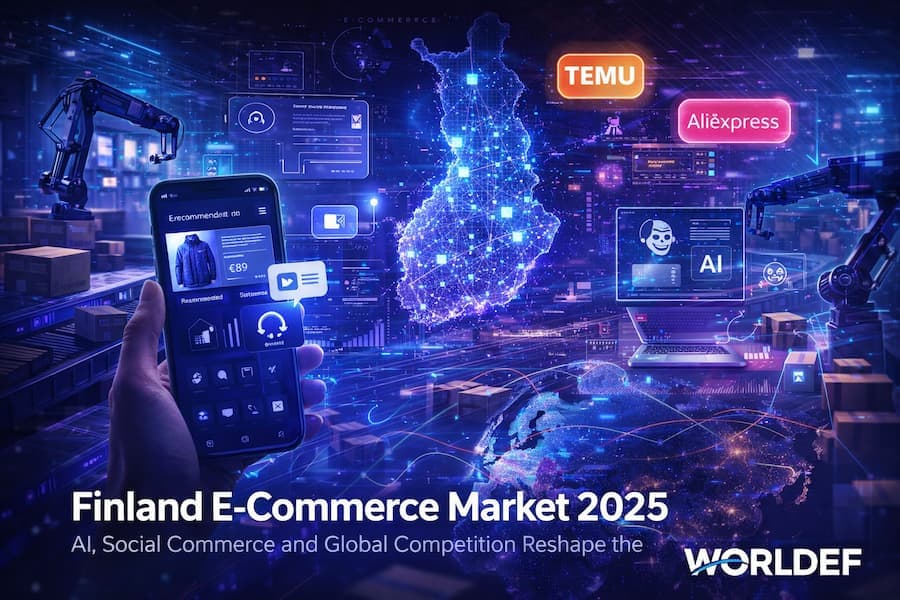
Finland E-Commerce Market 2025: AI, Social Commerce and Global Competition Reshape the Industry

Finland E-Commerce Market 2025: AI, Social Commerce and Global Competition Reshape the Industry

Finland E-Commerce Market Reaches €5.6 Billion in 2025

Finland e-commerce market continues to expand, with total online retail spending reaching approximately €5.6 billion in 2025. The market grew by 4.8% year-on-year, confirming that digital commerce remains a core part of consumer behavior.

However, the nature of this growth is evolving. Rather than uniform expansion, the market is now driven by category-specific trends, shifting consumer habits and increasing global competition.

Finland E-Commerce Trends Show Strong Growth in Grocery, Health and Electronics

Growth within the Finland e-commerce ecosystem is not evenly distributed. Consumer electronics, cosmetics and health products, and grocery categories are leading the market.

Grocery e-commerce has reached a new level of maturity, with around 30% of consumers purchasing food or beverages online. This signals a structural shift where e-commerce is no longer limited to discretionary spending but is becoming embedded in everyday consumption.

In contrast, the fashion segment is facing pressure due to price competition from international platforms and the rise of second-hand commerce.

Top-Selling Categories in Finland E-Commerce Market

According to the report, the Finland e-commerce market is led by a small number of dominant product categories.

Consumer electronics is the largest category, accounting for approximately 23% of total online spending. It is followed by fashion (21%) and cosmetics and health products (17%), making these three segments the core of Finland’s e-commerce market

Other key categories include:

Food and beverages (13%)
Spare parts and DIY products (9%)
Home and interior products (8%)
Hobbies, leisure and pet products (7%)

This distribution shows that while traditional strong categories such as electronics and fashion continue to dominate, everyday consumption categories are gaining share.

In particular, the growth of groceries and health-related products indicates that Finland e-commerce is moving beyond occasional purchases toward more frequent, necessity-driven consumption.

Finland E-Commerce Platforms Face Rising Global Competition

Domestic platforms continue to dominate Finland e-commerce traffic. Local players such as K-Ruoka, Verkkokauppa.com and Tokmanni remain among the most visited platforms.

At the same time, international marketplaces including Temu, Amazon and AliExpress are increasing their presence. These platforms compete aggressively on pricing, assortment and mobile experience, making the competitive landscape more complex.

Cross-border e-commerce is also growing, with Finnish consumers increasingly purchasing from outside the European Union. This trend is intensifying pressure on local players to differentiate beyond price.

Social Media Becomes a Key Driver in Finland E-Commerce

One of the most important Finland e-commerce trends is the growing role of social media in the purchasing journey.

More than half of consumers now receive purchase inspiration from social platforms. This influence is expanding across all age groups, not just younger users.

A growing share of consumers are also making purchases directly through social platforms or through embedded links. This indicates that social commerce is becoming a core part of the e-commerce ecosystem.

AI Is Transforming Product Discovery in Finland E-Commerce

Artificial intelligence is emerging as a new layer in Finland e-commerce. Product discovery is increasingly shifting from traditional search engines to AI-driven systems.

This change requires businesses to rethink their visibility strategies. Structured product data, authentic customer reviews and machine-readable content are becoming critical for visibility.

E-commerce is moving toward AI-driven discovery models where recommendation systems play a central role.

Mobile Apps Are Reshaping Finland E-Commerce Behavior

Mobile apps are becoming increasingly important in Finland e-commerce. Adoption is particularly strong among younger consumers, who use apps for browsing, price comparison and purchasing.

Both local and international platforms are competing in this space, creating a hybrid ecosystem. Apps such as Vinted, Temu and AliExpress are gaining strong traction alongside domestic solutions.

Finland E-Commerce Outlook: Growth Continues but Market Becomes More Complex

The Finland e-commerce market is expected to continue growing in the coming years, but at a more moderate pace.

External factors such as logistics costs, global competition and geopolitical uncertainty are becoming more relevant for market performance.

More importantly, the structure of e-commerce is changing. The market is no longer defined only by digital adoption, but by platform competition, social influence and technological transformation.

Businesses operating in Finland e-commerce will need to adapt to this new reality. Success will depend on flexibility, strong positioning within digital ecosystems and the ability to integrate emerging technologies into the customer journey.