WORLDEF ISTANBUL 2026 - Early Bird Registration Ends Soon

Register Now

Crisis Shakes Economic Indicators in the Middle East; A 2.2% Contraction Is Expected in 2026

Economi

Rising geopolitical tensions in the Middle East are putting significant pressure on regional economies, while growth expectations for 2026 have been revised sharply downward.

According to the latest Economic Update report published by ICAEW, the effects of the Iran-centered conflict are directly impacting the economic outlook of the Gulf Cooperation Council (GCC) countries.

The report states that the global economy is expected to grow by 2.6% this year. This figure points below the narrow 2.8% to 3.0% range seen over the past three years. However, the outlook for the Middle East is significantly weaker. The regional economy, which was projected to grow by 3.6% three months ago, is now expected to contract by 2.2% in 2026. This sharp revision is driven by the combined effects of volatility in energy markets, disruptions in trade flows, and a slowdown in the tourism sector.

GCC Economic Growth Forecast Revised Down to -0.2%

For GCC economies, a more limited but still notable contraction is expected. The region’s 2026 growth forecast has been lowered by 4.6 percentage points over the past three months to -0.2%. Analysts emphasize that this contraction will be more pronounced in economies that are more dependent on trade and tourism. However, a strong recovery is expected in 2027, with GCC economies projected to grow by 8.5% next year.

Brent Oil Prices May Reach $113

Energy markets are among the areas where the effects of the current crisis are most visible. As the conflict escalated, Brent oil prices have exceeded $100 per barrel since mid-March, with the second-quarter average expected to reach $113. While prices are projected to return to pre-crisis levels by 2028 in the long term, high volatility is expected to persist in the short term.

Natural Gas Prices Are 60% Higher

A sharper shock is being observed in natural gas markets. Due to disruptions in Qatar’s liquefied natural gas production, gas prices are reported to be approximately 60% higher compared to forecasts made three months ago. This situation continues to impact both regional and global economies through increased energy costs.

Disruptions in logistics lines are also among the key factors negatively affecting the economic outlook. Transit through the Strait of Hormuz, a critical route for global energy transportation, has been severely disrupted. Under normal conditions, 18 million barrels of oil pass through the strait daily, but approximately 7 million barrels of this volume are now being rerouted through alternative pipelines. However, countries such as Bahrain, Kuwait, and Qatar have limited alternative routes, leading to production cuts.

In line with these developments, the GCC oil sector is expected to contract by 5.8% in 2026. However, a strong recovery of 18.2% is projected for 2027.

Tourism Could Decline by 27%

The tourism and travel sector is also among the most affected areas of the crisis. Due to airspace closures and flight cancellations, the number of international visitors to the Middle East is expected to decline by between 11% and 27% this year. This decline corresponds to approximately 23 million to 38 million fewer visitors. The loss in tourism revenues is estimated to range between $34 billion and $56 billion.

On the consumer side, a slowdown in spending is anticipated due to declining confidence and rising inflation expectations. Household consumption growth in GCC countries is expected to fall to 1.4% in 2026, marking a 2.6 percentage point decline compared to forecasts three months ago. In contrast, consumption is expected to grow by 6% in 2027.

The inflation outlook in the region has also been revised upward. Inflation in GCC countries is expected to reach 2.5% in 2026, before easing to 2.4% in 2027. Rising costs are primarily driven by disruptions in logistics and imports.

Notable Declines in Dubai and Abu Dhabi Stock Markets

In financial markets, increasing geopolitical risks have created a more cautious investment environment. Significant declines have been observed in the Dubai and Abu Dhabi stock markets, while markets in countries such as Oman and Saudi Arabia have remained relatively more resilient.

The report also notes that Iran’s economy is expected to contract by 9.4% in 2026. At the same time, escalating conflicts in Lebanon and the displacement of 20% to 25% of the population are highlighted as major risks to regional recovery.

Overall, while the current crisis is creating significant short-term economic pressure, the region’s strong structural fundamentals and investment potential continue to support expectations of a medium-term recovery. However, the pace and scope of this recovery will largely depend on the course of geopolitical developments.

E-commerce in the Shadow of the 2026 Gulf Crisis

e-commerce

E-commerce in the GCC is facing its most significant resilience test to date. The sirens that echoed across Abu Dhabi and Dubai in early March 2026 told two very different stories. To the global news cycle, the sight of air defence streaks over the Burj Khalifa signalled a region at a breaking point. But on the ground, the reality was a testament to the UAE’s sophisticated national readiness. Despite almost 2000 drone and missile threats intercepted by the Ministry of Defence this month, there has been no chaos and no panic. Malls remain open, schools have seamlessly pivoted to remote learning, and the government’s 4-to-6-month strategic reserve of essential goods has kept shelves full and prices stable. Yet, while the streets are quiet, the digital economy, the “invisible engine” of the Gulf, is experiencing a profound and unprecedented stress test.

I. The Physicality of E-commerce: A Logistics Architecture Under Siege

The fundamental paradox of the Middle Eastern digital economy is its reliance on physical bottlenecks. While a consumer in Riyadh interacts with a sleek interface, the fulfilment of that transaction depends on a hyper-efficient network of shipping lanes and air corridors. The current escalation has exposed the jugular vein of this system: the Strait of Hormuz.

With the waterway effectively closed to commercial traffic, the maritime lifeblood of GCC e-commerce has slowed to a trickle. War-risk insurance premiums for containers have jumped to 1% of hull value, a staggering increase from the 0.02% seen in January. For the high-volume, low-margin world of digital trade, these costs are transformative. Furthermore, the GCC’s status as an aviation hub has been tested by the imposition of rolling airspace closures. With air-cargo capacity slashed, the “Next-Day Delivery” promise has, for many, been replaced by a “Wait-and-See” reality.

II. E-commerce Platforms as Geopolitical Infrastructure

In this crisis, e-commerce platforms have ceased to be mere marketplaces; they are now critical national infrastructure. The “real damage” became clear on March 1st, when Amazon Web Services (AWS) confirmed drone strikes damaged two data centres in the UAE and one in Bahrain. This was the first publicly confirmed military strike on a hyperscale cloud provider, and the ripple effects were immediate.

Amazon’s Defensive Pivot: Amazon temporarily shuttered its Abu Dhabi fulfilment centre and suspended deliveries across the emirate. While nearly 300,000 third-party sellers face delays, the company’s decision was rooted in a “safety-first” protocol rather than a failure of the system itself.

The Noon Resilience: Conversely, Noon has leveraged its hyper-local “dark store” network to maintain service. While global giants have paused, local players are proving that a decentralised, regional-first logistics model is better suited for a kinetic environment.

The Fintech Pulse: The strikes on cloud infrastructure led to “higher error rates” for digital payment gateways such as Tabby, Tamara, and PayTabs. However, the UAE’s rapid shift to software-based recovery paths has prevented a total financial freeze, allowing the domestic economy to continue functioning even as its global links are strained.

III. Supply Chain Fragility in a Digital Marketplace

The current crisis has effectively broken the traditional drop-shipping and cross-border models. The UAE, long the region’s re-export hub, is navigating a pincer movement of geopolitical risk.

  1. Inventory Paralysis: As container routes are rerouted around the Cape of Good Hope, restocking lead times have doubled. For B2B platforms like Tradeling, this means empty shelves and stalled projects.
  2. The Logistics Heavyweights: While Aramex and DHL continue to move goods, they are doing so under a “war-risk” framework. The rerouting of shipments to alternative ports and the rise in surcharges have made “free shipping” a relic of the pre-war era.
  3. The Ambition Test: The GCC’s goal of becoming a $135 billion e-commerce market by 2025 is currently facing the reality of $90+ oil and 300% insurance spikes. This is a moment of forced evolution for every player from Namshi to Talabat.

IV. Solutions and the Path Forward

The damage is real, estimated to be a 1.8-percentage-point drag on 2026 GDP forecasts, but the solutions being forged in the heat of this crisis will define the next decade.

The Saudi Land Bridge: To bypass the Strait of Hormuz, the region is accelerating rail and road corridors connecting the UAE directly to Saudi Arabia’s Red Sea ports.

Sovereign Digital Rails: There is an urgent push for domestic payment systems and “Hardened Edge Computing”, smaller, decentralised data centres that can survive localised strikes without bringing down the entire regional network.

Decentralised Warehousing: The era of the “Mega-Fulfilment Centre” is giving way to a “Micro-Hub” strategy, distributing inventory across more locations to minimise the impact of a single facility’s closure.

Conclusion: A Negative Shock, a Positive Evolution

The outlook for the Gulf’s digital economy is a complex binary. In the short term, the outlook is negative: the loss of momentum during the crucial Ramadan season and the physical damage to infrastructure are significant setbacks. However, the long-term outlook is overwhelmingly positive.

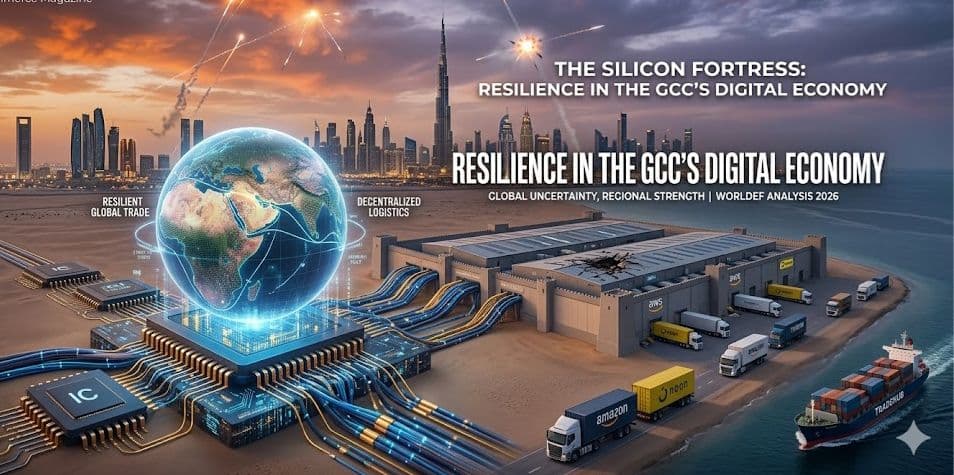
By stripping away the illusion of “frictionless” trade, this crisis is forcing the GCC to build the world’s most resilient, sovereign digital ecosystem. The UAE and its neighbours are not just surviving a war; they are redesigning the architecture of the 21st-century economy. The “Silicon Mirage” has vanished, replaced by a “Silicon Fortress”, a digital economy that is as rugged as it is ambitious. The Gulf is no longer just a place where the world’s goods pass through; it is becoming the place where the future of resilient trade is written. The Gulf is moving from being a “transit hub” for global goods to a “fortress of inventory,” a shift that will ultimately make it the world’s most resilient digital market by 2027.

Burak Yalım

Editor in Chief