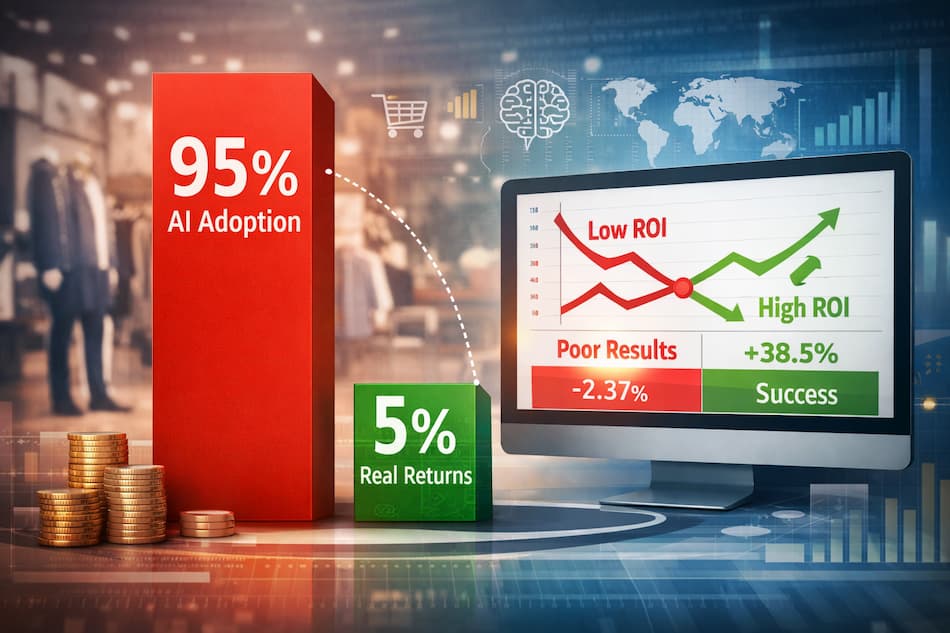
The global retail sector is entering a more pragmatic phase of AI adoption, as new research reveals a significant gap between experimentation and real business impact. A joint report by Voyado and Retail Economics shows that while 95% of companies have already tested AI in marketing or e-commerce, only 5% report clear and scalable returns.
The findings highlight a critical shift in the AI narrative-from rapid adoption to measurable performance-raising new questions about how retail businesses can turn AI investments into tangible results.
Data and Organizational Gaps Hold Back AI Performance
According to the report, the challenge is not access to AI tools, but the lack of strong data foundations and organizational readiness. Retail companies that achieve meaningful results typically rely on significantly more data sources and have more mature internal systems.
A major barrier remains internal capability. Around 58% of respondents identified skills shortages as the primary obstacle, while most of the top challenges were linked to organizational structure rather than technology itself.
This suggests that many retailers are still operating AI in isolated pilots rather than embedding it into core workflows.
AI Investment Set to Reshape the Retail Sector by 2030
Despite current limitations, the long-term impact of AI across the retail industry remains substantial. The report estimates that 39% of marketing and e-commerce budgets will be exposed to AI by 2030, representing approximately €14.9 billion annually.
Businesses are increasingly expecting AI to become a standard part of operations. Around 71% believe AI will be fully integrated into marketing workflows within two years, while 45% expect it to deliver measurable returns within the same timeframe.
The shift indicates that while adoption is already widespread, the next phase will be defined by execution-where only companies with strong data infrastructure and operational alignment are likely to capture real value.
Source: My Newsdesk