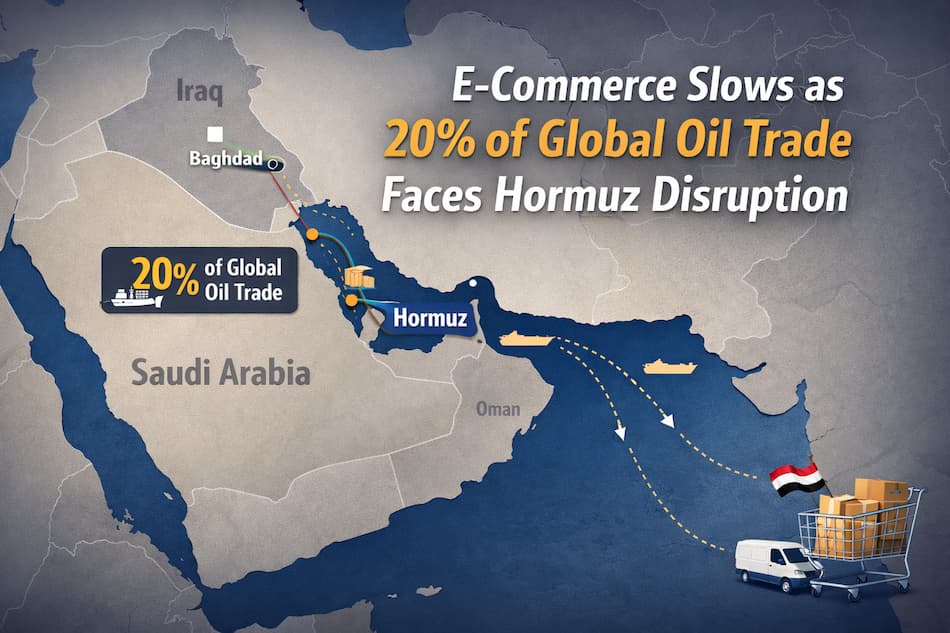
The ongoing disruption in the Strait of Hormuz is beginning to ripple through Iraq’s digital economy, with e-commerce businesses facing rising costs, delayed deliveries, and increasing order cancellations.
Online retailers across Iraq report mounting logistical challenges as shipments-many routed through key global trade corridors are slowed or rerouted. The impact is particularly visible in delivery timelines, once considered a competitive advantage for e-commerce platforms.
Delivery Delays and Rising Cancellations
Small and medium-sized online sellers are among the hardest hit. Many rely on imported goods from international suppliers, particularly in Asia, making them highly dependent on stable shipping routes.
Retailers say delayed shipments have triggered a surge in cancellations, as customers opt out of purchases when delivery times become uncertain. Sellers are also absorbing additional operational pressure, balancing customer expectations with limited control over supply chain disruptions.
Transport costs have increased significantly, squeezing already thin margins. Some businesses are choosing to maintain prices to remain competitive, even as profitability declines.
Supply Chain Pressure Hits Core E-Commerce Model
The Strait of Hormuz is one of the world’s most critical maritime trade routes, handling a substantial share of global energy and cargo flows. Any disruption quickly translates into higher fuel prices and shipping costs globally, directly impacting online retail.
Economists warn that e-commerce built on speed, affordability, and product availability is especially vulnerable to such shocks.
Higher oil prices are already driving up logistics expenses across both air and sea freight. This, in turn, is increasing product prices, reducing consumer purchasing power, and weakening demand in price-sensitive markets like Iraq.
Reduced Variety and Slower Market Activity
Beyond delays, the disruption is also affecting product availability. Import-dependent markets are seeing reduced variety as supply chains slow, particularly for goods sourced from China and India.
This shift is forcing e-commerce platforms and sellers to rethink inventory strategies, promotional campaigns, and pricing models. Some larger players may pass costs directly to consumers, while smaller sellers risk losing market share.
Experts note that emerging markets tend to feel the impact more sharply due to their reliance on imports and limited logistical alternatives.
A Structural Challenge for Digital Commerce
The situation highlights a broader vulnerability in global e-commerce: dependence on key geopolitical chokepoints.
As disruptions in the Strait continue, Iraqi e-commerce is likely to remain under pressure, with longer delivery cycles, higher prices, and reduced competitiveness shaping the market in the near term.
For the sector, the crisis serves as a reminder that digital commerce is only as resilient as the physical infrastructure behind it.