WORLDEF ISTANBUL 2026 - Upcoming Event

Register Now

UAE-Based RSA XB Raises $1.5 Million Seed Round to Expand Cross-Border Logistics

UAE-Based RSA XB Raises $1.5 Million Seed Round to Expand Cross-Border Logistics

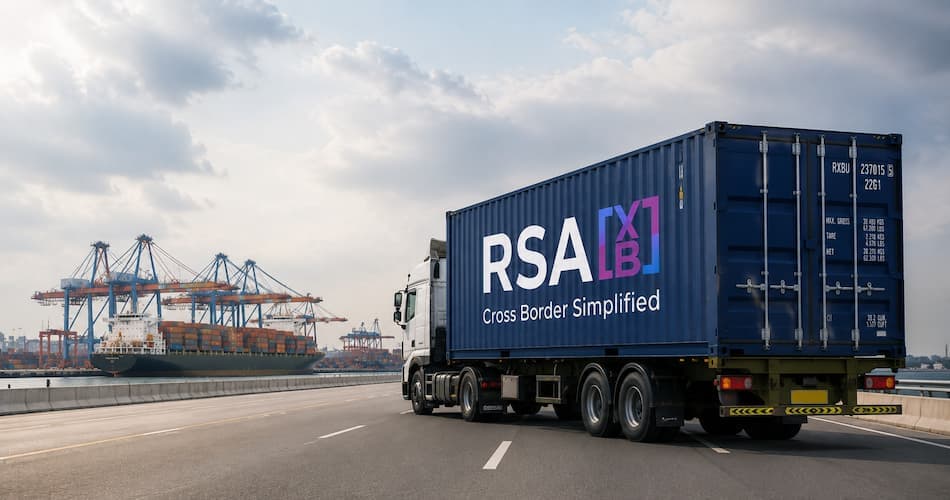
Dubai-based logistics startup RSA XB has secured $1.5 million in a Seed funding round led by 21 Ventures, marking its official spin-off from RSA Global as the company accelerates development of AI-powered cross-border shipping solutions for e-commerce businesses.

The company is focused on simplifying international logistics operations for small and medium-sized enterprises by offering a modular shipping platform that combines air freight, customs clearance, and last-mile delivery services under one flexible infrastructure. Unlike traditional logistics models that require heavy operational investments, RSA XB enables businesses to customize international shipping services under their own brand without building extensive logistics networks.

AI and Flexible Logistics at the Core

RSA XB’s platform operates through a “service modules” system, allowing logistics functions to be combined or separated depending on route requirements and operational needs. The company also integrates an artificial intelligence layer designed to automate operational workflows and improve coordination between freight operators, customs brokers, and last-mile delivery providers.

By consolidating shipments for smaller businesses, RSA XB aims to reduce shipping costs while improving delivery efficiency across international trade corridors. The company believes this model can help SMEs compete more effectively in the rapidly growing global e-commerce market.

Expansion Plans Across Key Trade Routes

In its first expansion phase, RSA XB plans to strengthen operations across major trade corridors connecting India, the Gulf region, the United Kingdom, and Europe. The strategy comes as Indian businesses increasingly look toward international expansion and cross-border commerce opportunities.

Operating from Dubai with additional activities in India, RSA XB intends to use the fresh capital to enhance its technology infrastructure, improve data management capabilities, and launch new shipping routes over the next 18 months. The startup is also preparing for additional fundraising efforts by the end of 2026 as it scales operations globally.

Source

AI Startups Lead 2026 Unicorn Boom as 25 of 98 New Billion-Dollar Companies Emerge

AI Startups Lead 2026 Unicorn Boom as 25 of 98 New Billion-Dollar Companies Emerge

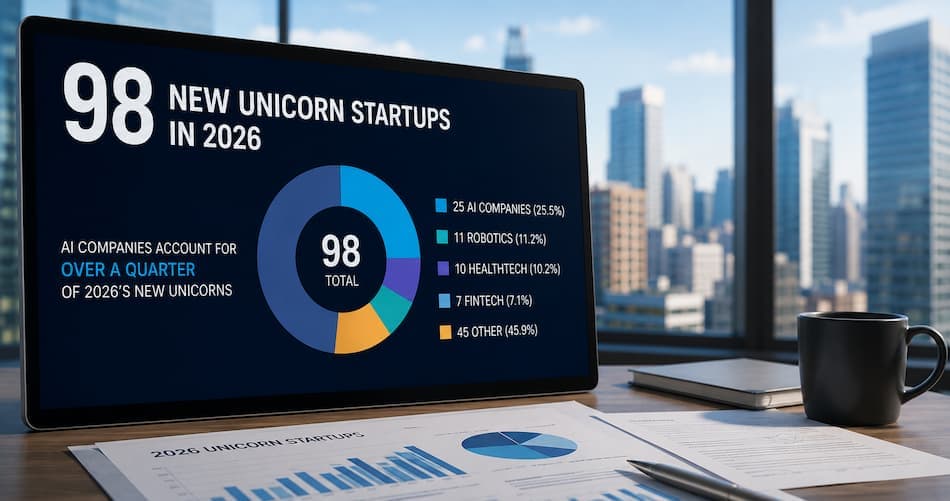
Artificial intelligence startups continue to dominate the global investment landscape in 2026, accounting for more than a quarter of all newly created unicorn companies this year. According to new market data, 25 AI-focused startups have already reached valuations exceeding $1 billion, highlighting how investor appetite for AI infrastructure, robotics, and automation technologies continues to accelerate worldwide.

AI and Robotics Drive Global Venture Capital Growth

A recent analysis by BestBrokers, based on data from the Crunchbase Unicorn Board and PitchBook, found that 98 startups achieved unicorn status during the first months of 2026. Artificial intelligence companies represented the largest share with 25 new unicorns, followed by robotics startups with 11 companies, HealthTech with 10, and Fintech with 7.

The report reflects a broader shift in venture capital trends. Investors are increasingly focusing not only on generative AI applications but also on the infrastructure powering the next generation of intelligent systems. Funding is rapidly flowing into semiconductors, cloud computing, robotics, aerospace, and defense technologies designed to support large-scale AI deployment.

Among the most valuable new unicorns of 2026 is UK-based AI startup Ineffable Intelligence, valued at $5.1 billion after raising more than $1.1 billion in funding. U.S.-based AI companies humans& and Ricursive Intelligence followed with valuations of $4.5 billion and $4 billion respectively.

Robotics and Physical AI Gain Momentum

The unicorn surge also demonstrates growing investor confidence in robotics and “physical AI” technologies. Several robotics companies reached billion-dollar valuations this year as automation expands across manufacturing, logistics, and industrial operations. Analysts suggest that the market is moving beyond software-focused AI toward real-world deployment of autonomous systems and intelligent machines.

Defense technology and aerospace startups are also attracting strong investor interest. U.S.-based aerospace company True Anomaly reportedly raised $650 million and achieved a valuation of $2.2 billion, while robotics company Mind Robotics secured $500 million in venture funding.

The United States remains the leading hub for unicorn creation, producing 60 of the 98 newly valued billion-dollar startups this year. China ranked second with 11 new unicorns, many operating in AI, robotics, and semiconductor industries. The United Kingdom followed with seven newly created unicorn companies.

AI Sector Continues Expanding Globally

The rapid rise of AI unicorns highlights how artificial intelligence has become the dominant force shaping global technology investment. Companies developing large-scale AI infrastructure, autonomous systems, and advanced machine learning models continue attracting significant funding as businesses worldwide accelerate digital transformation initiatives.

Industry analysts expect the momentum to continue throughout 2026 as competition intensifies between global technology ecosystems, particularly in the United States, China, and Europe. Emerging sectors such as robotics, embodied AI, cybersecurity, and AI-powered automation are expected to remain major drivers of startup investment activity in the coming years.

Source

UAE Strengthens Global Position as a Leading Hub for Company Formation

UAE Strengthens Global Position as a Leading Hub for Company Formation

The United Arab Emirates is further strengthening its position as one of the world’s leading destinations for company formation, entrepreneurship, and international investment. Driven by pro-business reforms, digital transformation, and innovation-focused economic strategies, the UAE continues to attract startups, investors, and multinational corporations seeking regional and global expansion opportunities.

According to insights shared through the Emirates News Agency (WAM), the UAE’s business-friendly environment and modern regulatory framework are playing a key role in accelerating corporate growth across multiple sectors. Industry experts noted that the country has successfully created an ecosystem that combines ease of doing business, strategic connectivity, and advanced infrastructure.

UAE Strengthens Global Appeal for Entrepreneurs and Investors

The UAE’s geographic position between Europe, Asia, and Africa remains one of its strongest competitive advantages. Combined with world-class airports, logistics networks, and free economic zones, the country offers companies direct access to rapidly growing international markets.

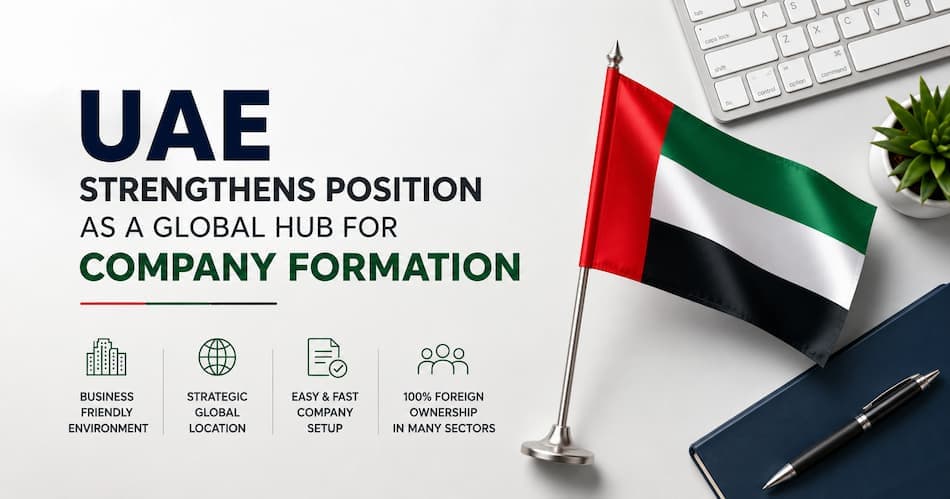
Government initiatives have also contributed significantly to the country’s attractiveness for entrepreneurs. Policies allowing 100% foreign ownership in several sectors, long-term residency options for investors, and streamlined licensing procedures have encouraged global businesses to establish regional headquarters in the UAE.

Dubai and Abu Dhabi continue to lead the country’s innovation and startup ecosystem growth. Financial and technology hubs such as Dubai International Financial Centre (DIFC), Abu Dhabi Global Market (ADGM), and Hub71 are supporting both early-stage startups and established enterprises through funding opportunities, accelerator programs, and international partnerships.

The UAE’s digital economy ambitions are also accelerating investment in sectors including artificial intelligence, fintech, e-commerce, logistics, and smart mobility. Experts believe these industries will play a major role in shaping the country’s next phase of economic growth while strengthening its competitiveness on the global stage.

The country’s strong entrepreneurial performance has been recognized internationally as well. The UAE ranked among the world’s leading countries in entrepreneurship and startup ecosystem development, reflecting its growing influence in the global business landscape.

As global competition for innovation and investment intensifies, the UAE is positioning itself as a long-term hub for entrepreneurs and high-growth companies. Analysts believe the country’s ability to combine regulatory flexibility, advanced infrastructure, and international connectivity will continue driving strong business formation activity in the coming years.

With ongoing investments in technology, digital transformation, and business-friendly reforms, the UAE is expected to further expand its role as a global center for entrepreneurship, company formation, and cross-border trade.

Source

MENA Startups Raise $150 Million in April as Investor Activity Recovers Despite Ongoing Caution

MENA Startups Raise $150 Million in April as Investor Activity Recovers Despite Ongoing Caution

Startup investment activity across the Middle East and North Africa (MENA) rebounded strongly in April 2026, with regional startups raising $150 million across 27 deals, signaling renewed investor confidence after a difficult March. However, despite the recovery, venture capital activity across the region remains cautious as investors continue prioritizing structured financing and lower-risk business models.

According to Wamda’s latest investment report, April’s funding volume marked a 211% increase compared to March, when geopolitical tensions and economic uncertainty significantly slowed dealmaking. Yet, overall funding levels still remained 42% lower than April 2025, reflecting the broader pressure facing the global startup ecosystem.

A major trend shaping April’s investment landscape was the growing dominance of debt financing. Nearly half of the total capital raised during the month came through debt-based transactions, accounting for approximately $80 million across only two deals. The report noted that investors are increasingly favoring capital-efficient structures and downside protection strategies instead of traditional equity-heavy investments.

Fintech Continues to Lead MENA Startup Investments

Financial technology remained the strongest-performing sector for the fourth consecutive month, attracting $89.4 million across seven deals. Investors continued backing fintech companies focused on financial infrastructure, enterprise services, and scalable digital payment solutions, sectors considered more resilient during volatile market conditions.

Business-to-business startups also maintained strong momentum, securing $95.8 million across 11 transactions. Investors increasingly prioritized companies with predictable revenue models, enterprise clients, and long-term monetization strategies, reflecting a broader shift toward sustainable and defensible business operations.

Meanwhile, e-commerce startups regained momentum after slowing in March, raising $19.3 million across four deals. Online services startups collected $15 million, while food technology companies secured $13 million through two transactions.

UAE Maintains Leadership as Saudi Arabia and Egypt Follow Closely

The UAE once again led regional startup funding activity, attracting $78 million across eight deals and accounting for more than half of the total capital raised during April. Saudi Arabia ranked second with $26.2 million raised across seven startups, while Egypt maintained its position as one of the region’s most active startup ecosystems with a similar funding total spread across five deals.

Smaller Gulf markets including Oman, Bahrain, and Qatar also experienced increased startup activity, collectively securing $14.5 million through five transactions, indicating broader regional participation in venture funding.

Siin Expands Live Commerce Presence Across the Gulf

Among the notable deals announced during April was Bahrain-born e-commerce startup Siin, which secured fresh investment, bringing its total funding to $3 million. The round was led by VentureSouq and Shift Group, with participation from Plus VC, Oqal, and several regional investors.

Founded in 2024 by Ahmed Al-Lawi, Hesham Al-Saati, and Khaled Al-Balooshi, Siin operates an interactive live-commerce platform that allows users to buy and sell products through livestream shopping experiences. The company currently operates across Saudi Arabia, the UAE, Kuwait, Bahrain, Qatar, and Oman.

The startup plans to use the new funding to expand across the region, strengthen its seller ecosystem, and further scale its platform infrastructure. The rise of live-commerce platforms reflects growing demand for video-driven shopping experiences as retailers and creators increasingly seek more interactive ways to engage digital consumers.

Female-Led Startups Return to the Funding Landscape

April also marked the return of female-led startups to the regional investment ecosystem after two months without recorded funding activity. Female-founded startups raised $1.5 million across five deals, while startups led by male founders secured $138.8 million across 19 transactions. Mixed-gender founding teams raised an additional $10 million through three deals.

Despite the funding rebound, Wamda’s report concluded that investors remain highly selective, favoring startups aligned with institutional demand, financial infrastructure, and AI-driven technologies. While market activity has resumed, capital deployment continues to prioritize risk management, sustainable growth, and operational resilience over aggressive expansion strategies.

Source

Khwarizmi Ventures Achieves Powerful $70M First Close for GCC Tech Startups

Khwarizmi Ventures Achieves Powerful $70M First Close for GCC Tech Startups

Saudi Arabia-based venture capital firm Khwarizmi Ventures has announced the first close of its second investment fund, securing more than $70 million in commitments to support early-stage technology startups across the GCC. The move reflects growing investor confidence in the Gulf’s expanding startup ecosystem, particularly in Saudi Arabia, which continues to strengthen its position as a regional venture capital hub.

Strong First Close Signals Investor Confidence

Khwarizmi Ventures confirmed that the first close of Fund II exceeded SAR 270 million ($70 million+), backed by institutional investors and major Saudi family offices. The fund will focus primarily on Seed and Series A startups developing scalable technology-driven businesses across GCC markets.

The VC firm stated that Fund II is designed to support ambitious founders building companies with regional and global expansion potential. The investment strategy will continue targeting sectors experiencing rapid digital transformation, including fintech, e-commerce, logistics, artificial intelligence, SaaS, and enterprise technology.

The announcement also highlights the increasing maturity of the GCC startup landscape, where venture funding activity has accelerated over the past few years due to economic diversification efforts and rising private-sector participation.

Saudi Arabia Continues Expanding Its Startup Ecosystem

Saudi Arabia has become one of the Middle East’s fastest-growing startup ecosystems, supported by initiatives aligned with Vision 2030. Government-backed programs, sovereign investment activity, and growing interest from institutional investors have significantly boosted the Kingdom’s technology sector.

Venture capital activity in Saudi Arabia has steadily increased as more startups secure regional and international funding rounds. The country’s push toward digital transformation, fintech innovation, and entrepreneurship development has created favorable conditions for investors seeking long-term growth opportunities in the region.

Khwarizmi Ventures’ latest fund launch comes amid rising demand for early-stage capital across the Gulf, where startups are increasingly targeting cross-border expansion from day one.

Building on the Success of Fund I

Founded in 2018, Khwarizmi Ventures has established itself as one of Saudi Arabia’s active early-stage investment firms. Its first fund, launched in 2021 with approximately $70 million in capital, invested in more than 30 startups across the MENA region.

The firm’s portfolio includes several fast-growing regional technology companies such as Calo, Eyewa, Tamara, and HALA. Khwarizmi Ventures has also recorded multiple successful exits from Fund I, strengthening its reputation within the regional investment ecosystem.

The company said the second fund aims to build on these results by identifying high-potential startups earlier and supporting them throughout their growth journey.

Focus on Long-Term Founder Support

Khwarizmi Ventures plans to write initial investment checks ranging between $1 million and $5 million while reserving additional capital for follow-on rounds in top-performing portfolio companies.

This strategy reflects a broader shift among GCC venture capital firms toward long-term founder support and sustainable scaling rather than short-term capital deployment. Investors across the region are increasingly prioritizing startups with strong fundamentals, scalable business models, and regional expansion capabilities.

Managing Partner Abdulaziz Al-Turki previously described the regional startup environment as a “golden opportunity” for early-stage investment, citing the growing number of technology unicorns and the increasing sophistication of founders emerging from the MENA ecosystem.

GCC Startup Market Attracts Global Attention

The Gulf startup ecosystem has continued attracting both regional and international investors as governments accelerate investments in digital infrastructure, AI, financial technology, and entrepreneurship programs.

Saudi Arabia, the UAE, and other GCC markets are witnessing stronger collaboration between private investors, sovereign wealth funds, accelerators, and venture capital firms. This momentum has helped position the region as one of the fastest-growing innovation markets globally.

Industry analysts expect Khwarizmi Ventures’ Fund II to play an important role in financing the next generation of GCC startups, particularly companies using Saudi Arabia as a launchpad for regional and international growth.

Source

3 Dubai Unicorn Leaders Signal a Strong Innovation Future for the Digital Economy

3 Dubai Unicorn Leaders Signal a Strong Innovation Future for the Digital Economy

Dubai is strengthening its position as one of the world’s most ambitious innovation hubs, with leaders from several Dubai-based unicorn companies praising the city’s regulatory environment, digital infrastructure, and long-term vision for technology-led growth. Their comments reflect growing confidence in Dubai’s ability to support not just startup formation, but global scale-up in the digital economy.

According to statements published by the Government of Dubai Media Office on April 19, 2026, executives from Kitopi, Property Finder, and XPANCEO highlighted the emirate’s ability to combine business-friendly regulation, access to talent, and strong public-private alignment. Together, these factors are helping position Dubai as more than a regional commercial center. Instead, it is increasingly seen as a launchpad for digital companies with international ambitions.

A major theme across the executives’ comments was innovation at scale. Mohamad Ballout, CEO and Co-founder of Kitopi, said Dubai’s ecosystem has helped the company build, test, and scale quickly thanks to forward-looking regulation, strong infrastructure, and connectivity to regional and global markets. This combination, he suggested, has made Dubai a practical base for companies aiming to grow beyond the UAE.

Dubai builds innovation with policy and infrastructure

Property Finder’s Chief Product and Technology Officer, Fernando Fanton, also pointed to Dubai’s broader policy direction, including the Dubai Economic Agenda D33, digital-first governance, and paperless government progress. He noted that these frameworks help companies innovate with greater confidence while giving investors, regulators, and businesses a clearer path to scale. He also referenced AI-driven tools and digital real estate initiatives as examples of how the city is enabling next-generation business models.

XPANCEO Founder Roman Axelrod emphasized another dimension of Dubai’s innovation appeal: its support for deep tech, science, and AI. He described the city as a place where business, government, and academia work in close coordination, helping complex technology ventures grow faster. He also linked Dubai’s momentum to broader UAE efforts such as advanced AI infrastructure and long-term investment in future-focused sectors.

Taken together, the remarks underline a clear message: Dubai is no longer competing only as a business destination. It is increasingly competing as a global innovation platform designed to attract unicorns, high-growth startups, and technology pioneers looking for scale, stability, and strategic reach. That makes the emirate a market to watch closely as the digital economy evolves.

Source

1 Surprising Book Behind Amazon’s Massive E-Commerce Success

1 Surprising Book Behind Amazon’s Massive E-Commerce Success

From a Garage Startup to Global E-Commerce Leader

Long before Amazon became the world’s leading “everything store,” its journey began with a single, almost symbolic purchase.

In 1995, Amazon’s very first customer order was a book titled “Fluid Concepts and Creative Analogies” by Douglas Hofstadter, a work focused on artificial intelligence. At the time, the internet was still in its early stages, and Amazon operated as a small online bookstore from a garage.

This seemingly ordinary transaction has recently resurfaced online, going viral across social media platforms and reigniting discussions about the origins of modern e-commerce.

AI Before the AI Boom

What makes this story particularly striking today is its connection to artificial intelligence. Decades before AI became a global technology race, Amazon’s first-ever sale was already linked to the concept.

The viral post caught the attention of Jeff Bezos, who reacted with a simple acknowledgment, while Elon Musk described it as “the start of something great.”

The moment has sparked both nostalgia and irony, highlighting how a company that began with selling books is now deeply embedded in AI, cloud computing, and global digital infrastructure.

The Beginning of the “Everything Store”

Amazon officially launched in 1994 as an online bookstore, chosen for its scalability and wide product availability. Within months of opening in 1995, it expanded rapidly, reaching customers across the United States and dozens of countries.

What started with one book quickly evolved into a platform that reshaped retail, logistics, and digital commerce worldwide.

Today, that first purchase is more than just a historical detail, it represents the foundation of the modern e-commerce ecosystem.

Source: Financial Express, NDTV, Economic Times

AI Boom Accelerates as E-Commerce Tech Drives 100% Surge in Foundational Funding

AI Boom Accelerates as E-Commerce Tech Drives 100% Surge in Foundational Funding

The global investment landscape is undergoing a major shift as foundational AI startups attract unprecedented levels of capital, signaling a new phase for digital commerce infrastructure.

According to Crunchbase data, funding to foundational AI companies – including firms developing large-scale generative models – reached $178 billion in Q1 2026 alone, doubling the $88.9 billion raised across all of 2025.

This sharp increase highlights how artificial intelligence is rapidly becoming the backbone of e-commerce, powering everything from personalization and search to logistics optimization and customer service automation.

E-Commerce Transformation Accelerates with AI Investment Boom

The surge in funding is heavily concentrated among a small group of dominant players. Companies such as OpenAI, Anthropic, and xAI are capturing a disproportionate share of global capital, reflecting a growing “winner-takes-most” dynamic in the AI ecosystem.

OpenAI alone has raised over $120 billion, marking one of the largest private funding rounds in history. Meanwhile, Anthropic secured $30 billion, and xAI raised $20 billion, reinforcing their positions as leading forces shaping the future of digital infrastructure.

Beyond the scale, the structure of funding is also shifting. While fewer deals are being made – just 24 major transactions in Q1 2026 – the average deal size has grown significantly, indicating that investors are placing larger, more concentrated bets on a limited number of AI leaders.

This trend comes after years of broader but less focused venture investment. In contrast, today’s capital allocation strategy prioritizes companies building foundational models that can be applied across industries, including e-commerce platforms, marketplaces, and payment systems.

The impact on e-commerce is already visible. AI-driven tools are enabling faster product discovery, smarter recommendation engines, automated customer support, and more efficient supply chain operations. As these technologies mature, they are expected to redefine how online businesses operate and scale globally.

At the same time, the dominance of a few major players raises concerns about market concentration. With a significant portion of venture funding flowing into just a handful of companies, smaller startups may face increasing challenges in accessing capital and competing at scale.

Still, investor confidence remains strong. AI-related startups accounted for nearly 50% of global venture funding in 2025, underscoring the sector’s central role in the future of digital economies.

As the AI race intensifies, the connection between foundational models and e-commerce will only deepen. What was once considered a supporting technology is now becoming the core infrastructure powering the next generation of online commerce.

Source: Crunchbase

SPARK Reaches 7,500 Companies as Startup Demand Surges in Sharjah

SPARK in 2026 Reaches 7,500 Companies as Startup Demand Surges in Sharjah

Sharjah’s innovation ecosystem is gaining momentum as the Sharjah Research, Technology and Innovation Park (SPARK) continues to attract startups and technology-driven businesses at scale.

In the early months of 2026 alone, SPARK recorded more than 1,200 licensing transactions, including new company formations and renewals. The steady inflow highlights sustained demand from startups and innovation-focused firms looking to establish and expand operations in the UAE.

The growth builds on a broader expansion of the ecosystem, which now includes more than 7,500 companies ranging from early-stage startups to global technology firms.

Startup Momentum Holds Despite Global Uncertainty

The continued rise in licensing activity comes at a time of global economic and geopolitical uncertainty. Despite these conditions, SPARK is seeing consistent interest from companies investing in long-term growth.

The park’s leadership has emphasized a shift toward scaling innovation into real economic value, with a focus on infrastructure, partnerships and commercialization. The model is designed not only to support early-stage startups but also to help companies grow beyond incubation and enter global markets.

Ecosystem Expansion and Global Positioning

SPARK’s ecosystem has expanded significantly, supported by partnerships with more than 30 local and international entities. These collaborations are helping connect startups with global markets, research institutions and industry networks.

New initiatives are also shaping the next phase of growth. The launch of BASE39, a dedicated hub for creative industries, signals a broader diversification beyond traditional technology sectors. The move aims to support design-led businesses and emerging talent, adding depth to the innovation ecosystem.

At the same time, international outreach remains a key driver. SPARK is actively working with global markets such as China and India to attract companies seeking entry into the UAE and the wider Middle East.

What This Means for the Regional E-Commerce Ecosystem

The rapid growth of SPARK reflects a broader shift in how innovation hubs compete globally. The focus is no longer limited to attracting startups, but on building integrated ecosystems that support scaling, partnerships and market access.

For e-commerce and technology businesses, this signals increasing opportunities in the UAE as a gateway to regional markets. With infrastructure, policy support and international connectivity aligned, Sharjah is strengthening its position as a hub for research, development and commercialisation.

As previously highlighted in WORLDEF’s coverage of global e-commerce expansion, ecosystems that combine innovation with scalability are becoming central to long-term growth strategies.

The pace of activity in early 2026 suggests that Sharjah’s approach is gaining traction. For startups and tech companies, the region is no longer just an entry point — it is becoming a destination for building and scaling global businesses.

Source: Gulf News

EU Inc.: 5 Major Changes Set to Boost Startup Scaling in Europe

EU Inc. startup scaling in Europe visual showing digital growth and connected ecosystem

The European Union is preparing a major transformation in its startup ecosystem with the introduction of EU Inc., a new framework designed to make it significantly easier for companies to scale across the region.

For years, European founders have faced a structural disadvantage compared to their counterparts in the United States. While the U.S. operates under a single legal and regulatory system, startups in Europe must navigate 27 different national frameworks, each with its own rules on incorporation, taxation, and compliance.

EU Inc. aims to solve this fragmentation by introducing a unified, optional system that allows startups to operate more seamlessly across the EU single market.

Tackling Europe’s Fragmentation Problem

One of the biggest barriers to startup growth in Europe has been regulatory complexity. Expanding beyond a home country often means rebuilding legal structures, adapting to new compliance systems, and managing multiple jurisdictions at once.

The EU Inc. initiative introduces what policymakers describe as a “28th regime” — an additional, standardized corporate framework that companies can choose instead of relying solely on national systems.

This model is designed to reduce administrative friction and create a more consistent environment for scaling businesses across borders.

Faster and Simpler Company Formation

A key feature of EU Inc. is its digital-first approach to company creation and management. Startups would be able to register and begin operating through a fully online process, significantly reducing both time and costs.

According to recent proposals, businesses could be established in as little as 48 hours, a move aimed at bringing Europe closer to the efficiency of markets like the United States.

The system would also introduce more standardized procedures for areas such as employee stock options and insolvency rules, helping startups attract investment and scale more efficiently.

Closing the Global Competitiveness Gap

Despite strong innovation and early-stage startup activity, Europe continues to lag behind global leaders when it comes to scaling companies.

Data shows that while startup creation rates in Europe are comparable to the U.S., the region produces significantly fewer high-value companies. By early 2025, the EU had around 110 unicorns, compared to hundreds in the United States and China.

This gap is largely driven by structural challenges, including fragmented markets, limited access to late-stage funding, and regulatory complexity. As a result, many European startups choose to relocate or expand abroad to access better growth opportunities.

EU Inc. is designed to reverse this trend by making it easier for companies to remain and scale within Europe.

Supporting Investment and Talent Growth

The EU Inc. initiative is part of a broader strategy to strengthen Europe’s startup ecosystem. Alongside regulatory simplification, policymakers are working to improve access to capital, attract global talent, and enhance infrastructure for innovation.

The EU Startup and Scaleup Strategy focuses on creating a more supportive environment for high-growth companies by improving financing options, enabling faster market expansion, and building stronger innovation networks.

Together, these efforts aim to position Europe as a more competitive destination for startups and scale-ups.

Limitations and Ongoing Challenges

While EU Inc. represents a major step forward, it is not a complete solution. Companies operating under the new framework will still need to comply with national rules related to taxation, labor laws, and other local regulations.

Experts also note that simplifying legal structures alone may not fully address deeper challenges such as operational complexity, leadership, and cross-border team management.

Nevertheless, EU Inc. is widely seen as a critical foundation for improving Europe’s ability to scale innovative businesses.

A Turning Point for Europe’s Startup Ecosystem

The introduction of EU Inc. signals a clear shift in Europe’s approach to entrepreneurship and innovation. By reducing fragmentation and streamlining business operations, the EU is taking a significant step toward building a more integrated and globally competitive startup ecosystem.

If successfully implemented, the initiative could help Europe retain more high-growth companies, attract international investment, and close the gap with global innovation leaders.

Source: European Business Magazine, European Commission, Reuters