WORLDEF Istanbul 2026 - Upcoming Event

Register Now

AI Startups Lead 2026 Unicorn Boom as 25 of 98 New Billion-Dollar Companies Emerge

AI Startups Lead 2026 Unicorn Boom as 25 of 98 New Billion-Dollar Companies Emerge

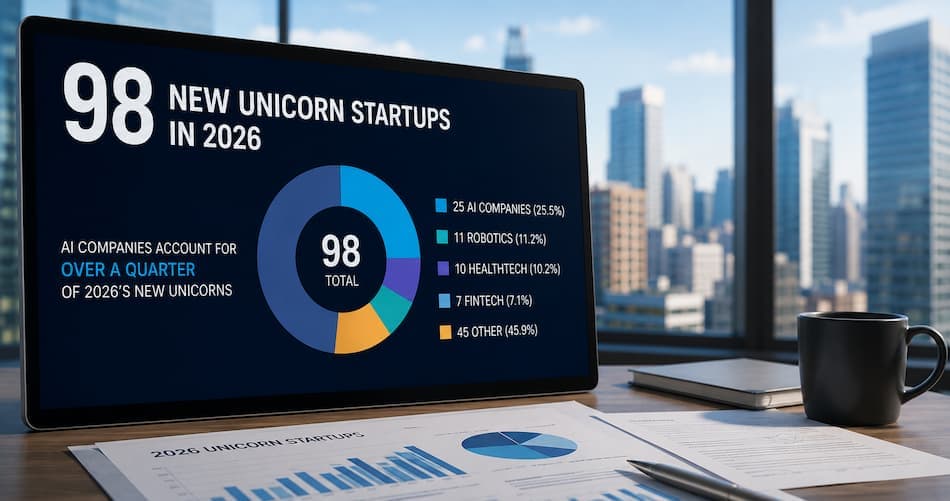
Artificial intelligence startups continue to dominate the global investment landscape in 2026, accounting for more than a quarter of all newly created unicorn companies this year. According to new market data, 25 AI-focused startups have already reached valuations exceeding $1 billion, highlighting how investor appetite for AI infrastructure, robotics, and automation technologies continues to accelerate worldwide.

AI and Robotics Drive Global Venture Capital Growth

A recent analysis by BestBrokers, based on data from the Crunchbase Unicorn Board and PitchBook, found that 98 startups achieved unicorn status during the first months of 2026. Artificial intelligence companies represented the largest share with 25 new unicorns, followed by robotics startups with 11 companies, HealthTech with 10, and Fintech with 7.

The report reflects a broader shift in venture capital trends. Investors are increasingly focusing not only on generative AI applications but also on the infrastructure powering the next generation of intelligent systems. Funding is rapidly flowing into semiconductors, cloud computing, robotics, aerospace, and defense technologies designed to support large-scale AI deployment.

Among the most valuable new unicorns of 2026 is UK-based AI startup Ineffable Intelligence, valued at $5.1 billion after raising more than $1.1 billion in funding. U.S.-based AI companies humans& and Ricursive Intelligence followed with valuations of $4.5 billion and $4 billion respectively.

Robotics and Physical AI Gain Momentum

The unicorn surge also demonstrates growing investor confidence in robotics and “physical AI” technologies. Several robotics companies reached billion-dollar valuations this year as automation expands across manufacturing, logistics, and industrial operations. Analysts suggest that the market is moving beyond software-focused AI toward real-world deployment of autonomous systems and intelligent machines.

Defense technology and aerospace startups are also attracting strong investor interest. U.S.-based aerospace company True Anomaly reportedly raised $650 million and achieved a valuation of $2.2 billion, while robotics company Mind Robotics secured $500 million in venture funding.

The United States remains the leading hub for unicorn creation, producing 60 of the 98 newly valued billion-dollar startups this year. China ranked second with 11 new unicorns, many operating in AI, robotics, and semiconductor industries. The United Kingdom followed with seven newly created unicorn companies.

AI Sector Continues Expanding Globally

The rapid rise of AI unicorns highlights how artificial intelligence has become the dominant force shaping global technology investment. Companies developing large-scale AI infrastructure, autonomous systems, and advanced machine learning models continue attracting significant funding as businesses worldwide accelerate digital transformation initiatives.

Industry analysts expect the momentum to continue throughout 2026 as competition intensifies between global technology ecosystems, particularly in the United States, China, and Europe. Emerging sectors such as robotics, embodied AI, cybersecurity, and AI-powered automation are expected to remain major drivers of startup investment activity in the coming years.

Source

Khwarizmi Ventures Achieves Powerful $70M First Close for GCC Tech Startups

Khwarizmi Ventures Achieves Powerful $70M First Close for GCC Tech Startups

Saudi Arabia-based venture capital firm Khwarizmi Ventures has announced the first close of its second investment fund, securing more than $70 million in commitments to support early-stage technology startups across the GCC. The move reflects growing investor confidence in the Gulf’s expanding startup ecosystem, particularly in Saudi Arabia, which continues to strengthen its position as a regional venture capital hub.

Strong First Close Signals Investor Confidence

Khwarizmi Ventures confirmed that the first close of Fund II exceeded SAR 270 million ($70 million+), backed by institutional investors and major Saudi family offices. The fund will focus primarily on Seed and Series A startups developing scalable technology-driven businesses across GCC markets.

The VC firm stated that Fund II is designed to support ambitious founders building companies with regional and global expansion potential. The investment strategy will continue targeting sectors experiencing rapid digital transformation, including fintech, e-commerce, logistics, artificial intelligence, SaaS, and enterprise technology.

The announcement also highlights the increasing maturity of the GCC startup landscape, where venture funding activity has accelerated over the past few years due to economic diversification efforts and rising private-sector participation.

Saudi Arabia Continues Expanding Its Startup Ecosystem

Saudi Arabia has become one of the Middle East’s fastest-growing startup ecosystems, supported by initiatives aligned with Vision 2030. Government-backed programs, sovereign investment activity, and growing interest from institutional investors have significantly boosted the Kingdom’s technology sector.

Venture capital activity in Saudi Arabia has steadily increased as more startups secure regional and international funding rounds. The country’s push toward digital transformation, fintech innovation, and entrepreneurship development has created favorable conditions for investors seeking long-term growth opportunities in the region.

Khwarizmi Ventures’ latest fund launch comes amid rising demand for early-stage capital across the Gulf, where startups are increasingly targeting cross-border expansion from day one.

Building on the Success of Fund I

Founded in 2018, Khwarizmi Ventures has established itself as one of Saudi Arabia’s active early-stage investment firms. Its first fund, launched in 2021 with approximately $70 million in capital, invested in more than 30 startups across the MENA region.

The firm’s portfolio includes several fast-growing regional technology companies such as Calo, Eyewa, Tamara, and HALA. Khwarizmi Ventures has also recorded multiple successful exits from Fund I, strengthening its reputation within the regional investment ecosystem.

The company said the second fund aims to build on these results by identifying high-potential startups earlier and supporting them throughout their growth journey.

Focus on Long-Term Founder Support

Khwarizmi Ventures plans to write initial investment checks ranging between $1 million and $5 million while reserving additional capital for follow-on rounds in top-performing portfolio companies.

This strategy reflects a broader shift among GCC venture capital firms toward long-term founder support and sustainable scaling rather than short-term capital deployment. Investors across the region are increasingly prioritizing startups with strong fundamentals, scalable business models, and regional expansion capabilities.

Managing Partner Abdulaziz Al-Turki previously described the regional startup environment as a “golden opportunity” for early-stage investment, citing the growing number of technology unicorns and the increasing sophistication of founders emerging from the MENA ecosystem.

GCC Startup Market Attracts Global Attention

The Gulf startup ecosystem has continued attracting both regional and international investors as governments accelerate investments in digital infrastructure, AI, financial technology, and entrepreneurship programs.

Saudi Arabia, the UAE, and other GCC markets are witnessing stronger collaboration between private investors, sovereign wealth funds, accelerators, and venture capital firms. This momentum has helped position the region as one of the fastest-growing innovation markets globally.

Industry analysts expect Khwarizmi Ventures’ Fund II to play an important role in financing the next generation of GCC startups, particularly companies using Saudi Arabia as a launchpad for regional and international growth.

Source