WORLDEF Istanbul 2026 - Upcoming Event

Register Now

OpenAI Defers Its Plan for Direct Shopping via ChatGPT

OpenAI

OpenAI is making a significant strategic shift at a time when AI-powered shopping experiences are increasingly being discussed. The company has temporarily suspended the system that would enable direct payments through ChatGPT. Instead, it is reported that the company is focusing on a model that redirects users to brands’ or retailers’ own platforms.

Despite the rapid emergence of the AI-mediated shopping model known as “agentic commerce” in the technology world, OpenAI is said to be reassessing its plans in this area.

ChatGPT Will Remain a Discovery Tool

Rather than launching the integrated payment system planned for ChatGPT, OpenAI prefers to position artificial intelligence as a product search and recommendation engine. In this model, users will be able to discover products through ChatGPT, but they will complete the purchase process through the brands’ or e-commerce platforms’ own applications.

The “Instant Checkout” feature that the company tested last year was developed particularly for Etsy and Shopify sellers. However, it is stated that the system did not attract the expected interest and was used by only a limited number of merchants in the United States.

User Habits Became a Barrier at the Purchase Stage

Studies analyzing user behavior by OpenAI show that the product research and comparison phase within ChatGPT is quite active. However, it has emerged that users are more cautious about completing the purchase process within the AI interface.

A study published by Adobe also presents a similar picture. According to the report, 70 percent of consumers are comfortable with artificial intelligence assisting in shopping processes. However, only 13 percent of respondents trust AI tools to complete purchases on their behalf.

Collaboration Between OpenAI and Stripe Continues

It is reported that OpenAI has not completely abandoned payment processes, but plans to carry out these transactions through different systems rather than within its own platform. Through the infrastructure called the Agentic Commerce Protocol, which the company developed together with Stripe, transactions are expected to be carried out more smoothly. This approach may also open the door for OpenAI to move toward different areas within its revenue model. In particular, advertising and sponsorship-based revenue models built around product discovery and recommendation processes are expected to come to the forefront.

Competition in AI-Powered Commerce Is Intensifying

Competition in the field of AI-based commerce is steadily increasing. While Google is working on a new infrastructure aimed at standardizing e-commerce data on a global scale, Meta is also testing AI-powered shopping features within its social media platforms.

According to experts, although AI-powered shopping technologies are developing rapidly, it will take time for consumer habits to adapt to this transformation. For this reason, the sector is expected to shift toward hybrid models in the short term that strengthen product discovery and decision-making processes, rather than enabling direct purchases through artificial intelligence.

Stripe AI Commerce Strategy Targets Southeast Asia’s $100B Digital Economy

Stripe AI commerce

Stripe AI commerce initiatives are expanding across Southeast Asia as the global payments platform explores artificial intelligence-driven commerce and stablecoin payments.

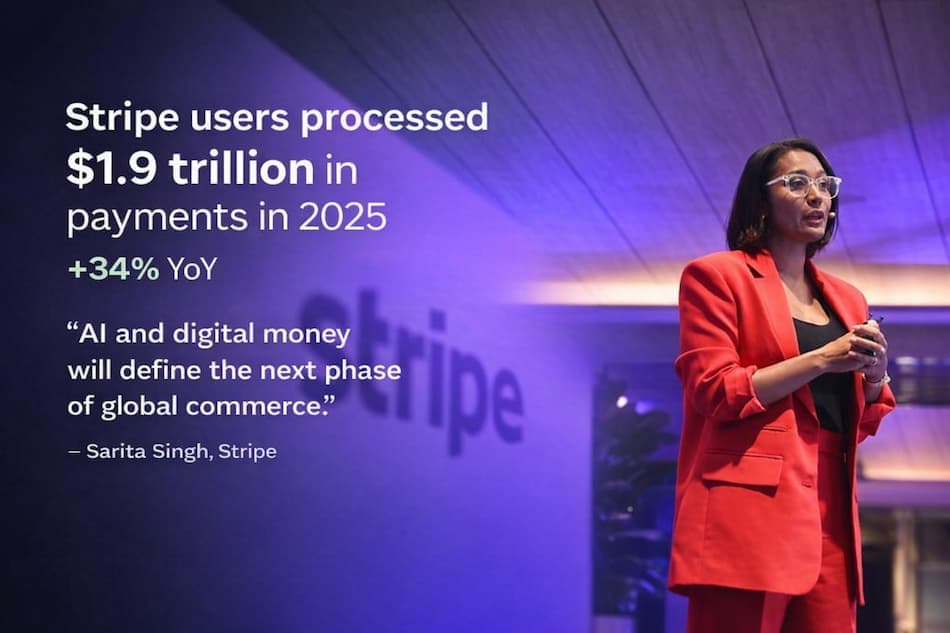
In an interview with TNGlobal, Sarita Singh, Regional Head and Managing Director for Southeast Asia and Greater China, reflected on Stripe’s performance in 2025 and outlined the company’s priorities for 2026.

The fintech infrastructure provider processed $1.9 trillion in total payment volume in 2025, representing a 34 percent year-on-year increase, according to Singh. The figure is equivalent to roughly 1.6 percent of global GDP, highlighting the scale of transactions flowing through the platform.

Stripe, headquartered in San Francisco and Dublin, provides programmable financial infrastructure used by millions of businesses worldwide to process payments, manage revenue streams, and scale digital operations.

Stripe AI Commerce Strategy in Southeast Asia

Stripe also reported record growth in new companies joining its platform during 2025.

More than 57% of newly onboarded businesses were based outside the United States, reflecting the increasing globalization of online entrepreneurship and the growing importance of emerging digital markets.

Across Asia, many startups are now launching with international expansion built into their strategy from day one.

Stripe supports a range of fast-growing “global-by-default” companies, including Aspire, Halara, Manus AI and Shoplazza. Meanwhile, cross-border payments processed through the platform grew by more than 30 % in key regional hubs such as Singapore, underscoring Southeast Asia’s role as a major center of digital trade.

AI-Powered “Agentic Commerce” Emerging as Next Digital Payments Frontier

A major development for Stripe in 2025 was the rise of agentic commerce, a model where artificial intelligence agents can autonomously complete transactions on behalf of users.

Stripe said it has been working with partners including OpenAI and Microsoft to build frameworks enabling AI systems to transact securely while merchants maintain control over pricing, brand identity, and risk management.

The company believes AI-native commerce models will reshape how businesses interact with customers online, enabling faster transactions and more automated purchasing experiences.

Stripe is currently developing infrastructure such as the Agentic Commerce Protocol, designed to support secure AI-driven transactions across ecommerce platforms and payment networks.

Stripe Aims to Simplify Southeast Asia’s Fragmented Payments Landscape

Looking ahead to 2026, Stripe says one of its main goals in Asia is helping businesses navigate the region’s complex and fragmented payments ecosystem.

Rather than replacing local payment systems, the company aims to unify them through a single programmable payments infrastructure layer, allowing merchants to operate across multiple markets without managing the complexities of different payment methods, compliance frameworks and regulations.

Singh noted that many businesses still operate with underperforming payment infrastructure, a situation Stripe founders describe as “low revenue mode.”

In such cases, weak payment conversion rates, lower authorization performance and inefficient fraud management can significantly reduce revenue potential.

Optimizing payment infrastructure, Singh said, remains one of the most effective ways businesses can unlock additional growth.

Stablecoins Expected to Transform Global Money Movement

Another major focus for Stripe is the increasing adoption of stablecoins in cross-border payments and digital commerce.

According to the company, global stablecoin payment volumes doubled to around $400 billion last year, with approximately 60 percent linked to business transactions.

Stripe’s research indicates that nearly half of Asian businesses plan to begin using stablecoins within the next four years, largely due to their ability to enable faster and cheaper cross-border money transfers.

The company says it is positioning its infrastructure to support the growing integration of stablecoins into global commerce.

Southeast Asia’s Tech Ecosystem Set for Next Decade of Growth

Singh remains optimistic about the long-term outlook for Southeast Asia’s technology sector.

The year 2026 marks ten years since Stripe launched operations in Singapore, a period that coincided with the rapid expansion of the region’s internet economy.

According to Singh, the past decade of digital growth across Asia was largely driven by improvements in payments infrastructure, logistics networks and digital marketplaces.

The next phase, she said, will be shaped by programmability – the ability for businesses to build and scale global digital commerce through unified financial infrastructure.

Analysts say Stripe AI commerce strategy could accelerate digital payments and AI-driven retail innovation across Southeast Asia.

Source

© TNGlobal

AI-Powered E-Commerce: Meta’s Move into Agentic Commerce

AI-Powered E-Commerce: Meta’s Move into Agentic Commerce

Meta is preparing to revolutionize online shopping through AI-powered shopping agents, a concept it refers to as “agentic commerce.” With significant investments in AI tools, the company aims to enhance user experiences and increase advertising revenue.

Meta CEO Mark Zuckerberg stated that the company’s focus is shifting towards “agentic commerce.” Zuckerberg explained that this new approach would offer AI-powered shopping agents that help users find the right products based on their personal preferences and behaviors. These personalized AI agents will analyze Meta’s extensive user data, including past interactions, preferences, and social connections, to provide tailored product recommendations for each user.

Zuckerberg mentioned that Meta had rebuilt its AI infrastructure over the past year and would begin rolling out new models and products in the coming months. In his statement to investors, he said, “This year will be a big year for delivering personal superintelligence.” The company aims to go beyond traditional static product listings and search bars, with AI offering instant, personalized product recommendations for users.

Meta’s Strategy in the Competitive AI Shopping Space

Meta’s vision for AI-powered commerce is taking shape at a time when “agentic commerce” is gaining increasing attention in the tech world. OpenAI and Google have already introduced AI-powered shopping agents. OpenAI is enhancing shopping experiences with GPT-4, while Google has started integrating AI tools into its Search and Shopping platforms. Meta believes it has a unique advantage due to its access to vast user data, which enables the creation of even more personalized AI assistants.

In December 2025, Meta strengthened its position in this space by acquiring Manus, an AI agency developer. By integrating Manus technology, Meta plans to create shopping agents that interact with users across multiple platforms and ultimately transform product discovery into shopping.

Key Insights for Marketers About Meta’s AI Investment

Meta’s move toward “agentic commerce” raises important questions for marketers. As AI-powered shopping experiences gain momentum, brands may need to adjust their approach to advertising and product promotions on Meta platforms.

  • New shopping formats: Marketers should be prepared for new AI-powered shopping formats and adapt their product feeds and creative strategies to align with new conversational interfaces.
  • More granular ad targeting: With AI agents utilizing personal data, ads will become more contextual and tailored to real-time preferences. Brands may need to explore how to provide relevant data or signals to these agents.
  • AI-oowered product discovery: Just as SEO adapted to algorithmic curation, commerce brands may need to develop new strategies for AI-first product discovery.
  • Testing AI-driven tools: Meta plans to invest $135 billion in AI-related capital expenditures. Marketers should quickly test AI tools integrated with Meta’s Shops, Business Suite, and advertising platforms to understand how these tools work.

Meta’s focus on agentic commerce and AI-powered shopping tools promises to revolutionize e-commerce. This new personalized shopping experience will provide users with a more efficient shopping process while creating new opportunities and challenges for marketers in the digital world.

Agentic Commerce: The Future of AI Shopping

Sahibinden.com Integrates AI Technologies Under “sahiAI”; Natural Language Search Feature Introduced!

Türkiye’s leading classifieds, second-hand, and e-commerce marketplace, Sahibinden.com, has combined all of its AI-based products developed over eight years in its R&D center under the “sahiAI” brand. With sahiAI, a search feature has been developed that allows users to find listings in seconds using daily conversational language. This new feature is part of the AI advancements the company has gathered under the sahiAI brand.

Natural Language Search Now Available!

This innovation allows users to search for properties and vehicles using everyday expressions instead of complex filters. For example, users can now search using phrases like “apartment near the metro with a master bathroom” or “fuel-efficient, hybrid, white SUV.”

Previously, users had to select a series of filters to narrow down their searches, which was a time-consuming and complex process. However, with this new feature, the platform understands the user’s intent, significantly simplifying the process. The system does not just match words; it uses large language models in the background to understand the user’s intent, providing an experience similar to conversing with a real estate agent or car dealer.

“We Established the sahiAI Department with Over 300 Turkish Engineers”

Sahibinden.com CEO Burak Ertaş emphasized that this new technology was not sourced from external packages but was developed entirely in-house. Ertaş pointed out that the company made significant investments in research and development, establishing the sahiAI department with more than 300 Turkish engineers. He also highlighted that this local approach ensures the technology is more suitable for local needs and nuances, offering a more effective solution for Turkish users.

Ertaş stated, “AI is on everyone’s agenda, but there are not many companies that widely offer it in their products and services. Since our establishment, we have achieved many firsts. In 2000, we took the classifieds industry digital, and in 2011, we launched the first mobile app in our sector. While no one in Türkiye was talking about AI, we made it our company focus in 2018. Today, we are proud to bring all the AI products we have developed over the last eight years, which our users experience every day, under our umbrella brand, sahiAI.”

The Foundations of sahiAI Were Laid in 2018!

sahiAI is not just a search feature but the umbrella brand for a wide range of AI-based products, from visual recognition to natural language processing. The sahiAI product range was first established in 2018 with “Vehicle Recognition from Photos” and has since expanded to include products like Fotobot, which enhances the quality of listing images, Virtual Tour, which allows users to navigate through homes in 3D, and SahiDeko, which changes the decoration of a home in seconds. Now, with the addition of the AI-powered listing search feature, sahiAI offers an unparalleled experience to all users, developed entirely by Turkish engineers within Sahibinden.com.

As AI continues to shape the future of e-commerce and digital services, Sahibinden.com’s integration of natural language search positions the platform as a forward-thinking leader in the Turkish online marketplace.

sahibinden.com: “Every Listing is the First Step of a Dream”

AI-Powered Search Is Expected to Influence €500 Billion in Retail E-Commerce by 2028

AI-powered search and discovery tools are expected to influence up to €500 billion in retail e-commerce by 2028. These tools have become an integral part of consumers’ product search and purchasing decisions through generative artificial intelligence. A new analysis published by Euromonitor International revealed that AI-based platforms have fundamentally transformed the ways in which brands are discovered, evaluated, and trusted in the online environment.

According to the “Euromonitor International Voice of the Consumer: Lifestyles Survey 2025,” more than half of global consumers use generative AI tools to obtain information and recommendations. This finding points to a structural transformation in digital commerce behavior.

From Search Results to AI-Powered Conversations

Rabia Yasmeen, global insight manager for e-commerce at Euromonitor International, stated that AI-powered search has created a deeper transformation than previous digital trends such as social commerce or livestream shopping. Yasmeen said that artificial intelligence is “reshaping how consumers discover brands, evaluate choices, and make online purchasing decisions.”

In traditional search models, visibility depended on search engine optimization, paid advertising, and retail media investments. However, in AI-generated responses, there is no guaranteed visibility slot, even for market leaders. Yasmeen emphasized that the impact has now shifted from “share of views” to “share of conversations.”

Euromonitor data show that this transformation will have a significant impact on the global e-commerce market and that the market is expected to exceed USD 595 billion by 2028.

Risk to Brand Visibility in AI-Powered Discovery

The analysis also points to significant risks for established brands. Euromonitor examined more than 8,700 brands operating in the US online skin care category and found that as consumer attention increasingly shifts toward AI-generated recommendations, up to half of existing brands could face the risk of a gradual loss of relevance over time.

In traditional digital shopping journeys, strong brands benefited from advantages such as scale, advertising budgets, and category placement. In AI-powered responses, however, visibility changes dynamically depending on the user’s context and query. This situation creates opportunities not only for established brands but also for new and smaller players.

Yasmeen noted that while this shift involves risks, it also makes the emergence of new winners possible. She said that brands offering product relevance, clear positioning, and trustworthy signals could stand out in AI-generated responses.

Faster Decisions, Shorter Shopping Journeys

AI-powered search is also significantly shortening the online shopping journey. Traditionally, consumers went through many stages such as searching, browsing category pages, reading reviews, and comparing alternatives. According to Euromonitor, in AI-mediated interactions these steps often merge into a single conversation.

Consumers now ask questions in natural language instead of browsing product listings and expect short, context-aware answers. While this reduces friction in shopping, it concentrates the decision-making process largely on outputs provided by artificial intelligence.

Euromonitor concluded that retailers and brands need to rethink their digital strategies in order to remain visible in AI-powered environments. According to the report, future competitiveness will depend less on traditional ranking tactics and more on how well brands align with consumer intent, context, and trust signals.

UAE-Based Yozo.ai Raised USD 1.7 Million in Pre-Seed Funding to Develop an AI-Powered E-Commerce Revenue Engine

UAE-based startup Yozo.ai raised USD 1.7 million in pre-seed funding to develop an AI-powered revenue engine for e-commerce sellers. The round was co-led by Access Bridge Ventures and Disruptech Ventures, while a number of regional venture capital funds and angel investors also participated in the round.

Founded in early 2025, Yozo.ai develops an AI agent that autonomously manages email, WhatsApp, and SMS campaigns for online retailers. The company announced that it will use the new investment to support product development and its goals of expanding into markets outside the Middle East.

Investors Supported the AI-Native Approach

The investment round was completed under the co-leadership of Access Bridge Ventures and Disruptech Ventures. Arzan VC, Oraseya Capital, Plus VC, Suhail Ventures, Glint Ventures, and M-Empire Angels also participated in the round.

Issa Aghabi of Access Bridge Ventures stated that the Yozo.ai team demonstrated strong execution capability and stood out with its approach of practically integrating artificial intelligence into daily e-commerce workflows. Aghabi expressed that the company has the potential to build a scalable and meaningful platform in this field.

The strong interest from regional investors revealed growing demand for AI-based commerce solutions developed for sellers operating in digital markets characterized by fragmentation and intense competition.

An Autonomous Growth Agent Is Being Built

Yozo.ai positions itself as an “AI growth agent” rather than a traditional marketing software. After sellers connect their e-commerce accounts to the system, they approve campaigns, and the system autonomously carries out marketing activities across email, WhatsApp, and SMS channels.

The company stated that its technology takes on tasks such as segmentation, timing, experimentation, and performance optimization, which are typically handled by growth and customer retention teams. In this way, it aims to reduce the need for specialized teams that are costly or difficult to find, particularly for small and medium-sized e-commerce businesses.

Yozo.ai founder Hossam Ali said that conversion and retention marketing involves many variables such as data, timing, and continuous optimization, and that most teams struggle to manage this complexity in a sustainable way. Ali emphasized that Yozo.ai was designed to take on this complexity and operate continuously without manual intervention.

Yozo.ai’s Global Growth Targets

With the new investment it has received, the company aims to build an AI-native revenue engine that automates customer retention and revenue growth processes in a scalable manner. Yozo.ai identified global e-commerce markets where growth teams are expensive, overly manual, or difficult to hire as its primary targets.

Initially focusing on the Middle East, Yozo.ai announced that it has international expansion plans to also serve sellers in other regions facing similar operational challenges. The company aims to become the “default revenue engine” for digital sellers by closing the gap between users who show purchase intent but do not complete a transaction and actual buyers.

Yozo.ai argues that this gap leads to a significant amount of revenue remaining uncaptured in the e-commerce sector. By establishing automated customer engagement at the right time and through the right channel, it states that conversion and customer loyalty rates can be increased in a meaningful way.

The pre-seed investment round is considered an important milestone in Yozo.ai’s transition from the product development stage to broader market adoption. While the company did not share details regarding revenue or customer numbers, it stated that the investment will be used primarily for engineering, data infrastructure, and expansion into new markets.

eBay Banned AI Shopping Agents; Opened the Door to Approved Bots

eBay announced that as of February 2026 it will ban artificial intelligence–powered shopping agents from operating on the platform.

eBay’s decision was taken at a time when, with the rapid spread of AI-based commerce tools in the retail sector, marketplaces are reassessing the impact of automated buyers on human customers and existing business models. This policy change was announced via an email sent to eBay users. The platform had previously taken technical steps aimed at limiting automated access.

New Rules Against Autonomous Shopping Bots

eBay stated that as of 20 February 2026, chatbots, large language model–based agents and other automated systems will be explicitly prohibited from placing bids or completing purchase transactions on the auction platform unless prior permission is obtained. The updated user agreement clearly defined that “automated means” used to access services cannot be used without explicit approval from eBay.

The update also expanded the scope of existing provisions that restrict robots, scrapers and other automated tools from accessing eBay services. In addition, with changes made to the platform’s robots.txt file, it was emphasized that checkout processes are reserved exclusively for human users.

Although the robots.txt protocol cannot technically prevent all bot access, the updated user agreement provided eBay with a legal basis against unauthorized AI activities. The company stated that it took this step in order to protect the integrity of the marketplace and to maintain a fair competitive environment for human buyers.

Pressure From Agentic Commerce Increased

The ban decision came at a time when new shopping models referred to as agentic commerce have begun to be rapidly tested in the technology sector. These models envision consumers delegating product discovery and purchasing decisions to software agents instead of directly visiting websites.

Conversational AI platforms such as ChatGPT have begun to integrate early-stage commerce features that enable direct purchases from certain e-commerce sites. Similarly, Perplexity offers one-click checkout options for paid users, while Google is working on a Universal Commerce Protocol aimed at standardizing how shopping agents interact with retailers.

Amazon is also testing features that allow users to purchase products from external brands directly within its own application. However, it has also been reported that Amazon has taken legal steps to prevent unauthorized AI agents from operating on its own marketplace. This situation points to growing concerns across the industry regarding uncontrolled automation.

eBay Takes a Cautious Approach

While eBay’s updated user agreement introduced a clear ban, it also pointed to a more selective future. By stating that certain AI-based entities may operate on the platform if prior approval is obtained, the company implied that tightly controlled agents could be allowed in the future.

eBay CEO Jamie Iannone had previously indicated that the company could participate in OpenAI’s Instant Checkout program. Iannone also stated that eBay is experimenting with its own agentic shopping experiences.

This dual approach showed that eBay is not completely rejecting AI-powered commerce, but instead wants to strictly control how and when it is deployed. Experts noted that this cautious stance is largely rooted in eBay’s auction-based business model, as automated bidding systems carry the risk of disrupting price dynamics.

Economic and Operational Concerns

One of eBay’s main concerns was economic. The platform charges a variable “final value fee” on sales and earns more revenue from higher-priced transactions. Autonomous agents focused on securing the lowest possible price could win auctions at lower amounts, leading to reduced selling prices and potential revenue loss for eBay.

There are also operational risks. Fully automated agents could generate heavy traffic on servers, straining infrastructure. In addition, since such agents would not respond to cross-selling or promotional efforts aimed at human users, seller engagement and advertising effectiveness could decline.

Trust and safety issues also came to the forefront. For eBay, which continues to combat counterfeit goods and unsafe sales, monitoring autonomous purchasing systems and assigning responsibility could become more complex.

Industry-Wide Debate

The decision became part of a broader debate on how agentic artificial intelligence should be integrated into e-commerce. Proponents foresee a future in which AI agents anticipate consumer needs, evaluate options, negotiate prices and complete transactions independently. Consulting firms such as McKinsey are already highlighting such multi-step, autonomous shopping scenarios.

Critics, however, argue that this approach could reduce direct consumer interaction with websites, weakening brand visibility, product discovery and upselling opportunities. In this case, retailers may be forced to develop new machine-to-machine systems alongside interfaces designed for human users.

A Controlled Path Forward

By banning unauthorized AI shopping agents while not fully closing the door to approved uses, eBay adopted a controlled agentic commerce approach. The company acknowledged that automation could play a role in the future, but made it clear that this should occur under conditions that protect marketplace fairness, revenue balance and user trust.

As AI-powered shopping tools continue to evolve, eBay’s decision stood out as an important example of how large marketplaces are attempting to strike a delicate balance between innovation and control.

eBay Launches SpeedPAK Service to Simplify International Shipping for German Sellers

A Large Portion of E-Commerce Brands Are Deploying AI-Powered Shopping Agents

According to research conducted by Pattern Group, AI-powered search and shopping agents are rapidly reshaping the e-commerce economy. Pattern Group research revealed that AI-focused product discovery and purchasing tools are changing consumer behavior and leading brands to reassess their customer acquisition, marketing, and operational approaches.

According to the study based on a survey conducted with 1,000 senior business leaders operating in the United States, the United Kingdom, Germany, and the United Arab Emirates, the use of AI-powered shopping agents has moved beyond the testing phase and reached an active implementation level in many organizations.

Customer Acquisition Costs Are Decreasing, Adoption Is Increasing

Pattern Group’s research showed that 76 percent of e-commerce organizations have reduced customer acquisition costs as consumers increasingly turn to AI-powered tools in product discovery and purchasing processes. One third of the companies participating in the survey stated that they have already integrated AI-powered shopping agents into their operations.

Pattern Chief Technology Officer Ryan Byrd said that AI agents are no longer an interface of the future but have become a new operational layer of commerce. Byrd stated that brands that treat agentic AI merely as a marketing channel face the risk of falling behind.

According to the research, AI-powered systems bring forward brands that are based on clean data infrastructure, real-time operations, and tangible customer value.

Confidence in AI-Powered Sales Growth Is Increasing

As consumers increasingly use AI tools such as ChatGPT and Gemini in their purchasing decisions, confidence in the commercial impact of artificial intelligence is also increasing. Eighty-seven percent of survey respondents stated that they expect AI-powered search and shopping tools to drive direct sales growth over the next 12 months.

This expectation was associated with consumers turning to conversational AI and intelligent search systems to compare products, evaluate value, and make purchasing decisions. For brands, this transformation reduces dependence on paid advertising channels while increasing the importance of structured product data and AI compatibility.

AI Investments Are Accelerating

Alongside increasing adoption, investments in artificial intelligence in the e-commerce sector have also gained momentum. According to the research, companies invested an average of 291,626 US dollars in AI last year. This amount is expected to increase by 11 percent to 323,886 US dollars in 2026 as brands prioritize AI-powered customer service, personalized advertising, and intelligent product discovery.

The study revealed that AI spending is increasingly being seen as a core operational investment rather than an optional innovation budget. Companies are focusing on integrating AI into daily workflows such as inventory optimization, customer engagement, and sales processes.

The Rise of Agentic Commerce

The research also revealed the rapid rise of a commerce model defined as agentic commerce, which is based on autonomous or semi-autonomous AI agents acting on behalf of consumers. According to the findings, 57 percent of e-commerce businesses are exploring AI agent use cases, while 33 percent are actively preparing for deployment.

Differences by sector drew attention. The fashion sector took a leading position in adoption and readiness levels. Forty-six percent of fashion brands stated that they are prepared for AI agents to become a primary channel in customer discovery and purchasing processes. In the beauty sector, 59 percent of brands are exploring AI agents, while only 27 percent stated that they are fully ready.

These differences showed that interest in agentic commerce is widespread, but the level of operational readiness varies by sector.

Strategic Implications for E-Commerce Brands

Pattern Group’s research revealed that AI-powered shopping agents have become a structural element of e-commerce rather than a short-term trend. With the acceleration of adoption, brands are facing increasing pressure to ensure product data accuracy, system interoperability, and consumer trust in transactions carried out through artificial intelligence.

The research showed that companies that invest early in agentic AI and ensure operational integration are highly likely to achieve cost advantages and competitive superiority as AI-powered commerce continues to grow on a global scale.

PayPal Is Acquiring Cymbio to Expand Its Agentic Commerce Capabilities

PayPal announced that it has agreed to acquire the multi-channel commerce orchestration platform Cymbio in a move aimed at accelerating its agentic commerce strategy.

PayPal’s decision to acquire Cymbio was built on the existing partnership between the two companies. This step aims to enable merchants to sell more effectively across artificial intelligence–powered shopping environments and traditional e-commerce channels. The transaction is expected to be completed in the first half of 2026, subject to customary closing conditions. Financial details of the deal were not disclosed.

Agentic Commerce Is Being Strengthened

PayPal stated that this acquisition would increase its capacity to support the agentic commerce model, in which artificial intelligence–powered interfaces play an active role in product discovery, purchasing, and payment processes. Cymbio’s technology enables brands to distribute and manage their product catalogs across multiple digital touchpoints, including emerging AI-based shopping surfaces.

Michelle Gill, Executive Vice President and General Manager of Small Business and Financial Services at PayPal, said that PayPal is positioned as a key commerce partner for merchants looking to sell on leading artificial intelligence platforms. Gill stated that bringing Cymbio’s technology and team into PayPal would accelerate the scaling of agentic commerce services to a broader merchant base.

PayPal’s agentic commerce services and payment solutions are currently available for merchants selling through Microsoft Copilot and Perplexity. The company confirmed that these capabilities would soon be expanded to OpenAI’s ChatGPT and Google’s Gemini platform as well.

The Role of Cymbio Within PayPal

Following the acquisition, Cymbio’s team and technology are expected to support Store Sync, one of PayPal’s core agentic commerce services. Store Sync ensures that merchants’ product data is discoverable across artificial intelligence–powered shopping channels while also maintaining operational continuity.

Through Store Sync, merchants are able to route orders directly to their existing fulfillment, inventory, and order management systems. PayPal emphasized that merchants will continue to remain the merchant of record, retain ownership of customer relationships, and maintain control over their brands.

Brands such as Abercrombie & Fitch, Fabletics, Ashley Furniture, Newegg, and Adorama were actively using Store Sync integrations on Microsoft Copilot and Perplexity at the time of the announcement.

Expanding Multi-Channel Access for Merchants

Founded in 2015 and headquartered in Tel Aviv, Cymbio offers a platform specialized in multi-channel commerce orchestration. The platform automates complex processes such as product data management, inventory synchronization, order routing, and billing across marketplaces, retailers, social commerce platforms, and artificial intelligence–powered shopping experiences.

PayPal stated that Cymbio’s more than a decade of experience in brand integration and marketplace connectivity would strengthen its own commerce ecosystem. By reducing operational friction and providing merchants with a unified view of sales channels, this integrated structure aims to help brands expand their reach, increase efficiency, and adapt to changing consumer shopping behaviors.

This acquisition also aligns with PayPal’s strategy to assume a central role in the next-generation commerce model, in which artificial intelligence agents are becoming increasingly influential in consumers’ product discovery and purchasing decisions.

Strategic Context and Market Position

PayPal emphasized that agentic commerce represents a significant transformation in digital retail as artificial intelligence platforms become more central to consumer decision-making processes. With the integration of Cymbio’s orchestration technology, PayPal aims to enable merchants to participate in these new sales channels without compromising control over fulfillment, brand presentation, or customer data.

The company stated that, thanks to its global scale operating in approximately 200 markets, it is able to provide merchants with consistent payment, checkout, and commerce services as new sales surfaces emerge. The acquisition was positioned as a step toward making artificial intelligence–powered commerce more accessible and operationally viable for businesses of different sizes.

The parties announced that the transaction is expected to be finalized in the first half of 2026 following the completion of regulatory approvals and other standard closing conditions. Until completion, PayPal and Cymbio are planned to continue operating under their existing partnership structure.

Once the acquisition is completed, PayPal is expected to further deepen its agentic commerce infrastructure and strengthen its role in supporting merchants as artificial intelligence–powered platforms become an increasingly important channel in global online shopping.

PayPal to Embed Digital Wallet in ChatGPT via OpenAI Partnership