Europe’s e-commerce story in 2025 is not one of uniform growth, but of divergence.
Two of the continent’s most advanced digital markets, the Netherlands and Sweden, moved in opposite directions, revealing a deeper shift in how e-commerce is evolving across mature economies. While Dutch e-commerce recorded a 1% decline, Sweden surged ahead with 10% growth, underscoring a widening gap between stabilization and expansion phases in Europe’s digital commerce landscape.
A Subtle Slowdown in the Netherlands
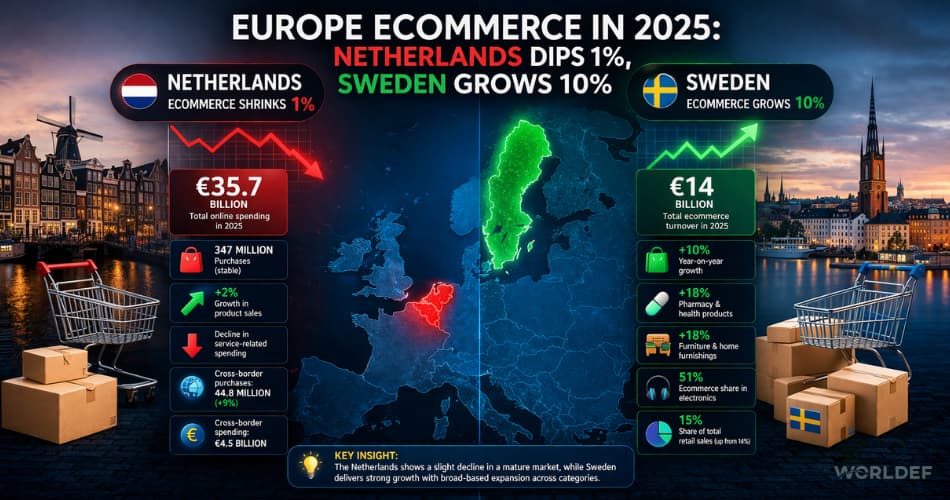
At first glance, a 1% drop in e-commerce spending in the Netherlands, totaling around €35.7 billion ,may appear like a warning sign. In reality, it tells a more nuanced story.
This is a market that has already reached high penetration levels. Growth is no longer driven by volume, but by structural shifts within consumer behavior.
Transaction volumes remained stable, and even more tellingly, online product sales continued to grow. Categories such as home & living, electronics, and toys maintained upward momentum. What dragged overall performance down was not demand, but a decline in service-related spending, a segment that had previously inflated e-commerce figures.
At the same time, Dutch consumers are increasingly looking outward. Cross-border e-commerce expanded rapidly, with spending reaching €4.5 billion. This signals a clear transition: domestic platforms are facing stronger competition as consumers turn to global marketplaces for price, variety, and convenience.
In essence, the Netherlands is not shrinking, it is rebalancing.
Sweden’s Return to Strong Growth
While the Netherlands adjusts to maturity, Sweden is moving with renewed energy.
E-commerce in Sweden grew by 10% in 2025, reaching approximately €14 billion, marking one of its strongest performances in recent years. Unlike the Dutch case, this growth is not selective, it is broad and consistent across sectors.
Health and pharmacy products saw particularly strong demand, alongside home furnishings ,both categories benefiting from long-term lifestyle shifts. Electronics, already a dominant segment, continued to deepen its online penetration, with more than half of purchases now happening digitally.
E-commerce’s share of total retail also edged higher, reaching 15%, reinforcing its role as a central pillar of Sweden’s retail economy rather than a complementary channel.
Sweden’s performance reflects more than recovery – it signals continued expansion in a still-developing digital retail environment.
Two Markets, Two Realities
Placed side by side, these markets highlight a critical truth: Europe’s e-commerce ecosystem is no longer moving in sync.
- The Netherlands represents a post-growth market, where optimization, competition, and cross-border pressure define the next phase
- Sweden reflects a growth-driven market, where penetration is still increasing and demand continues to expand
This divergence is not a contradiction – it is a natural evolution of e-commerce maturity.
The Strategic Shift Ahead
For e-commerce players operating in Europe, this split has clear implications.
Growth strategies that worked across the region five years ago are no longer universally effective.
- In mature markets like the Netherlands, success will depend on differentiation, pricing strategy, and cross-border positioning
- In growth markets like Sweden, the focus remains on scaling, category expansion, and customer acquisition
The era of “one Europe, one strategy” is over.
A Fragmented but Promising Future
Europe’s e-commerce future is not slowing down – it is becoming more complex.
Some markets are stabilizing, refining their structures and redefining growth drivers. Others are still accelerating, offering strong opportunities for expansion.
Understanding this two-speed dynamic will be essential for brands, marketplaces, and investors navigating the next phase of global e-commerce.
Because in 2025, the real story is not whether e-commerce is growing, but where, how, and why.