WORLDEF ISTANBUL 2026 - Early Bird Registration Ends Soon

Register Now

1 Surprising Book Behind Amazon’s Massive E-Commerce Success

1 Surprising Book Behind Amazon’s Massive E-Commerce Success

From a Garage Startup to Global E-Commerce Leader

Long before Amazon became the world’s leading “everything store,” its journey began with a single, almost symbolic purchase.

In 1995, Amazon’s very first customer order was a book titled “Fluid Concepts and Creative Analogies” by Douglas Hofstadter, a work focused on artificial intelligence. At the time, the internet was still in its early stages, and Amazon operated as a small online bookstore from a garage.

This seemingly ordinary transaction has recently resurfaced online, going viral across social media platforms and reigniting discussions about the origins of modern e-commerce.

AI Before the AI Boom

What makes this story particularly striking today is its connection to artificial intelligence. Decades before AI became a global technology race, Amazon’s first-ever sale was already linked to the concept.

The viral post caught the attention of Jeff Bezos, who reacted with a simple acknowledgment, while Elon Musk described it as “the start of something great.”

The moment has sparked both nostalgia and irony, highlighting how a company that began with selling books is now deeply embedded in AI, cloud computing, and global digital infrastructure.

The Beginning of the “Everything Store”

Amazon officially launched in 1994 as an online bookstore, chosen for its scalability and wide product availability. Within months of opening in 1995, it expanded rapidly, reaching customers across the United States and dozens of countries.

What started with one book quickly evolved into a platform that reshaped retail, logistics, and digital commerce worldwide.

Today, that first purchase is more than just a historical detail, it represents the foundation of the modern e-commerce ecosystem.

Source: Financial Express, NDTV, Economic Times

Azerbaijan E-Commerce Dominates as Traditional Payments Fall Behind in 8.2 Billion Market

Azerbaijan E-Commerce Dominates as Traditional Payments Fall Behind in 8.2 Billion Market

Azerbaijan is experiencing a rapid shift toward digital payments, with e-commerce emerging as the dominant force in the country’s cashless economy.

According to the Central Bank of Azerbaijan, non-cash transactions reached 8.2 billion manats in February 2026, marking a 15% year-on-year increase. Notably, e-commerce accounted for 7.17 billion manats, representing 87.5% of all cashless payments.

POS terminals contributed 1.026 billion manats, while self-service terminals remained minimal at just 3 million manats.

Digital Payments Accelerate Across Azerbaijan

The growth reflects a broader transformation in consumer behavior, with digital channels increasingly replacing traditional payment methods. Since the beginning of 2026, domestic non-cash transactions using payment cards have made up nearly 70% of total card activity, highlighting strong adoption of digital finance solutions.

At the same time, payment infrastructure continues to expand rapidly. The number of POS terminals surged by 49.1%, while ATMs increased by 7%, improving accessibility nationwide.

Card Usage Trends Signal Market Shift

As of March 1, the total number of payment cards in circulation reached 22.3 million, reflecting steady growth both monthly and annually. Debit cards continue to dominate the market, rising by 12.8% year-on-year, while credit card usage declined by 8.5%.

This trend indicates a preference for direct spending and tighter financial control among consumers, aligning with broader global patterns in digital payments.

What It Means for E-Commerce

The overwhelming share of e-commerce in non-cash transactions underscores its central role in Azerbaijan’s digital economy. As infrastructure expands and consumer confidence grows, the sector is expected to continue driving financial innovation and shaping the future of commerce in the region.

Source: AzerNews

Global E-Commerce Gets a Boost as China Announces 5 Cross-Border Trade Measures

Global E-Commerce Gets a Boost as China Announces 5 Cross-Border Trade Measures

China has unveiled a new policy framework aimed at strengthening its e-commerce sector, with a particular focus on cross-border trade and global market expansion. The move reflects Beijing’s effort to balance domestic growth with increasing international pressures and competition.

The guidance, jointly issued by multiple government bodies including commerce, industry, and cyberspace regulators, outlines a coordinated approach to improving both regulation and promotion within the digital economy.

A Strategic Push for Global E-Commerce Integration

At the core of the policy is the ambition to better align China’s domestic e-commerce ecosystem with global markets. Authorities emphasized the need to integrate the digital and real economies while maintaining a balance between efficiency, fairness, and regulatory oversight.

This comes shortly after increased scrutiny from international partners, particularly the European Union, over issues such as product safety, market access, and competitive fairness.

5 Key Measures Driving China’s E-Commerce Strategy

The new guidance introduces several major initiatives shaping the future of China’s e-commerce landscape:

  • Pilot zones for cross-border e-commerce to test new policies and accelerate innovation
  • Development of international rules and standards to align with global trade practices
  • Expansion of Chinese platforms into overseas markets to strengthen global reach
  • Encouragement for companies to establish procurement bases abroad
  • Streamlined import channels for high-quality global products entering China

These measures aim to position China as a more integrated and competitive player in global digital trade.

Addressing Global Trade Tensions

The policy also reflects broader geopolitical dynamics. Recent discussions with EU lawmakers highlighted concerns about unsafe products and limited access for foreign businesses in China.

While the new framework does not directly address these disputes, it signals China’s willingness to improve coordination and potentially ease tensions through regulatory refinement and market openness.

What It Means for the Global E-Commerce Ecosystem

China remains the world’s largest e-commerce market, and its regulatory direction has a significant impact on global supply chains and digital trade flows.

By promoting cross-border e-commerce, improving standards, and encouraging international expansion, the country is reinforcing its role as a central hub in global online commerce.

However, experts suggest that while the policy is a positive step, it may not fully resolve deeper trade imbalances and regulatory concerns between China and its international partners.

Source: Reuters

Europe’s Ecommerce Faces Sharp Divide as Netherlands Slips 1% While Sweden Surges 10% in 2025

Europe’s Ecommerce Faces Sharp Divide as Netherlands Slips 1% While Sweden Surges 10% in 2025

Europe’s e-commerce story in 2025 is not one of uniform growth, but of divergence.

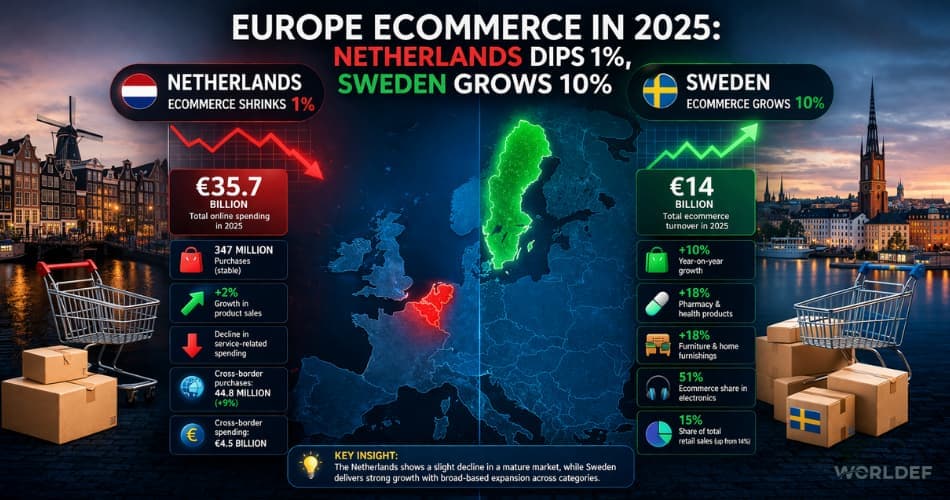
Two of the continent’s most advanced digital markets, the Netherlands and Sweden, moved in opposite directions, revealing a deeper shift in how e-commerce is evolving across mature economies. While Dutch e-commerce recorded a 1% decline, Sweden surged ahead with 10% growth, underscoring a widening gap between stabilization and expansion phases in Europe’s digital commerce landscape.

A Subtle Slowdown in the Netherlands

At first glance, a 1% drop in e-commerce spending in the Netherlands, totaling around €35.7 billion ,may appear like a warning sign. In reality, it tells a more nuanced story.

This is a market that has already reached high penetration levels. Growth is no longer driven by volume, but by structural shifts within consumer behavior.

Transaction volumes remained stable, and even more tellingly, online product sales continued to grow. Categories such as home & living, electronics, and toys maintained upward momentum. What dragged overall performance down was not demand, but a decline in service-related spending, a segment that had previously inflated e-commerce figures.

At the same time, Dutch consumers are increasingly looking outward. Cross-border e-commerce expanded rapidly, with spending reaching €4.5 billion. This signals a clear transition: domestic platforms are facing stronger competition as consumers turn to global marketplaces for price, variety, and convenience.

In essence, the Netherlands is not shrinking, it is rebalancing.

Sweden’s Return to Strong Growth

While the Netherlands adjusts to maturity, Sweden is moving with renewed energy.

E-commerce in Sweden grew by 10% in 2025, reaching approximately €14 billion, marking one of its strongest performances in recent years. Unlike the Dutch case, this growth is not selective, it is broad and consistent across sectors.

Health and pharmacy products saw particularly strong demand, alongside home furnishings ,both categories benefiting from long-term lifestyle shifts. Electronics, already a dominant segment, continued to deepen its online penetration, with more than half of purchases now happening digitally.

E-commerce’s share of total retail also edged higher, reaching 15%, reinforcing its role as a central pillar of Sweden’s retail economy rather than a complementary channel.

Sweden’s performance reflects more than recovery – it signals continued expansion in a still-developing digital retail environment.

Two Markets, Two Realities

Placed side by side, these markets highlight a critical truth: Europe’s e-commerce ecosystem is no longer moving in sync.

  • The Netherlands represents a post-growth market, where optimization, competition, and cross-border pressure define the next phase
  • Sweden reflects a growth-driven market, where penetration is still increasing and demand continues to expand

This divergence is not a contradiction – it is a natural evolution of e-commerce maturity.

The Strategic Shift Ahead

For e-commerce players operating in Europe, this split has clear implications.

Growth strategies that worked across the region five years ago are no longer universally effective.

  • In mature markets like the Netherlands, success will depend on differentiation, pricing strategy, and cross-border positioning
  • In growth markets like Sweden, the focus remains on scaling, category expansion, and customer acquisition

The era of “one Europe, one strategy” is over.

A Fragmented but Promising Future

Europe’s e-commerce future is not slowing down – it is becoming more complex.

Some markets are stabilizing, refining their structures and redefining growth drivers. Others are still accelerating, offering strong opportunities for expansion.

Understanding this two-speed dynamic will be essential for brands, marketplaces, and investors navigating the next phase of global e-commerce.

Because in 2025, the real story is not whether e-commerce is growing, but where, how, and why.

Source:

Ecommerce News Europe

Digital SEZ Integration Drives 5 Powerful Shifts in Global E-Commerce

Digital SEZ Integration Drives 5 Powerful Shifts in Global E-Commerce

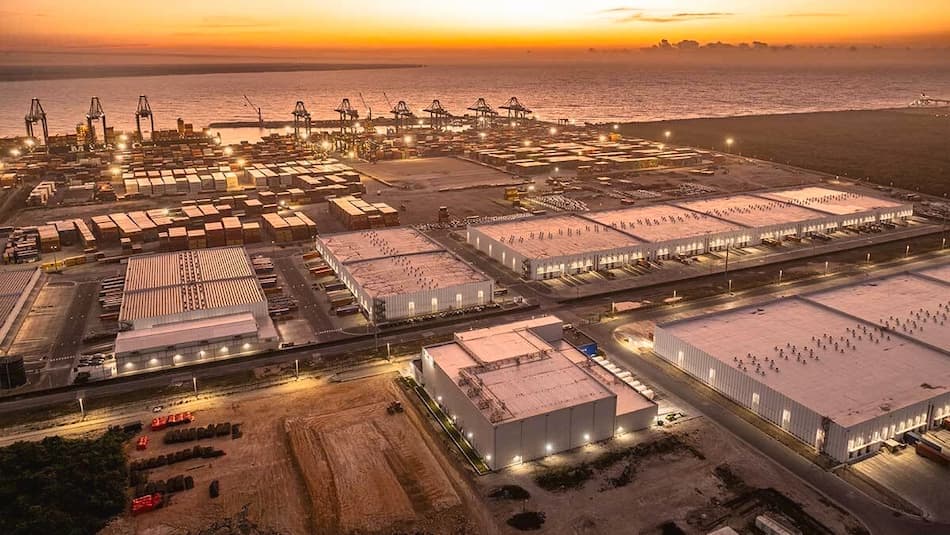
The global trade landscape is undergoing a structural transformation as digital capabilities are integrated into traditional Special Economic Zones (SEZs). Once designed primarily to attract manufacturing investment and boost exports, SEZs are now evolving into hybrid ecosystems where physical infrastructure meets digital commerce.

According to a recent analysis by The Dialogue, this convergence is not only strengthening regional competitiveness but also unlocking new growth pathways for e-commerce businesses operating across borders.

From industrial zones to digital commerce hubs

The role of SEZs is expanding beyond production. By embedding technologies such as data infrastructure, e-commerce platforms, and smart logistics systems, these zones are becoming end-to-end trade environments.

This transformation allows businesses to manage the entire value chain-from manufacturing to global distribution-within a single, integrated ecosystem. For e-commerce players, this means faster operations, reduced friction, and greater scalability.

Accelerating cross-border e-commerce

One of the most immediate impacts of digitally integrated SEZs is the reduction of cross-border trade barriers. Simplified customs procedures, tax incentives, and streamlined regulations create a more efficient environment for international transactions.

As a result, brands can expand into new markets more easily, while consumers benefit from faster delivery times and broader product availability. This shift is reinforcing the rise of borderless e-commerce models, where geography becomes less of a constraint.

Logistics becomes a competitive advantage

Location has always been a key advantage of SEZs, with most zones positioned near ports, airports, and major transport corridors. However, when combined with digital systems, this advantage becomes significantly more powerful.

Real-time inventory tracking, automated warehousing, and data-driven supply chain optimization are enabling e-commerce companies to shorten delivery cycles and improve fulfillment accuracy. In a market where speed is critical, this creates a clear competitive edge.

A catalyst for digital investment

Digitally enhanced SEZs are increasingly attracting investment from global technology players, including e-commerce platforms, fintech providers, and logistics innovators. This influx of capital is strengthening the broader ecosystem, enabling faster innovation and improved infrastructure.

For businesses operating within these zones, the benefits are twofold: access to advanced technologies and proximity to a growing network of digital service providers.

Empowering SMEs in global commerce

Perhaps one of the most significant outcomes is the opportunity created for small and medium-sized enterprises (SMEs). Traditionally limited by logistics costs and market access barriers, SMEs can now leverage SEZ infrastructure to reach international customers through e-commerce channels.

By lowering entry barriers and providing integrated support systems, digital SEZs are helping create a more inclusive global trade environment.

Balancing opportunity with risk

Despite their potential, experts caution that SEZs must be carefully designed to ensure long-term impact. Without the right policies, there is a risk of limited local economic integration or uneven regional development.

To fully realize their value, digital SEZ strategies need to focus on sustainability, inclusivity, and balanced growth.

The future of e-commerce infrastructure

As global trade becomes increasingly digital, SEZs are no longer just production zones. They are emerging as critical infrastructure for the next generation of e-commerce, combining logistics, technology, and policy into a single operational framework.

For e-commerce companies looking to scale internationally, digitally integrated SEZs may soon become not just an advantage-but a necessity.

Source: The Dialogue

6 Critical Challenges Reshaping Europe’s E-Commerce Gateways

6 Critical Challenges Reshaping Europe’s E-Commerce GatewaysSlug Generator

Europe’s e-commerce logistics model is undergoing a structural transformation. What once relied heavily on a few dominant gateways across Europe is now evolving into a more distributed system shaped by speed, fragmentation, and flexibility.

The rise of cross-border e-commerce has fundamentally changed cargo dynamics across Europe. Instead of large, predictable shipments, logistics networks are now handling high-frequency, low-volume flows moving across multiple routes. This shift is forcing operators to rethink systems originally designed for scale, not agility.

At the same time, traditional hubs such as Frankfurt, Amsterdam, and Paris remain important – but they are no longer sufficient on their own. Logistics players across Europe are increasingly adopting multi-hub strategies, integrating secondary airports and regional fulfilment centres to reduce congestion and improve delivery performance.

Speed, Technology and New Trade Routes Take the Lead

Speed has become non-negotiable. Next-day delivery is rapidly turning into a baseline expectation across Europe, rather than a competitive advantage. To meet this demand, companies are relying more on air cargo and hybrid logistics models, especially for high-value and time-sensitive goods.

Technology is playing a defining role in this transformation. AI-driven forecasting, real-time tracking, and automated cargo handling systems are enabling logistics providers to operate with greater precision. Performance is no longer just about capacity – it is about visibility, coordination, and responsiveness.

Meanwhile, geopolitical developments and shifting trade corridors are adding new complexity. Airspace restrictions and evolving economic routes are forcing companies to rethink traditional pathways, accelerating the emergence of alternative gateways connecting Europe with Asia and the Middle East.

Infrastructure Pressure and the New Competitive Reality

This transformation is placing increasing pressure on infrastructure. Airports and logistics hubs across Europe must scale rapidly through automation, expanded cargo capacity, and specialised facilities. Without these investments, bottlenecks will become unavoidable.

Ultimately, Europe’s e-commerce gateways are no longer defined by location alone. They are defined by how efficiently they operate within a broader network. Competitive advantage is shifting from size to flexibility – and from physical infrastructure to intelligent, connected systems.

Source: Air Cargo Week

Istanbul Chamber of Commerce Signals Positive Shift With 3 AI Expansion Priorities

Istanbul Chamber of Commerce Signals Positive Shift With 3 AI Expansion Priorities

The Istanbul Chamber of Commerce is accelerating its focus on artificial intelligence, outlining a strategic push to expand AI adoption across industries as part of its broader economic vision.

The initiative reflects a growing recognition that AI is no longer optional but a core driver of competitiveness, particularly for businesses navigating digital transformation and global market pressures.

AI Moves From Experimentation to Business Core

According to chamber representatives, artificial intelligence in Türkiye is transitioning from early experimentation to structured, large-scale implementation across sectors.

This shift is being driven by increasing demand for:

  • automation and efficiency
  • data-driven decision-making
  • scalable digital business models

The Istanbul Chamber of Commerce is positioning itself as a key facilitator in this transition, helping companies integrate AI into their operations more effectively.

Expanding AI Ecosystem in 2026

The chamber’s strategy includes expanding AI-related initiatives, partnerships, and knowledge-sharing platforms throughout 2026.

Türkiye is already strengthening its position as a regional hub for AI innovation, supported by upcoming global events such as major technology gatherings in Istanbul aimed at accelerating investment and collaboration.

These developments are expected to:

  • boost AI adoption among SMEs
  • attract international investors
  • strengthen the country’s digital economy

Supporting Businesses Through Transformation

With over 300,000 registered members, the Istanbul Chamber of Commerce plays a critical role in shaping business strategy and supporting companies through technological change.

Its AI expansion agenda focuses on:

  • increasing awareness and training
  • enabling access to new technologies
  • fostering collaboration between startups, enterprises, and institutions

Türkiye Positions Itself for AI-Driven Growth

As global competition intensifies, Türkiye is placing artificial intelligence at the center of its economic roadmap.

The Istanbul Chamber of Commerce’s push highlights a broader trend:
AI is becoming a foundational layer of business, not just a technological upgrade.

Source: Hürriyet Daily News

Business Enters a New Era as 2026 Marks the Rise of AI-Run E-Commerce Stores

Business Enters a New Era as 2026 Marks the Rise of AI-Run E-Commerce Stores

Artificial intelligence is moving beyond support tools and into full operational control, as a new generation of AI agents begins to manage entire e-commerce businesses. Emerging platforms like Genstore are introducing a model where autonomous AI systems can build, launch and operate online stores with minimal human involvement.

This shift marks a significant evolution in digital commerce. Instead of relying on fragmented tools for design, marketing, analytics and operations, AI agents now function as a coordinated “virtual team,” handling multiple roles simultaneously. These systems can generate storefronts, optimize product listings, manage campaigns and even support customer interactions.

According to industry insights, AI-native platforms are designed to remove the complexity that has traditionally slowed down e-commerce adoption. By analyzing product data, market trends and design patterns, AI can create a ready-to-sell store within minutes – dramatically reducing time to market.

How AI Agents Are Reshaping Business Operations

The key innovation lies in the concept of agent-based automation. Unlike traditional AI tools that assist with individual tasks, AI agents are capable of executing complete workflows across the e-commerce lifecycle.

These agents can take on specialized roles, such as product management, marketing execution and customer support. In practice, this means that what previously required a full team can now be handled through a single interface powered by conversational AI.

For business owners, this represents a major shift in how online stores are built and managed. Instead of focusing on technical setup and operational tasks, founders can concentrate on strategy, branding and growth while AI handles execution in the background.

At the same time, this transformation aligns with a broader trend across the industry. AI agents are increasingly being deployed not just to generate content, but to perform actions and complete transactions, signaling a move toward more autonomous digital ecosystems.

The Rise of Autonomous Commerce

The emergence of AI-managed stores introduces a new phase often described as AI-native commerce. In this model, automation is no longer an add-on but the foundation of the entire business structure.

Platforms like Genstore are positioning this as a step toward fully self-running commerce environments, where AI systems continuously optimize performance, adapt to market conditions and scale operations without constant human input.

This approach could significantly lower barriers to entry, particularly for small businesses and solo entrepreneurs. By reducing the need for technical skills, capital investment and operational experience, AI-driven platforms are making it easier to launch and manage online businesses at scale.

However, this shift also raises important questions about control, differentiation and long-term competitiveness. As more businesses rely on similar AI systems, maintaining unique brand identity and customer experience may become more challenging.

What It Means for Business Leaders

For business leaders, the rise of AI agents signals a fundamental change in how digital commerce will operate in the coming years. The focus is shifting from manual execution to orchestrating intelligent systems that can act independently.

While the benefits of speed, efficiency and scalability are clear, companies will also need to rethink governance, oversight and strategy in an environment where AI is increasingly making operational decisions.

Ultimately, the transition toward AI-run e-commerce stores reflects a broader transformation across industries: from human-led processes to AI-driven execution at scale. Businesses that adapt early to this shift may gain a significant competitive advantage in the evolving digital economy.

Source: Forbes

Indonesia Signals 3 New Controls as E-Commerce Imports Surge Raises Concerns

Indonesia Signals 3 New Controls as E-Commerce Imports Surge Raises Concerns

Indonesia is moving toward tighter control of its e-commerce market as concerns grow over the dominance of low-cost imported goods, particularly from China. Policymakers are increasingly signaling that stronger regulatory measures may be introduced to protect local businesses and ensure fair competition.

Why Business Concerns Are Rising in Indonesia’s E-Commerce Market

Authorities have raised alarms about the rapid growth of cross-border e-commerce, where foreign sellers – often offering significantly lower prices—are gaining substantial market share. This trend is putting pressure on domestic merchants, especially small and medium-sized enterprises that struggle to compete on pricing and scale.

Government signals suggest that Indonesia may introduce stricter rules targeting imported goods sold through online platforms. These measures could include tighter product compliance checks, taxation adjustments and enhanced oversight of digital marketplaces operating within the country.

The rise of major regional platforms such as TikTok Shop and Shopee has accelerated the inflow of cross-border products, reshaping consumer behavior and intensifying competition. While this has expanded product availability and affordability for consumers, it has also raised concerns about the long-term sustainability of local retail ecosystems.

Across Southeast Asia, similar regulatory trends are emerging. Countries in the region are increasingly exploring ways to balance the benefits of digital trade with the need to protect domestic industries. This includes introducing new tax frameworks, strengthening compliance requirements and monitoring foreign seller activity more closely.

For the global business community, Indonesia’s direction signals a broader shift in how governments approach e-commerce growth. As markets mature, there is a growing emphasis on regulation, fair competition and economic balance.

The outcome of these developments could reshape how international sellers operate in Southeast Asia, influencing pricing strategies, logistics models and market entry approaches. For businesses looking to expand in the region, adapting to evolving regulatory environments will become a critical factor for long-term success.

Source: TechNode Global

236 Business Groups Back WTO Reform and E-Commerce Moratorium Renewal

236 Business Groups Back WTO Reform and E-Commerce Moratorium Renewal

Global business pressure is intensifying as leading organisations call on governments to modernize the World Trade Organization and protect the future of digital trade. At the WTO’s 14th Ministerial Conference, the International Chamber of Commerce presented a Global Statement signed by 236 organisations, urging a time-bound WTO reform process and the renewal of the e-commerce moratorium.

The statement was delivered by ICC Secretary General John W.H. Denton AO to WTO Director-General Ngozi Okonjo-Iweala, highlighting growing concern across the global business community about the effectiveness of the current multilateral trading system.

Why Business Is Urging WTO Reform Now

Stakeholders emphasize that the WTO must evolve to remain relevant in a rapidly changing global economy. They are calling for structured and time-bound negotiations to restore the organisation’s ability to negotiate rules, resolve disputes and support modern trade flows, particularly in the digital economy.

A central issue is the future of the Moratorium on Customs Duties on Electronic Transmissions, which prevents countries from imposing tariffs on digital products and services. Maintaining this framework is critical to ensuring cost efficiency, cross-border scalability and predictable trade conditions for global business.

According to ICC, allowing the moratorium to expire could lead to increased trade fragmentation, higher operational costs and new barriers—especially for micro, small and medium-sized enterprises (MSMEs) that rely heavily on open digital markets.

The message from global business leaders is clear: a strong, rules-based trading system is essential for innovation, investment and sustainable growth. As digital commerce continues to expand, business groups are urging governments to act decisively to reduce uncertainty and support a more inclusive global trade environment.

For the e-commerce ecosystem, these discussions are highly consequential. The outcome will influence how companies operate internationally, how easily they enter new markets and how confidently they invest in digital expansion. In this context, WTO reform and moratorium renewal are becoming strategic priorities for global business.

Source: ICC