
EU Regulators Challenge JD.com’s $2.5B Economy Acquisition

The European Union has launched a formal review into whether JD.com’s planned $2.5 billion acquisition of German retailer Ceconomy involves unfair state subsidies from China.
The investigation, led by the European Commission, is being conducted under the EU’s Foreign Subsidies Regulation (FSR), a relatively new framework designed to prevent non-EU government support from distorting competition within the bloc.
Deadline set for initial findings
Regulators have set a May 28, 2026 deadline for the preliminary assessment. If concerns persist, the Commission may escalate the case into a full-scale investigation, potentially requiring JD.com to make concessions to proceed with the deal.
Interestingly, the acquisition does not fall under standard EU merger control rules, but is instead being scrutinized purely on subsidy-related concerns, highlighting the growing importance of the FSR in cross-border deals.
Strategic expansion into Europe
If approved, the deal would significantly strengthen JD.com’s international presence by giving it control over Ceconomy’s well-known retail brands, including MediaMarkt and Saturn, which operate across Europe.
This move is part of JD.com’s broader global expansion strategy as Chinese e-commerce giants increasingly look beyond domestic markets for growth.
Mixed regulatory response across Europe
While the EU review is ongoing, the deal has already triggered different reactions at the national level:
- Italy has approved the transaction with conditions
- Austria has raised concerns and continues its own scrutiny
- Other EU countries are monitoring the situation closely
These parallel reviews underline the growing sensitivity around foreign investments in strategic retail and technology sectors.
Why this matters for e-commerce
This case is a strong signal that Europe is tightening oversight on global e-commerce players, especially those backed by state-linked financing. The outcome could:
- Set a precedent for future Chinese acquisitions in Europe
- Impact how global e-commerce firms structure cross-border deals
- Accelerate regulatory fragmentation across EU markets
As the bloc balances openness to investment with competitive fairness, deals like JD.com-Ceconomy are becoming key test cases for the future of international commerce.
Read more on
About the author
Leila Gadirli Pirgulieva
253 stories on WORLDEF since March 2026.
More from Leila Gadirli Pirgulieva →Related
JD.com Opens Seoul Buying Office to Expand Korean Product Sourcing

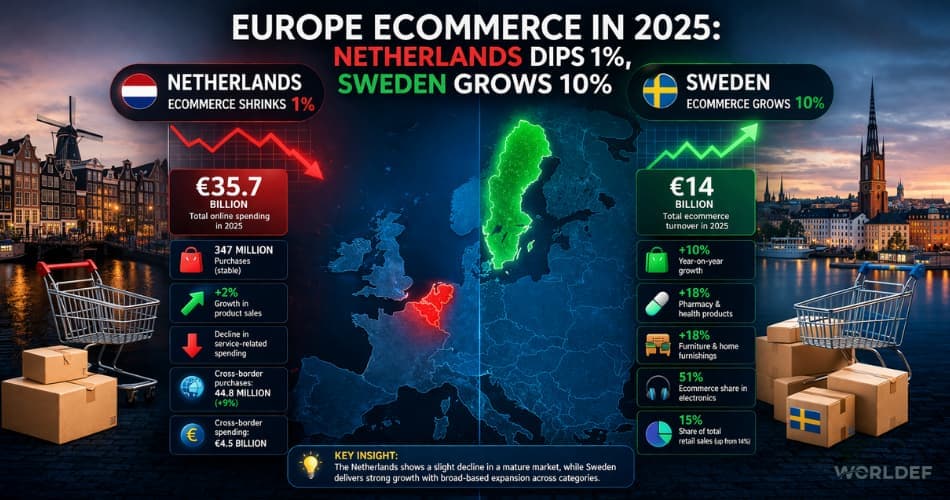
Europe’s Ecommerce Faces Sharp Divide as Netherlands Slips 1% While Sweden Surges 10% in 2025
3 Key Changes in EU De Minimis Rules and What It Means for UK E-Commerce Growth
Latin American E-Commerce Market Projected to Reach $215 Billion in 2026
The week in commerce, before your competitors.
1,469 stories since January 2025, distilled into three newsletters. Pick the ones you want.