WORLDEF ISTANBUL 2026 - Early Bird Registration Ends Soon

Register Now

5 Key Impacts of Google Expanding Pentagon AI Access After Anthropic’s Refusal

5 Key Impacts of Google Expanding Pentagon AI Access After Anthropic’s Refusal

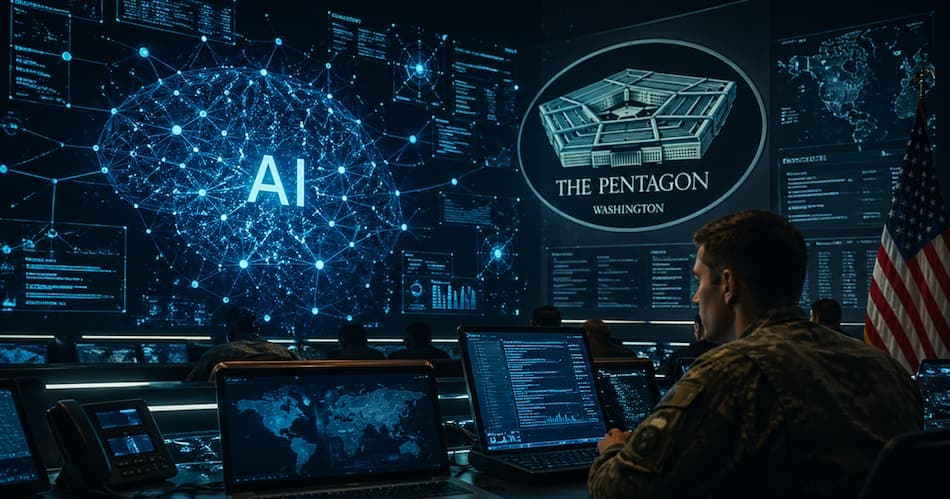
Google has significantly expanded the U.S. Department of Defense’s access to its artificial intelligence models, marking a pivotal shift in the relationship between Big Tech and military institutions. The move follows a high-profile refusal by Anthropic to loosen safeguards on its own AI systems for defense use.

According to recent reports, Google’s agreement allows the Pentagon to deploy its AI tools within classified environments for “any lawful government purpose.” This effectively positions Google among a growing group of AI providers, including OpenAI and xAI, supporting sensitive national security operations.

Anthropic’s Refusal Reshapes the Competitive Landscape

The development comes after Anthropic declined Pentagon requests to remove restrictions tied to autonomous weapons and mass surveillance applications. This refusal created a vacuum that competitors were quick to fill.

By contrast, Google’s agreement reportedly includes provisions that allow the government to modify safety settings and filters when necessary, raising questions about how enforceable ethical guardrails remain once systems are deployed in classified settings.

While the contract outlines limitations, such as avoiding domestic mass surveillance and ensuring human oversight in weapons-related use, experts note that these clauses may not fully constrain real-world applications.

Internal Backlash and Ethical Concerns

The deal has sparked significant internal resistance. More than 600 Google employees have voiced concerns, warning that deeper involvement in military AI projects could lead to ethical compromises and reputational risk.

This tension echoes earlier controversies, including Google’s withdrawal from the Pentagon’s Project Maven in 2018 after employee protests. The current agreement suggests a notable evolution in the company’s stance on defense-related AI.

Strategic Implications for the AI Industry

Google’s expanded role underscores a broader trend: AI is rapidly becoming central to modern defense infrastructure. Governments are increasingly seeking partnerships with leading AI firms to enhance capabilities in areas such as mission planning, intelligence analysis, cybersecurity, and battlefield decision support.

At the same time, the divergence between companies like Google and Anthropic highlights a growing split in the industry over how far AI providers should go in supporting military use cases.

A Defining Moment for AI Governance

The situation reflects a deeper, unresolved question shaping the future of artificial intelligence: how to balance national security priorities with ethical responsibility.

As governments push for greater access and control, and companies navigate internal and external pressures, the boundaries of acceptable AI use, especially in defense, are being actively redefined.

Source

Google Cloud Next 2026 Highlights 4 Positive Signals for the Agentic AI Era

Google Cloud Next 2026 Highlights 4 Positive Signals for the Agentic AI Era

Google used Cloud Next 2026 to make one message clear: the company wants to be seen not only as an AI model developer, but as a full-stack infrastructure partner for enterprises moving AI into daily operations. In a post published on April 22, CEO Sundar Pichai said Google Cloud is entering a new phase of momentum, with customer demand rising across models, chips, and enterprise AI tools.

At the center of the announcement was Google’s push toward what it calls the “agentic” era. According to Pichai, Google’s first-party models are now processing more than 16 billion tokens per minute through direct customer API use, up from 10 billion in the previous quarter. Google also said nearly 75% of Google Cloud customers are already using its AI products, while 330 customers processed more than one trillion tokens each over the last 12 months.

Google expands its enterprise AI platform

A major focus of this year’s Cloud Next was Gemini Enterprise. Google is positioning it as an end-to-end platform that connects enterprise data, employees, and workflows with AI agents. Pichai said paid monthly active users of Gemini Enterprise grew 40% quarter over quarter in the first quarter, signaling stronger commercial traction for the product. Reuters also reported that Google is rebranding and expanding parts of Vertex AI under the Gemini Enterprise banner as it sharpens its focus on enterprise deployments.

This matters because Google is trying to move beyond experimental AI use cases and into broader enterprise adoption. At the event, executives emphasized governance, scalability, and production-readiness, suggesting Google wants to compete not just on model quality, but on how easily businesses can build, manage, and secure AI systems at scale.

New TPU chips support training and inference

Google also used the event to introduce its eighth-generation Tensor Processing Units, TPU 8t and TPU 8i. The company says TPU 8t is designed for large-scale model training, while TPU 8i is optimized for low-latency inference, which is especially important for AI agents expected to respond quickly and handle complex tasks. In its chip announcement, Google said both processors were custom-engineered for the next phase of AI computing and will become available later this year.

Reuters reported that TPU 8i delivers 80% better performance for fast inference workloads than the previous generation, while TPU 8t can scale to large training clusters. The hardware rollout reinforces Google’s strategy of combining proprietary chips, models, cloud services, and security tools into one enterprise AI stack.

Another notable signal came from capital spending. Pichai reaffirmed Alphabet’s plan to spend $175 billion to $185 billion in 2026, with just over half of the company’s machine learning compute investment expected to support the Cloud business. That level of investment shows Google is willing to keep spending heavily to strengthen its position against Amazon, Microsoft, and emerging AI infrastructure rivals.

Overall, Cloud Next 2026 showed Google taking a more aggressive enterprise stance. Instead of focusing only on headline AI breakthroughs, the company is trying to prove it can provide the infrastructure, chips, software, and governance enterprises need to operationalize AI at scale. For cloud customers, that makes Google’s latest push less about experimentation and more about long-term adoption.

Source

India’s E-Commerce Market Expected to Reach $250 Billion by 2030

India’s e-commerce

India’s e-commerce market is undergoing not only quantitative growth but also a structural transformation in the coming years. According to a report by Google and Deloitte, the market is expected to expand from $90 billion to $250 billion by 2030. This growth is being driven by shifts in consumer behavior, the adoption of artificial intelligence technologies, and content-led discovery models.

According to the India E-Commerce Market report, approximately 220 million Gen Z consumers are expected to account for 45% of total online spending by 2030. This generation is not only purchasing products; it demands experience, speed, and personalization. At the same time, 150 million new users are expected to join the digital economy.

This shift indicates that the traditional “product-focused” approach in India’s e-commerce landscape is being replaced by an “experience-driven” model. Consumers are increasingly making purchases through content that inspires and is recommended to them, rather than actively searching for products.

The Era of “Algorithmic Intimacy” with AI in Indias E-Commerce

Artificial intelligence lies at the core of this transformation in India’s e-commerce market. AI is no longer just a recommendation engine; it is evolving into a “digital advisor.” Systems that can predict and even anticipate consumer needs before they are articulated are accelerating purchasing processes. According to experts, this new phase is defined as “algorithmic intimacy.” Demand is no longer merely predicted; it is generated in real time. This approach is expected to increase retail profitability by 30–35%.

The Rise of the Creator Economy and Live Commerce

The influence of content creators in e-commerce is steadily increasing. By 2030, creators are expected to drive 30% of total retail spending in India’s e-commerce market. Particularly in smaller cities, creators could bring millions of new users into digital commerce. Meanwhile, live commerce is projected to reach a market size of $8 billion, with fashion, beauty, and electronics leading the way.

Quick Commerce Is Expanding Its Boundaries

Quick commerce, known for rapid delivery, is no longer limited to major metropolitan areas in India’s e-commerce market. Expected to reach a $50 billion market size by 2030, this model is expanding beyond grocery into non-food categories. Additionally, the growing role of Tier 2 and Tier 3 cities in this expansion highlights how e-commerce is spreading across a broader geographic landscape.

The Future of E-Commerce Is Shaped by Experience and Speed

The example of India’s e-commerce market demonstrates that the future of e-commerce is shaped not only by technology but by the convergence of content, speed, and personalization. Brands that successfully integrate artificial intelligence, the creator economy, and rapid delivery solutions will be the winners of this new era. This transformation sends a strong signal not only for India but also for the direction of global e-commerce.