WORLDEF ISTANBUL 2026 - Early Bird Registration Ends Soon

Register Now

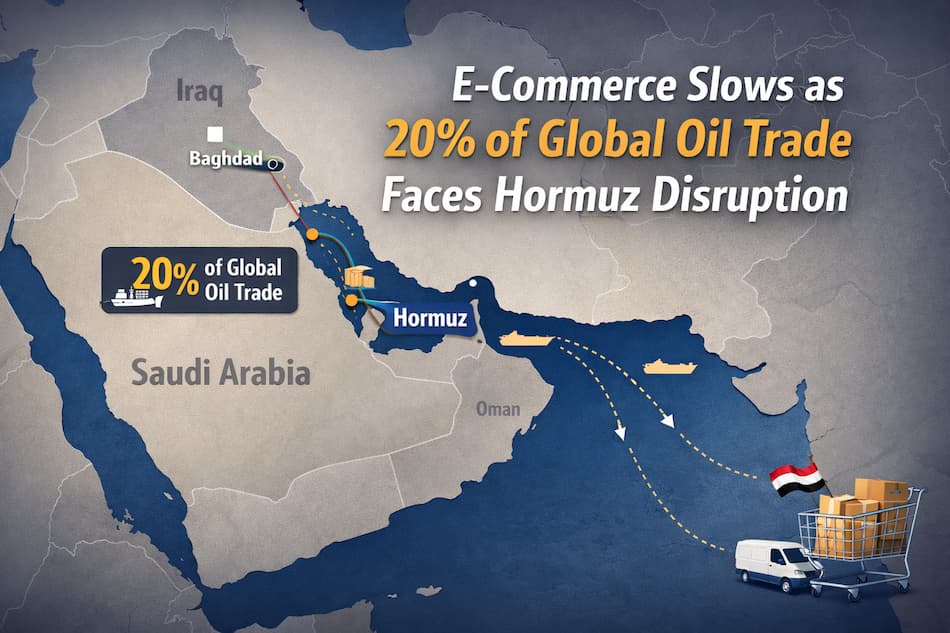
E-Commerce Hit by Hormuz Crisis as 20% of Global Oil Trade Is Affected

strait-of-hormuz-disruption-slows-iraqi-e-commerce-as-costs-rise-and-deliveries-delay

The ongoing disruption in the Strait of Hormuz is beginning to ripple through Iraq’s digital economy, with e-commerce businesses facing rising costs, delayed deliveries, and increasing order cancellations.

Online retailers across Iraq report mounting logistical challenges as shipments-many routed through key global trade corridors are slowed or rerouted. The impact is particularly visible in delivery timelines, once considered a competitive advantage for e-commerce platforms.

Delivery Delays and Rising Cancellations

Small and medium-sized online sellers are among the hardest hit. Many rely on imported goods from international suppliers, particularly in Asia, making them highly dependent on stable shipping routes.

Retailers say delayed shipments have triggered a surge in cancellations, as customers opt out of purchases when delivery times become uncertain. Sellers are also absorbing additional operational pressure, balancing customer expectations with limited control over supply chain disruptions.

Transport costs have increased significantly, squeezing already thin margins. Some businesses are choosing to maintain prices to remain competitive, even as profitability declines.

Supply Chain Pressure Hits Core E-Commerce Model

The Strait of Hormuz is one of the world’s most critical maritime trade routes, handling a substantial share of global energy and cargo flows. Any disruption quickly translates into higher fuel prices and shipping costs globally, directly impacting online retail.

Economists warn that e-commerce built on speed, affordability, and product availability is especially vulnerable to such shocks.

Higher oil prices are already driving up logistics expenses across both air and sea freight. This, in turn, is increasing product prices, reducing consumer purchasing power, and weakening demand in price-sensitive markets like Iraq.

Reduced Variety and Slower Market Activity

Beyond delays, the disruption is also affecting product availability. Import-dependent markets are seeing reduced variety as supply chains slow, particularly for goods sourced from China and India.

This shift is forcing e-commerce platforms and sellers to rethink inventory strategies, promotional campaigns, and pricing models. Some larger players may pass costs directly to consumers, while smaller sellers risk losing market share.

Experts note that emerging markets tend to feel the impact more sharply due to their reliance on imports and limited logistical alternatives.

A Structural Challenge for Digital Commerce

The situation highlights a broader vulnerability in global e-commerce: dependence on key geopolitical chokepoints.

As disruptions in the Strait continue, Iraqi e-commerce is likely to remain under pressure, with longer delivery cycles, higher prices, and reduced competitiveness shaping the market in the near term.

For the sector, the crisis serves as a reminder that digital commerce is only as resilient as the physical infrastructure behind it.

Source

Saudi Arabia, UAE and Oman Activate New Cargo Routes to Counter Strait of Hormuz Risks

Hormuz

Amid rising geopolitical tensions in the Gulf region, countries in the area have begun activating alternative logistics corridors to prevent potential disruptions in the Strait of Hormuz, one of the world’s most critical maritime trade chokepoints.

Saudi Arabia, the United Arab Emirates and Oman are reorganizing cargo flows through new land, rail and port connections to ensure that regional trade continues without interruption. These measures effectively create alternative cargo routes to mitigate risks related to the Strait of Hormuz.

In Saudi Arabia, a new logistics corridor program launched by the Saudi Ports Authority (Mawani) is linking Red Sea ports with Gulf markets. Jeddah Islamic Port, King Abdullah Port, the Yanbu ports, NEOM Port and Jazan ports have been positioned as key hubs within the new system. Containers arriving at these ports are transported by road to markets such as Kuwait, Bahrain, Qatar, the UAE and Oman, reducing trade dependence on the Strait of Hormuz.

UAE Identifies Alternative Routes to Hormuz

The United Arab Emirates is implementing a similar strategy. Part of the cargo traffic is being redirected to east-coast ports on the Gulf of Oman, including Fujairah and Khor Fakkan. Cargo arriving at these ports is then transported by road by DP World to Jebel Ali Port and other logistics centers.

At the same time, the national rail network operated by Etihad Rail has become an important part of the supply chain. Over the past nine days, more than 100 train trips have transported approximately 459,000 tonnes of cargo and nearly 8,000 containers.

Oman, meanwhile, is positioning the ports of Sohar, Duqm and Salalah as regional alternative gateways. The government has introduced new measures to accelerate customs and logistics processes, while facilitating transit operations through the Bayan electronic customs system.

Gulf Countries Handle a Significant Share of Cross-Border E-Commerce Shipments

These developments are not only critical for energy and industrial supply chains but also for global e-commerce logistics. As a major trade hub between Europe and Asia, Gulf countries handle a significant share of cross-border e-commerce shipments.

With the development of logistics corridors that bypass the Strait of Hormuz, e-commerce companies can maintain more secure and uninterrupted supply chains, particularly for electronics, fashion and consumer goods that require fast delivery.

According to experts, the new logistics infrastructure being established in the Gulf will not only serve as a safeguard during periods of crisis but will also strengthen the region’s strategic role in global trade and e-commerce logistics in the long term.