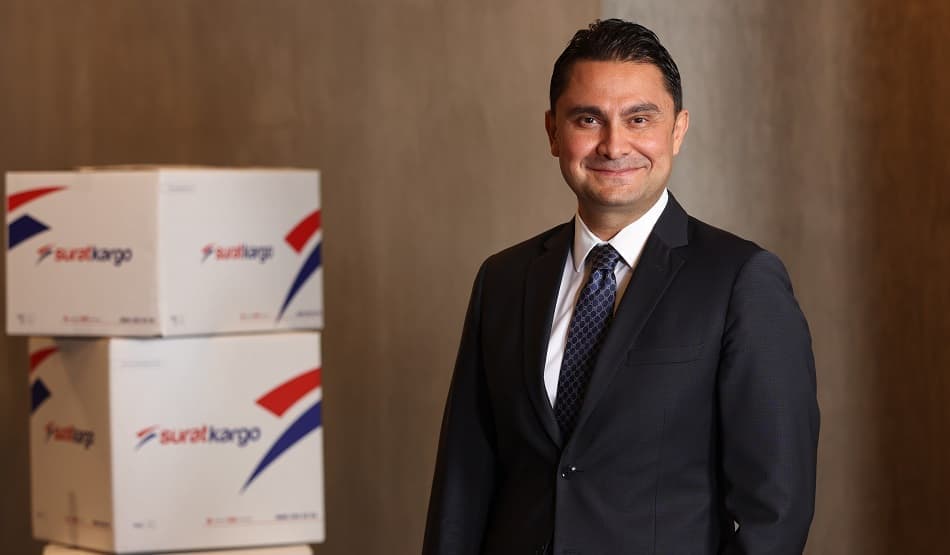
Sürat Kargo, which has structured its operational processes end to end through digital transformation investments, increased its transaction volume by 20 percent in the relevant period. Sürat Kargo General Manager Cem Oğuz said, “The fact that we established the infrastructure capable of meeting the increase in e-commerce volume in a timely manner has made the financial impact of our digital transformation investments more visible.”
Sürat Kargo, which addresses digitalization as a holistic transformation by redefining its ways of doing business end to end, continues to make a difference in many areas, from operational efficiency and transaction volume to delivery times and customer experience, through the steps it has taken in this direction.
Stating that Sürat Kargo achieved a 20 percent increase in transaction volume with the measurable and flexible structure it established, Sürat Kargo General Manager Cem Oğuz said, “The fact that we established the infrastructure capable of meeting the increase in e-commerce volume in a timely manner has made the financial impact of our digital transformation investments more visible.”
Sürat Kargo General Manager: We Are Building An Integrated Cross-Border Operation
Sharing that they plan to establish a compact structure that combines customs clearance and operational processes on the international shipments side on a single platform, Sürat Kargo GM Oğuz provided the following information:
“In this way, by simplifying processes dispersed across different systems, we aim to offer a more transparent, faster, and error-free experience for both our operational teams and our business partners. In particular, we are building an end-to-end digital and integrated cross-border operational infrastructure in a way that will support the increase in cross-border e-commerce volume. In addition, by continuously improving our integration capabilities, we are creating an ecosystem that enables faster and more flexible data exchange with our business partners.
On the customer side, we focus on offering more transparent tracking, more accurate delivery forecasts, and personalized services. In the coming period, we aim to take our digital transformation journey further with applications such as AI-supported demand forecasting, dynamic pricing, and proactive customer notification.”
E-commerce is not merely a sales channel; when built with the right strategy, it can transform into a powerful business model capable of financing personal dreams and creating opportunities on a global scale. The entrepreneurial journey of e-commerce entrepreneur Ekrem Rmuen is inspiring in terms of “turning e-commerce into a strategic growth engine.”
Rmuen sincerely explained the path to sustainable success, from the critical role of export-oriented thinking to operational discipline, and from the competitive advantage of remaining anonymous to trust-based business relationships. His experiences reveal that e-commerce offers not only profit, but also a transformation in perspective and lifestyle. Anyone whose path has crossed with e-commerce will enjoy reading this interview!
You began your professional life as an employee, not an entrepreneur. What originally pushed you toward e-commerce, and what problem were you trying to solve at the time?
My primary motivation for entering e-commerce was very clear: my dream of becoming a pilot. I am a mechanical engineer by training. I applied to the Turkish Airlines cadet program, and while the process was ongoing, the pandemic broke out. As the aviation industry suddenly slowed down, I was unable to complete the program. After the pandemic, I faced a second reality: I was now above the age limit for applying to the cadet track. That meant only one viable option remained if I still wanted to fly private flight training through a civilian flight school. At that time, however, I did not have the financial resources to fund that path.
I needed two things at once: the ability to create enough time to commit to training, and a strong enough income stream to finance it. When I looked for an answer that could realistically deliver both, the most rational solution I found was e-commerce. I initially started with the goal of generating additional income. But around one year in, I realised e-commerce was not just side income it could become a serious vehicle for long-term change.
At what point did you realise that e-commerce was no longer just an additional income stream, but a serious vehicle for long-term change in your life?
In aviation, almost all major costs are denominated in foreign currency particularly in U.S. dollars. Trying to finance a dollar-based education while earning in Turkish lira makes an already demanding journey significantly harder. That economic mismatch became very clear to me. I realised that if I could earn in foreign currency, the entire equation would change. That was the moment when e-commerce shifted from local sales to export-oriented thinking. Cross-border selling was not just about growth; it was about currency alignment.
To give a concrete example: when selling a product domestically, you might earn one unit of profit. Selling the same product internationally can multiply that return significantly -sometimes by ten times- not only because of pricing differences, but because you are operating in stronger currency markets. Additionally, export activities often benefit from government incentives and support mechanisms. These structural advantages reinforced my decision. At that point, e-commerce stopped being side income. It became a strategic financial engine.
What do most people misunderstand about success in marketplaces like Etsy or Amazon?
From what I have observed, the biggest mistake new sellers make is assuming that every product they launch will achieve high sales volume. The reality is very different. In my own experience, my success rate is approximately 5%. That means when I test 100 products, only about five reach the level of sales I initially target. And even that ratio is not guaranteed sometimes it is lower. E-commerce is not about guessing correctly once. It is about systematic experimentation and acceptance of failure as part of the model.
There are many ways to achieve strong sales numbers aggressive marketing, trend chasing, price competition. My personal preference, however, is different. I focus on products where competition is lower and where I have production capability and control. When you can produce what you sell, you gain flexibility in pricing, customization, and margin protection. For me, sustainability comes from controllability not virality.
At scale, what matters more: marketing creativity, operational discipline, or algorithmic alignment? Why?
At scale, operational discipline becomes the dominant factor. When you are small, minor mistakes are manageable. But as volume increases, small errors scale into expensive problems. To give a very recent example: in one of our ongoing operations in the United States, a miscalculation in a single box dimension caused a 45-day delay in the entire process. The financial impact of such an operational oversight at scale is significant.
Marketing can generate demand. Algorithms can amplify visibility. But operations determine whether growth is sustainable or fragile. In my view, systems should be designed to self-monitor and prevent repetition of critical errors. We are not perfect at that yet but we learn quickly. What I can confidently say is this: the same mistake has not happened twice. Operational maturity is not about avoiding mistakes entirely. It is about building structures that ensure they do not repeat.
You’ve chosen not to publicly share your store names or product links. Why is anonymity important for successful e-commerce sellers?
I do not share my store names publicly, especially on social media, for strategic reasons. One of the main reasons relates to algorithm dynamics. If a product listing receives traffic but does not convert into sales, conversion rates decline. On many marketplaces, low conversion signals reduce visibility. Unqualified traffic can therefore harm performance rather than help it. Another reason is market positioning. None of our products are sold in the domestic Turkish market.
That means sharing links locally does not create commercial value for us. On the contrary, it creates unnecessary exposure. In highly competitive digital environments, visibility attracts replication. Additional competitors do not need an invitation. Anonymity, in this context, is not about secrecy. It is about protecting conversion integrity, strategic positioning, and operational sustainability.
Do platforms sufficiently protect sellers, or does increased transparency often come at the cost of security and sustainability?
In my honest opinion, marketplaces prioritize buyer protection more consistently than seller protection. One of the simplest examples from my own experience was the suspension of one of our primary Etsy accounts. The account was suspended without clear explanation. Reinstatement took approximately nine months. The actual reason was communicated much later, and it was not explicitly defined in a way that had been clearly stated in platform policies.
Such uncertainty creates structural risk. When a seller invests years into building reputation, reviews, and operational systems, a sudden suspension without transparent communication can have serious consequences. My experience in domestic marketplaces in Türkiye was not entirely different. I encountered situations involving unfair competition. I reported competitors who were operating without proper invoicing and legal compliance, which naturally makes price competition impossible. Despite formal complaints, enforcement mechanisms were inconsistent, and those sellers continued operating.
One of the reasons I ultimately reduced my focus on domestic marketplaces was precisely this issue of regulatory inconsistency. To be fair, platforms operate at massive scale, and enforcement is complex. However, sustainable digital entrepreneurship requires balanced accountability not only for buyers, but for sellers who invest capital, time, and compliance effort.
You’ve shared examples where you prioritised customer trust over short-term profit. How do ethics and long-term thinking shape sustainable e-commerce businesses?
There are moments in business where you must choose between immediate security and long-term trust. I can give a concrete example. A U.S.-based company once placed an order with us worth approximately $30,000. Shortly after, they cancelled the order. When I asked for the reason, they openly expressed concern about making a high-value payment to a company located in another country.
Instead of insisting on prepayment, I offered blind shipping with post-delivery payment. I told them: “We will ship the products. Once you receive them and are satisfied, you can complete the payment.” This was a significant risk. But the company was reputable, and I believed that trust should sometimes be initiated rather than demanded. The order was completed successfully. Over time, this approach has led to long-term partnerships with major international companies including IKEA and Universal Orlando Studios. These relationships were not built on aggressive negotiation, but on reliability and credibility.
There is another dimension that many sellers hesitate to speak about openly. In marketplace environments, sometimes a customer may be dissatisfied for various reasons. In certain cases, within reasonable limits, we issue a refund without requiring the product to be returned.
Financially, this may not seem optimal in the short term. However, the long-term effect is measurable. Positive reviews, strengthened reputation, and increased order volume often outweigh the isolated loss. Sometimes, strategic courage is necessary. Trust, when extended wisely, compounds.
If you could speak to your earlier self, the employee who had a dream but no clear path, what would you tell him about e-commerce, risk, and patience?
After university, there were several years where I was searching for direction. If I could speak to that version of myself, I would tell him to invest that time in building an e-commerce foundation. When structured correctly, e-commerce becomes extremely valuable once the system begins to operate independently. When processes are in place and momentum builds, the business no longer depends entirely on your physical presence.
With internet access, almost anywhere can become your office. There are no traditional office hours which is both freedom and responsibility. At times, the working hours can be intense and long. But the flexibility is real.
Beyond income, e-commerce expands perspective. For example, on Etsy, when a customer places an order, we can sometimes see the other products they have favorited. Every day I encounter new ideas, designs, and product concepts from around the world. It constantly exposes you to innovation. It develops a research-oriented mindset.
In addition, today I have commercial relationships and friendships across multiple countries. Building a global network through trade is one of the most valuable outcomes of this journey. E-commerce, for me, was not only a financial tool it was an intellectual and social expansion.
What should ecosystem leaders, platforms, and policymakers better understand about the human side of digital entrepreneurship?
E-commerce, by its nature, is structurally cold. We operate through screens. There is no physical customer entering a store, no face-to-face interaction, no direct emotional feedback. Communication is almost entirely written. This creates both advantages and challenges. On the positive side, you are not required to stand in a physical store all day. In many ways, your business operates 24/7 without being physically tied to one location. That flexibility is powerful.
But on the other hand, we are human beings. We interpret tone, emotion, hesitation things that are difficult to perceive through text alone. The emotional dimension of trade becomes more abstract. Additionally, like all forms of commerce, e-commerce carries structural risks. A single announcement —for example, a new customs regulation introduced by a government— can instantly change the entire operating landscape. Overnight, margins, logistics, and compliance structures may need to be rebuilt.
Because of this volatility, I would hope that platform leaders approach sellers with greater balance and understanding. Behind every seller account is a human being managing inventory risk, capital exposure, and responsibility. We can make mistakes. As humans, that is inevitable. But the tolerance for error in digital marketplaces is often very low. If platforms want long-term sustainability, they must recognise not only performance metrics, but the people behind them.
In this interview, we had the privilege of speaking with H.E. Mr. Lütfullah Göktaş, Ambassador of the Republic of Türkiye to the United Arab Emirates. We are grateful for his time and for sharing his thoughtful perspectives on the evolving Türkiye–UAE relationship. The conversation offers valuable insights into strategic partnership, digital trade, investment, and technological cooperation, while highlighting how shared visions and complementary economic strengths are shaping a deeper and more resilient bilateral framework.
UAE–Türkiye Strategic Outlook
The UAE and Türkiye have deepened their economic relationship significantly in recent years. How does the UAE view Türkiye as a partner in digital trade and the new economy?
I can approach this question from both perspectives because the viewpoints of Türkiye and the UAE are quite similar. Both nations view each other as beacons of stability in a volatile region. This alignment is not limited to the political sphere; it extends to financial, commercial, and investment sectors, where Türkiye and the UAE support one another’s endeavors and complement their respective future visions.
His Excellency President Recep Tayyip Erdoğan and His Highness President Sheikh Mohamed Bin Zayed Al Nahyan agreed to elevate Türkiye-UAE relations to the level of strategic partnership in 2023. The first meeting of the “High-Level Strategic Council” convened in Ankara last July, resulting in the signing of seven agreements, primarily in the fields of investment and economics.
The signing of the Comprehensive Economic Partnership Agreement (CEPA) in 2023 stands as the most robust testament to the flourishing relations between Türkiye and the UAE. Facilitated by the favorable environment created by this agreement, our bilateral trade volume doubled in 2023, exceeding $20 billion. In the following years, as UAE Minister of Foreign Trade His Excellency Thani Al Zeyoudi has stated, bilateral trade figures have reached even higher milestones, surpassing $40 billion.
Bilateral investments have become another cornerstone of our developing economic ties. Turkish companies have undertaken 149 projects worth $17.7 billion, making the UAE the 10th most important country globally for Turkish international contracting services.
These figures serve as concrete evidence of the complementary and mutually beneficial nature of the Turkish and Emirati economies. Our strategic partnership, expanding across commercial, investment, and financial fields, generates fruitful outcomes not only for our two nations but for the wider region and beyond as well. Rooted in the mutual benefit of the two countries and strategic visions of His Excellency President Erdoğan and His Highness President Sheikh Mohamed, our collaboration paves the way for a stable and secure future in a world where volatility and uncertainty have become the new norm.
What distinguishes Türkiye as an attractive destination for UAE investors and tech-driven companies?
Türkiye’s attractiveness for UAE investors lies in the rare convergence of scale, capability, and strategic geography—a combination that few markets currently offer in one package.
Türkiye is one of the largest consumer markets in its wider region, with over 85 million people, high digital adoption, and a consumption profile that supports rapid scaling of platforms, marketplaces, and digital services. For UAE investors accustomed to building regional champions, Türkiye provides both a substantial domestic base and a springboard to adjacent markets.
Türkiye has evolved into a production-plus-technology economy, rather than a purely consumption-driven one. Unlike many emerging markets, Türkiye combines advanced manufacturing, strong industrial supply chains, and a growing software and digital services layer. This allows UAE tech-driven companies not only to sell into Türkiye, but to build, test, and export from Türkiye, particularly into Europe, MENA, and Central Asia.
Thirdly, cost-efficiency with sophistication is a major differentiator. Türkiye offers globally competitive engineering, product, and operations talent at costs that remain attractive compared to Western Europe or even parts of Eastern Europe. For UAE investors facing rising global tech costs, Türkiye represents a market where capital can be deployed more efficiently without sacrificing quality or execution speed.
Another critical factor is geostrategic positioning. Türkiye sits at the intersection of multiple trade corridors and time zones, enabling near-real-time operational overlap with Europe, the Gulf, and Asia. For UAE companies building cross-border platforms—whether in e-commerce, fintech, logistics, or SaaS—this makes Türkiye an ideal operational and regional coordination hub.
Finally, there is a strategic alignment of long-term visions. UAE investors increasingly favor partnerships that deliver technology transfer, ecosystem development, and regional integration rather than short-term financial returns. Türkiye’s policy focus on high-value foreign direct investment, digitalization, and export-oriented growth resonates strongly with this approach.
In summary, Türkiye stands out not because it offers a single advantage, but because it brings together scale, talent, industrial depth, and regional reach in a way that aligns naturally with the UAE’s ambition to build globally competitive, tech-enabled platforms.
CEPA & Digital Market Integration
How do you see CEPA transforming bilateral e-commerce flows, especially by lowering barriers and enabling faster cross-border transactions?
The Türkiye-UAE Comprehensive Economic Partnership Agreement (CEPA) represents a key driver in accelerating bilateral e-commerce. By reducing regulatory and operational barriers, simplifying customs processes, and enhancing transparency, CEPA lowers the cost and complexity of cross-border online trade. This is especially impactful for small and medium-sized enterprises and digital startups, enabling them to access each other’s markets more easily while benefiting from Türkiye’s strong production and e-commerce capabilities and the UAE’s role as a global logistics and fintech hub.
At the same time, CEPA facilitates faster and more secure cross-border transactions by improving trade facilitation, logistics efficiency, and digital trade frameworks. Clearer rules on electronic payments, data flows, and consumer protection help build trust and encourage businesses to scale their operations with confidence. Beyond increasing transaction volumes, the agreement lays the foundation for a deeper digital partnership, positioning Türkiye and the UAE to strengthen regional e-commerce connectivity and jointly expand into third markets.
UAE Investments in Türkiye
Türkiye investments in UAE continue to grow across different sectors. What long-term strategic priorities guide these investments?
I can name multiple priorities. Nevertheless the most significant ones are: Strengthening the mutual development in the fields not only crucial for today, but also for the future; empowering the stability to foster a fertile environment for our business people to grow, cooperate and support our industries to innovate products for the benefit of the third parties; and last but not least, collaborate in the future technologies that will generate outcomes beneficial not only for Türkiye and the UAE, but also for the whole world.
In this respect, I can proudly state that we have already made significant progress towards these objectives. Currently, there are multiple data center projects in which UAE initiatives are investing in Türkiye. Simultaneously, Turkish companies are undertaking the Dubai Metro Blue Line project. DP World and AD Ports are leveraging Türkiye’s strategic location by collaborating with their Turkish partners on long-term logistics investments. Additionally, our multilateral cooperation with Iraq and Qatar on the “Development Road Project” elevates our solidarity to a playmaker position and is redefining the rules of global supply chain routes.
However, these are merely the first steps of our robust cooperation. We still have a long way to go and significant potential to fulfill in sectors such as tourism and hospitality, pharmaceuticals, manufacturing, food and agriculture, and advanced technologies and so on. Thanks to the cordial mutual relations between our Presidents, we are working diligently to pave the way for our business leaders, assisting them in carrying the flag of both nations in the field of economic diplomacy.
How do UAE companies perceive Türkiye’s digital infrastructure, talent pool, and entrepreneurial ecosystem?
UAE companies generally view Türkiye’s digital infrastructure as reliable, evolving, and capable of supporting long-term growth. The country has made steady progress in digital connectivity, payments systems, and technology adoption, which provides a supportive framework for modern business operations and cross-border collaboration.
Türkiye’s talent pool is widely recognized as one of its key strengths. The availability of well-educated, adaptable, and internationally experienced professionals contributes significantly to investor confidence. This human capital, combined with a strong culture of entrepreneurship, supports innovation and encourages the development of new business models and partnerships.
From the perspective of UAE companies, Türkiye’s entrepreneurial ecosystem reflects a growing maturity. It demonstrates not only creativity and ambition, but also an increasing capacity to scale and integrate with regional and global markets. This makes Türkiye a natural partner for UAE businesses seeking to expand their regional footprint through cooperation rather than competition.
What opportunities exist for collaboration between e-commerce platforms in the UAE and Turkish sellers looking to scale regionally?
The UAE’s advanced marketplaces, digital infrastructure, and logistics capabilities provide an ideal gateway for Turkish businesses to access wider regional markets, enabling faster entry, efficient fulfillment, and improved delivery performance. Through partnerships in areas such as seller onboarding, digital payments, marketing, data analytics, and shared fulfillment solutions, Turkish companies can scale more effectively while UAE platforms diversify their offerings with high-quality Turkish products. These collaborations go beyond immediate commercial gains, contributing to a more integrated and resilient regional e-commerce ecosystem that benefits both countries.
Innovation, Logistics & New Economy Sectors
With the rise of AI, last-mile delivery innovations, and digital logistics corridors, how do you see the next stage of UAE–Türkiye cooperation unfolding?
The next stage of cooperation between the United Arab Emirates and Türkiye will be shaped by a shared understanding that technology is a key enabler of sustainable economic partnership. As global trade becomes increasingly digital, both countries recognize the importance of aligning their strengths to support innovation, efficiency, and inclusive growth.
Artificial intelligence will sit at the center of this transformation. Ongoing data center investments by UAE players including G42’s Khazna, Gulf Data Hub’s Castle Investments and Damac’s Edgnex combined over USD 1 billion is a great testament of how AI will shape the future of this rapid transformation.
In this context, advances in artificial intelligence, digital logistics, and smart delivery solutions should be viewed not merely as technological developments, but as tools that deepen economic connectivity between our two nations. These technologies allow businesses—large and small—to operate more efficiently, reach new markets, and respond more effectively to changing consumer expectations.
The UAE and Türkiye are well positioned to complement one another. The UAE’s role as a regional logistics and digital commerce hub, combined with Türkiye’s strong production capacity and growing digital capabilities, creates a natural foundation for closer cooperation. Together, we can work toward trade corridors that are not only faster, but also more transparent, reliable, and resilient.
Importantly, this next phase of cooperation will be inclusive. By improving digital and logistics infrastructure, we are creating opportunities not just for major companies, but also for small and medium-sized enterprises to participate more actively in cross-border trade. This supports job creation, entrepreneurship, and long-term economic stability in both countries.
Looking ahead, UAE–Türkiye collaboration in digital trade and logistics reflects a broader commitment to partnership, openness, and shared prosperity. By continuing to engage in dialogue, align standards, and encourage collaboration between our private sectors, we can ensure that technological progress translates into tangible benefits for our economies and our people.
The next phase of UAE–Türkiye cooperation will focus on deeper technological and logistical integration. Advances in artificial intelligence create strong potential for joint efforts in areas such as enhanced customer experiences, while innovation in last-mile delivery through smart systems in warehousing and delivery models will improve efficiency and resilience. At the same time, developing digital logistics corridors with real-time data sharing and faster customs processes will further strengthen bilateral trade. By aligning standards and promoting public-private collaboration, Türkiye and the UAE can build seamless supply chains that connect multiple regions and position both countries as leaders in digital trade and smart logistics.
What role do events like WORLDEF Dubai 2026 play in bringing the two economies closer together in e-commerce, innovation, and investment?
They play an important role in strengthening ties between our two economies by creating a shared platform for collaboration in e-commerce, innovation, and investment. By bringing together policymakers, industry leaders, startups, and investors, these gatherings encourage the exchange of expertise, showcase new technologies, and help align strategic priorities. They also translate dialogue into tangible partnerships, offering Turkish companies greater access to regional capital and markets while enabling UAE stakeholders to engage directly with Türkiye’s dynamic digital and production ecosystems. In this way, such events function as strategic connectors that deepen bilateral cooperation and accelerate cross-border growth.