WORLDEF Istanbul 2026 - Upcoming Event

Register Now

German Fashion Giant Breuninger Opens Online Stores in Denmark, Sweden and Romania

Breuninger

Germany-based premium fashion retail brand Breuninger continues to expand its cross-border e-commerce operations in Europe. The company announced that it has launched its online store in Denmark, Sweden and Romania. With the new launches, the number of European markets in which Breuninger operates has increased to 13.

Founded in Stuttgart in 1881 and regarded as one of Germany’s long-established retail brands, Breuninger aims to expand its premium position in fashion, beauty, footwear and lifestyle products across Europe.

Local Language and Regional Logistics Strategy

The company will offer consumers in Denmark, Sweden and Romania a fully localized online shopping experience. Users will be able to use the platform in their own languages. It was announced that PostNord and DHL will be collaborated with for delivery operations.

Breuninger CEO Holger Blecker stated in his statement on LinkedIn that the company wants to take the premium fashion experience beyond physical stores and reach a wider customer base. Blecker used the following statements in his statement: “Our online store launch in Denmark, Sweden and Romania is an important milestone in Breuninger’s growth journey in Europe. Thus, we now operate in 13 European countries.”

Breuninger’s First Major Expansion Since 2022

Breuninger first started its online growth process in Europe with Austria. The company then expanded into Switzerland and became active across the entire DACH region. The brand, which later entered the Polish market, launched operations in the Netherlands, Belgium, Luxembourg, Spain and Italy in 2022. Shortly afterward, Czechia also joined the company’s active markets.

The Denmark, Sweden and Romania move became the company’s first major European expansion in nearly four years. In the new markets, consumers will be offered online sales in clothing, footwear, cosmetics and home living categories.

Romania and Sweden Stand Out in E-Commerce

The company management describes the three newly added countries as “attractive markets with high potential.” In particular, the increasing interest in premium and luxury fashion products played a decisive role in Breuninger’s growth strategy. Industry data also supports this strategy. While Romania has been one of the countries where the number of consumers shopping online in Europe has increased the fastest over the last 10 years, Sweden’s e-commerce market recorded double-digit growth last year.

The Marketplace Model Is Expanding

Breuninger continues to expand its marketplace model by moving beyond a structure that sells only its own products. The marketplace system, which enables external brands and sellers to sell through the platform, has long been actively used in Germany. As of 2026, this model has also been launched in Austria and the Netherlands. It is stated that the company plans to expand its marketplace infrastructure to other European countries in the coming period.

Sweden’s PlayReplay Secures $12 Million to Accelerate MENA Expansion

Sweden’s PlayReplay Secures $12 Million to Accelerate MENA Expansion

Swedish sports technology startup PlayReplay has secured $12 million in fresh investment as the company intensifies its expansion strategy across the Middle East and North Africa (MENA) region. The funding round was led by Nordic investment firm Alfvén & Didrikson, supporting the company’s ambitions to strengthen its AI-powered sports video and analytics platform globally.

Founded in Sweden, PlayReplay develops advanced sports technology solutions that allow clubs, leagues, and broadcasters to automate match recording, video analysis, highlights creation, and performance tracking using artificial intelligence. The company has increasingly positioned itself as part of the growing SportsTech ecosystem connecting Europe and the Middle East.

The latest investment comes at a time when MENA’s sports and digital entertainment industries are experiencing rapid transformation. Governments and private investors across the Gulf region are pouring billions into sports infrastructure, esports, football development, and digital fan engagement platforms as part of broader economic diversification strategies.

Rising SportsTech Investment Momentum in MENA

PlayReplay sees this momentum as a major opportunity. The company aims to expand partnerships with sports organizations, academies, and media platforms throughout the region while enhancing localized solutions tailored for MENA markets.

The funding is also expected to support product development, AI capabilities, and international hiring efforts. As sports organizations increasingly demand real-time analytics and automated broadcasting tools, SportsTech startups are attracting growing investor attention worldwide.

Industry analysts note that MENA has become one of the fastest-growing regions for sports innovation, driven by large-scale investments in football, smart stadiums, esports, and media rights. Countries such as the UAE and Saudi Arabia continue to emerge as global hubs for sports business and technology-driven entertainment initiatives.

AI-Powered Sports Analytics Market Continues to Expand

For European startups like PlayReplay, the region offers both commercial scale and long-term strategic partnerships. The company’s expansion plans align with a broader trend of international technology firms establishing stronger operations in the Middle East to capture new audiences and enterprise clients.

The investment also reflects investor confidence in AI-driven sports solutions, a segment expected to grow significantly as clubs and broadcasters seek more efficient content production and performance analysis systems.

With fresh capital and rising demand for digital sports infrastructure, PlayReplay is positioning itself to become a stronger player in the global SportsTech market while deepening its footprint across MENA.

Source

Europe’s Ecommerce Faces Sharp Divide as Netherlands Slips 1% While Sweden Surges 10% in 2025

Europe’s Ecommerce Faces Sharp Divide as Netherlands Slips 1% While Sweden Surges 10% in 2025

Europe’s e-commerce story in 2025 is not one of uniform growth, but of divergence.

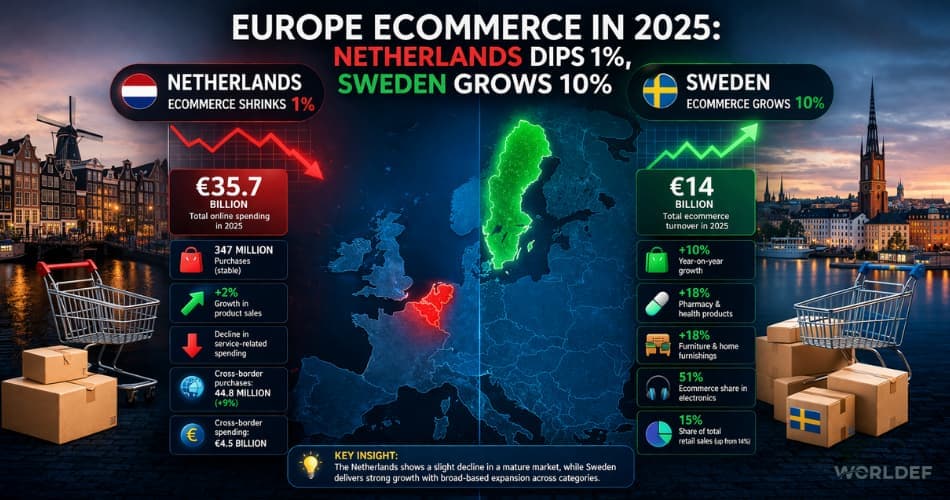
Two of the continent’s most advanced digital markets, the Netherlands and Sweden, moved in opposite directions, revealing a deeper shift in how e-commerce is evolving across mature economies. While Dutch e-commerce recorded a 1% decline, Sweden surged ahead with 10% growth, underscoring a widening gap between stabilization and expansion phases in Europe’s digital commerce landscape.

A Subtle Slowdown in the Netherlands

At first glance, a 1% drop in e-commerce spending in the Netherlands, totaling around €35.7 billion ,may appear like a warning sign. In reality, it tells a more nuanced story.

This is a market that has already reached high penetration levels. Growth is no longer driven by volume, but by structural shifts within consumer behavior.

Transaction volumes remained stable, and even more tellingly, online product sales continued to grow. Categories such as home & living, electronics, and toys maintained upward momentum. What dragged overall performance down was not demand, but a decline in service-related spending, a segment that had previously inflated e-commerce figures.

At the same time, Dutch consumers are increasingly looking outward. Cross-border e-commerce expanded rapidly, with spending reaching €4.5 billion. This signals a clear transition: domestic platforms are facing stronger competition as consumers turn to global marketplaces for price, variety, and convenience.

In essence, the Netherlands is not shrinking, it is rebalancing.

Sweden’s Return to Strong Growth

While the Netherlands adjusts to maturity, Sweden is moving with renewed energy.

E-commerce in Sweden grew by 10% in 2025, reaching approximately €14 billion, marking one of its strongest performances in recent years. Unlike the Dutch case, this growth is not selective, it is broad and consistent across sectors.

Health and pharmacy products saw particularly strong demand, alongside home furnishings ,both categories benefiting from long-term lifestyle shifts. Electronics, already a dominant segment, continued to deepen its online penetration, with more than half of purchases now happening digitally.

E-commerce’s share of total retail also edged higher, reaching 15%, reinforcing its role as a central pillar of Sweden’s retail economy rather than a complementary channel.

Sweden’s performance reflects more than recovery – it signals continued expansion in a still-developing digital retail environment.

Two Markets, Two Realities

Placed side by side, these markets highlight a critical truth: Europe’s e-commerce ecosystem is no longer moving in sync.

  • The Netherlands represents a post-growth market, where optimization, competition, and cross-border pressure define the next phase
  • Sweden reflects a growth-driven market, where penetration is still increasing and demand continues to expand

This divergence is not a contradiction – it is a natural evolution of e-commerce maturity.

The Strategic Shift Ahead

For e-commerce players operating in Europe, this split has clear implications.

Growth strategies that worked across the region five years ago are no longer universally effective.

  • In mature markets like the Netherlands, success will depend on differentiation, pricing strategy, and cross-border positioning
  • In growth markets like Sweden, the focus remains on scaling, category expansion, and customer acquisition

The era of “one Europe, one strategy” is over.

A Fragmented but Promising Future

Europe’s e-commerce future is not slowing down – it is becoming more complex.

Some markets are stabilizing, refining their structures and redefining growth drivers. Others are still accelerating, offering strong opportunities for expansion.

Understanding this two-speed dynamic will be essential for brands, marketplaces, and investors navigating the next phase of global e-commerce.

Because in 2025, the real story is not whether e-commerce is growing, but where, how, and why.

Source:

Ecommerce News Europe