WORLDEF Istanbul 2026 - Upcoming Event

Register Now

Vietnam’s E-Commerce Records Positive 47% Surge, Reaching $5.6B in Q1 2026

Vietnam’s E-Commerce Records Positive 47% Surge, Reaching $5.6B in Q1 2026

Vietnam’s e-commerce sector continued its rapid expansion in the first quarter of 2026, reinforcing the country’s position as one of Southeast Asia’s fastest-growing digital markets.

According to recent market data, total gross merchandise value (GMV) across Vietnam’s leading e-commerce platforms reached nearly VND148.6 trillion ($5.64 billion) during Q1 2026, representing a strong 47% year-on-year increase. The growth reflects rising consumer confidence, expanding platform competition and the increasing influence of social commerce in the country’s retail ecosystem.

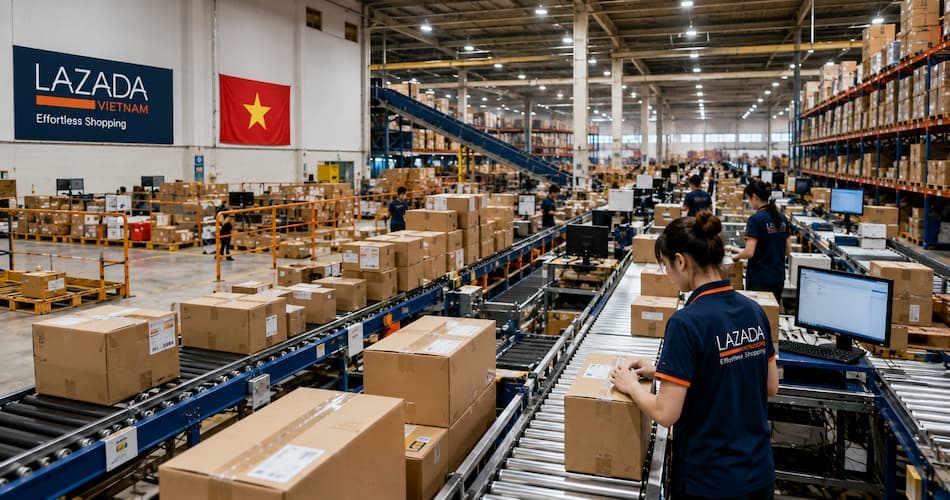
Major platforms including Shopee, TikTok Shop, Lazada and Tiki continued to dominate the market, while livestream commerce and short-form video shopping became key drivers of online consumer engagement.

The number of online transactions also grew significantly during the quarter, surpassing 1.14 billion products sold. Vietnamese consumers spent an average of nearly $63 million per day on e-commerce platforms, highlighting the growing importance of digital retail channels in daily purchasing habits.

Beauty and personal care products emerged as the strongest-performing category, generating more than VND24.4 trillion in revenue. Women’s fashion and home-related products also remained among the top-selling segments. At the same time, men’s fashion recorded one of the fastest growth rates in the market, signaling changing consumer behavior and stronger demand for lifestyle-focused online shopping.

Social Commerce and Livestream Shopping Reshape Vietnam’s Market

Vietnam’s e-commerce growth is increasingly being fueled by social commerce strategies. Platforms are investing heavily in livestream shopping, creator-driven sales and short-video content to increase customer engagement and conversion rates.

TikTok Shop continues to rapidly expand its market share through “shoppertainment” strategies, while Shopee strengthens its position through integrated creator partnerships and platform-wide promotional campaigns. Analysts note that video-led commerce is becoming one of the defining trends of Vietnam’s digital economy.

Industry experts also highlight that Vietnam’s young digital-first population, improving logistics infrastructure and growing mobile internet penetration are creating strong long-term opportunities for online retail growth.

As Southeast Asia’s e-commerce competition intensifies, Vietnam is increasingly positioning itself as one of the region’s most dynamic and high-potential digital commerce markets for both local and international brands.

Source

Vietnam’s $31B E-Commerce Market Holds 85% Untapped Cross-Border Opportunity

Vietnam’s $31B E-Commerce Market Holds 85% Untapped Cross-Border Opportunity

Vietnam’s e-commerce market has reached a defining moment. Valued at $31 billion, it is one of the fastest-growing digital economies in Southeast Asia driven by high internet penetration, mobile adoption, and a new generation of online consumers.

But behind this rapid growth lies a striking imbalance.

An estimated 85% of cross-border e-commerce potential remains untapped, revealing a significant gap between Vietnam’s domestic success and its global reach.

A Market Growing Inward, Not Outward

Vietnam has all the ingredients of a global e-commerce exporter. Its manufacturing base is strong, its workforce is competitive, and its digital adoption continues to accelerate.

Yet most of this growth remains concentrated within national borders.

While local platforms and domestic demand are expanding, international channels where higher margins and long-term brand value exist are still underutilized. For a country deeply integrated into global trade, this disconnect is increasingly difficult to ignore.

The Missing Link: From Production to Brand

One of the core challenges lies in how Vietnamese businesses operate globally.

A large portion of exports still follows a contract manufacturing model, where products are produced locally but sold under foreign brands. This limits visibility, pricing power, and long-term value creation.

Cross-border e-commerce offers a different path one where companies can build their own brands, engage directly with consumers, and control the full customer journey.

But making that shift requires more than supply it requires strategy.

Logistics Still Defines the Limits

Despite progress, logistics remains the biggest constraint.

Cross-border delivery costs, customs complexity, and fragmented infrastructure continue to slow down international expansion. For many SMEs, these barriers create uncertainty, making domestic growth the safer option.

At the same time, limited experience in digital marketing, marketplace management, and international compliance further widens the gap.

In other words, the opportunity is clear but execution remains uneven.

A Shift Already in Motion

There are early signs of change.

Vietnamese sellers are increasingly entering global marketplaces, particularly in categories like fashion, home goods, and lifestyle products. Awareness around cross-border opportunities is rising, and more businesses are exploring direct-to-consumer models.

The mindset is evolving from exporting products to building global businesses.

Policy Could Be the Turning Point

Government initiatives may accelerate this transition.

With a new e-commerce law expected to take effect in 2026 and a broader digital economy roadmap in place, Vietnam is working to create a more structured and supportive environment for cross-border trade.

If these efforts translate into better logistics, clearer regulations, and stronger SME support, the country could unlock a significant portion of its untapped potential.

From Opportunity to Advantage

Vietnam does not lack demand, supply, or capability.

What it lacks at least for now is full alignment between its domestic momentum and global ambition.

Closing that gap could redefine the country’s role in global e-commerce. Because in today’s market, success is no longer about how fast you grow locally but how effectively you scale internationally.

Source