WORLDEF Prime Antalya 2026 - Upcoming Event

Register Now

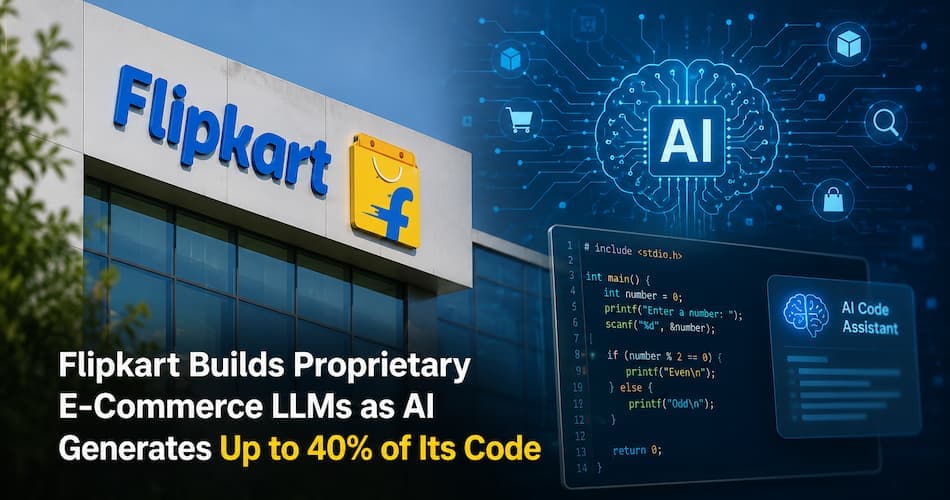
Flipkart Builds Proprietary E-Commerce LLMs as AI Generates Up to 40% of Its Code

Flipkart Builds Proprietary E-Commerce LLMs as AI Generates Up to 40% of Its Code

Walmart-owned Flipkart is deepening its artificial intelligence strategy by developing specialised e-commerce large language models (LLMs), with AI now generating nearly 40% of the company’s software code. The move highlights the growing role of AI as a core operating layer in modern commerce platforms.

India’s e-commerce giant has deployed more than 250 AI models across its ecosystem, according to Chief Product and Technology Officer Balaji Thiagarajan. The company is integrating AI across customer experiences, seller services, engineering processes, and operational workflows, positioning itself at the forefront of AI-driven retail innovation.

Speaking to Moneycontrol, Thiagarajan revealed that approximately 35–40% of Flipkart’s software code is already being generated by AI-powered tools. The company is also building what it describes as an “agentic e-commerce platform,” combining frontier AI technologies with proprietary models tailored specifically for commerce use cases.

How Flipkart Is Applying AI Across Its E-Commerce Ecosystem

Flipkart believes its long-term competitive advantage will come from specialised e-commerce models trained on its own data and operational expertise rather than relying solely on general-purpose AI systems. The company is using AI to enhance product discovery, conversational shopping experiences, catalogue enrichment, seller tools, customer support, and internal productivity systems.

Among its AI-powered initiatives is Seller Lens, a platform that helps merchants manage and grow their businesses through AI-driven insights. Flipkart is also deploying voice-based AI agents that currently make around 90,000 personalised calls each month to sellers for payment reminders, operational updates, and business recommendations. The company expects these volumes to increase significantly in the future.

To accelerate its AI transformation, Flipkart has strengthened its leadership team by recruiting senior executives from companies including Amazon, Coupang, Tata Digital, Razorpay, Swiggy, and Mastercard. The hires span engineering, product, supply chain, and data science functions, reflecting the company’s ambition to scale AI capabilities across the organisation.

Despite the substantial investments required for generative AI, Flipkart says its current priority is governance rather than immediate financial returns. The company is focusing on areas such as content moderation, response quality, human oversight, and reinforcement learning while measuring success through business metrics including conversion rates, customer engagement, basket sizes, demand forecasting accuracy, and inventory performance.

Flipkart’s AI push comes amid intensifying competition across the global e-commerce sector, where retailers are increasingly adopting artificial intelligence to improve efficiency, personalise shopping experiences, and automate operations. The company’s strategy signals a broader industry shift toward specialised, domain-specific AI systems that can reshape how commerce platforms are built and operated in the years ahead.

Source: Moneycontrol

Amazon Accelerates Against Walmart; Launches 1- and 3-Hour Fast Delivery in the U.S.

Fast Delivery

Amazon has taken a new step that redefines delivery speed in the United States. By introducing 1-hour and 3-hour delivery options across many markets, including major metropolitan areas such as Los Angeles and Chicago, the company has taken its competition with Walmart in fast delivery to a new stage.

According to information shared by Amazon, the new model was built on top of its same-day delivery infrastructure. Under the new service, customers can order more than 90,000 products, ranging from daily essentials to electronics, in a much shorter time. Amazon states that 1-hour delivery is available in hundreds of cities and towns, while the 3-hour delivery option is accessible in more than 2,000 locations.

Fast Delivery Is Now a New Growth Tool

For Amazon, this move is not only about logistics, but also a commercial strategy aimed at increasing basket size and shopping frequency. The company had previously launched a model called “Amazon Now” in certain parts of Seattle and Philadelphia, offering grocery and everyday essentials delivery in 30 minutes or less.

A New Operational Order Has Been Established

In order to manage these short delivery windows, the company created dedicated workstations within its existing same-day delivery centers. Yellow labels began to be used for the rapid sorting of packages, and on-site signage was also updated to guide delivery partners. Amazon also launched a new “get it fast” page to help users find eligible products more easily.

Prime Has an Advantage, but It Is Not Free

The new fast delivery model is offered for an additional fee. Prime members pay $9.99 for 1-hour fast delivery and $4.99 for 3-hour delivery. For customers without a Prime membership, the fees stand at $19.99 and $14.99, respectively. This shows that while Amazon is strongly playing the speed card, it is also trying to preserve profitability.

Walmart Pressure Was the Decisive Factor

Amazon’s timing is not a coincidence. According to the AP, Walmart says it can provide same-day fast delivery in under 3 hours to approximately 95 percent of the U.S. population. The company is also expanding its drone delivery network. This picture shows that in U.S. retail, competition measured in minutes for delivery has now been added to price competition.

A New Era in Retail: The Cost of Speed

The latest development reveals that customer expectations in e-commerce have now reached the point of delivery not only “the next day,” but “the same day or even within a few hours.” However, the expansion of this model will also bring new debates, including logistics costs, the burden of urban operations, and pressure on small retailers. Amazon’s latest move clearly shows that in U.S. retail, speed is no longer a privilege, but has become an area of strategic competition.