WORLDEF ISTANBUL 2026 - Upcoming Event

Register Now

Amex Introduces 5 Key Features in a Positive Agentic Commerce Development Kit Launch

Amex Introduces 5 Key Features in a Positive Agentic Commerce Development Kit Launch

American Express has unveiled a new developer toolkit designed to accelerate the adoption of agentic commerce, an emerging model where artificial intelligence agents can independently execute transactions on behalf of users. The launch signals a major step toward integrating AI-driven automation into the global payments ecosystem.

The newly introduced Agentic Commerce Experiences (ACE) Developer Kit provides a framework for developers to connect AI-powered agents with American Express payment infrastructure. The initiative aims to enable secure, seamless, and trusted transactions in environments where AI agents assist or act on behalf of consumers.

Agentic commerce represents a shift from traditional digital shopping toward autonomous systems capable of discovering products, evaluating options, and completing purchases without direct human interaction at every step.

Five Core Components Powering Agentic Transactions

The ACE Developer Kit introduces five key capabilities designed to support AI-led commerce:

  • Agent verification: Ensures that only authorized AI agents can initiate transactions
  • Account enablement: Allows users to register and link their payment credentials
  • Intent intelligence: Captures and validates user purchase intent
  • Secure payment credentials: Enables tokenized transactions executed by verified agents
  • Cart context sharing: Provides transaction transparency and supports dispute resolution

These features are designed to create a structured and secure framework where AI agents can operate within defined boundaries, ensuring both user control and transaction integrity.

Building Trust in Autonomous Commerce

A key challenge in agentic commerce is trust particularly when transactions are executed by AI rather than directly by users. To address this, American Express has introduced what it describes as an industry-first protection model.

Under this commitment, customers will be protected from financial losses caused by errors made by authorized AI agents, provided that the transaction includes verified purchase intent. This approach aims to reduce friction and increase confidence in AI-driven transactions.

The focus on trust, control, and visibility reflects broader industry concerns around the reliability and accountability of autonomous systems in financial services.

A Strategic Bet on the Future of Commerce

American Express views agentic commerce as a transformative shift comparable to earlier digital milestones such as the rise of the internet and mobile commerce. As AI agents become more capable, they are expected to reshape how consumers discover products, plan purchases, and complete transactions.

The company is already collaborating with major technology and payments players, including AI platforms and global payment providers to establish standards and protocols for this emerging ecosystem.

These partnerships highlight the growing importance of interoperability and shared frameworks in enabling scalable agent-based commerce.

Market Implications

The launch of the ACE Developer Kit signals a broader transition toward AI-native commerce models, where automation plays a central role in the customer journey. For businesses, this shift presents both opportunities and challenges.

On one hand, agentic commerce can streamline operations, improve efficiency, and unlock new revenue streams. On the other, it requires robust infrastructure, standardized data, and strong governance frameworks to ensure trust and compliance.

As financial institutions and technology providers continue to invest in AI-driven commerce, the competitive landscape is likely to evolve rapidly. Companies that successfully integrate secure, intelligent automation into their platforms will be better positioned to lead in the next phase of digital commerce.

Source: Finextra

For more global e-commerce and digital economy news, visit WORLDEF.

Saudi Arabia’s 85% E-Payments Milestone Signals Positive Digital Payment Boom

Saudi Arabia’s 85% E-Payments Milestone Signals Positive Digital Payment Boom

Saudi Arabia is rapidly moving toward a cashless economy, with electronic payments now representing 85% of total retail transactions in 2025, marking a significant leap in the Kingdom’s digital transformation journey. This milestone highlights the accelerating adoption of fintech solutions and the success of long-term government strategies aimed at reducing cash dependency.

The growth builds on strong momentum from previous years. In 2024, electronic payments already accounted for 79% of retail transactions, up from 70% in 2023, reflecting a steady and consistent shift toward digital payment methods.

This rapid adoption is largely driven by Saudi Arabia’s Vision 2030 initiative, which prioritizes financial innovation and aims to create a fully digital economy. Government-backed programs, combined with the expansion of payment infrastructure, have made digital transactions more accessible and convenient for both consumers and businesses.

E-Payments Drive Saudi Arabia’s Digital Economy Transformation

A key factor behind this growth is the widespread use of mobile wallets, contactless payments, and real-time banking solutions. Platforms like mada, SADAD, and sarie have significantly improved transaction speed and reliability, encouraging consumers to move away from cash. At the same time, smartphone penetration and internet accessibility have enabled seamless adoption across urban and rural areas.

E-commerce growth has also played a major role. As online shopping continues to expand in the Kingdom, digital payment methods have become the default option for transactions. Retailers are increasingly integrating advanced payment technologies to meet consumer expectations for speed, security, and convenience.

In addition, the rise of fintech companies is intensifying competition and innovation within the sector. Saudi Arabia had over 200 licensed fintech firms by 2024, with ambitions to significantly increase this number in the coming years. This dynamic ecosystem is contributing to the development of new payment solutions, including buy-now-pay-later (BNPL), embedded finance, and cross-border payment systems.

Despite this strong progress, challenges remain. Cybersecurity concerns, regulatory complexities, and the need for continuous infrastructure upgrades require ongoing attention. However, collaboration between regulators, banks, and fintech players continues to strengthen the overall ecosystem.

Looking ahead, Saudi Arabia is well-positioned to become one of the leading digital payment markets globally. The shift toward cashless transactions is not just a technological change, it represents a broader transformation in consumer behavior and financial systems. As adoption continues to rise, digital payments are expected to play an even more central role in shaping the future of commerce in the region.

Source

MBME Pay Receives Prestigious Payment Service Provider License from the CBUAE

MBME Pay

MBME Pay, a wholly owned subsidiary of MBME Group PJSC, has received a “Payment Service Provider” license from the Central Bank of the UAE (CBUAE) to conduct merchant acquiring and payment aggregation activities.

The license places MBME Pay among an exclusive group of fully regulated payment service providers in the UAE. It reflects the strength of MBME Pay’s infrastructure, its rigorous compliance framework, and its strategic ambition to power the next generation of digital commerce.

“MBME Pay is in a Unique Position in Digital Payments”

Abdelhadi Mohamed, CEO of MBME Group, said: “This is not only a regulatory milestone; it is a strong vote of confidence in our vision and capabilities. With the Central Bank license, MBME Pay is uniquely positioned to accelerate the transition to a cashless economy in the UAE and across the MENA region, while setting new standards for reliability, security, and customer experience in digital payments.”

A Fully Licensed, End-to-End Digital Payments Partner

With the CBUAE license, MBME Pay will now be able to provide end-to-end merchant acquiring solutions, from onboarding to settlement. It will also be able to operate as a licensed payment aggregator across multiple channels. The company will deliver secure, scalable, and compliant transaction processing services for high-volume and fast-growing businesses. It will support businesses, SMEs, and government entities in accelerating the transition to a cashless and digitally enabled economy.

MBME Pay offers merchants a single, trusted partner through which they can manage their entire payments journey. Its services include onboarding, integration, risk and fraud controls, transaction processing, and ongoing support, all within a strong and transparent regulatory framework.

Supporting E-Commerce, Retail, and Innovative Payment Experiences

MBME Pay sits at the center of a dynamic technology ecosystem that connects consumers, merchants, and institutions. Through this ecosystem, the company integrates advanced payment technologies, APIs, financial services, and digital platforms into a unified and regulated structure.

It supports innovative payment experiences across e-commerce, retail, services, and government channels. It enables secure and frictionless payments tailored to the evolving expectations of businesses and consumers across the UAE and the wider MENA region.

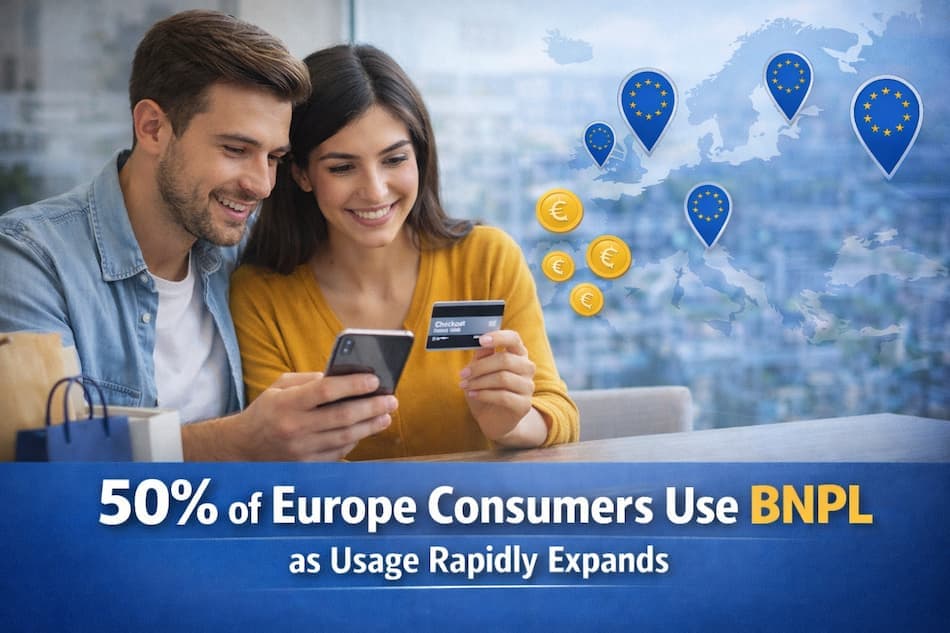
50% of European Consumers Use BNPL as Usage Rapidly Expands

50% of European Consumers Use BNPL as Usage Rapidly Expands

Half of European consumers adopt BNPL

Buy Now, Pay Later (BNPL) services are now used by 50% of consumers across Europe, according to data published by Ecommerce News Europe.

The report shows that BNPL has moved into the mainstream, with many consumers using these services multiple times per year as part of their regular online shopping behavior.

Adoption differs by market

Despite strong overall uptake, usage varies significantly between countries.

In markets such as Switzerland, BNPL penetration remains lower, with roughly one in four consumers using these services. The gap highlights the influence of local financial habits, credit culture, and regulatory frameworks across Europe.

Flexible payments reshape checkout

The growth of BNPL reflects a broader shift in payment preferences.

Installment-based options often interest-free are increasingly integrated into the checkout experience, offering consumers greater flexibility compared to traditional credit products. As a result, payment methods are playing a more central role in purchase decisions.

Regulatory scrutiny increases

The expansion of BNPL has drawn attention from regulators across the region.

Authorities are assessing the need for stricter consumer protection measures, including improved transparency, clearer terms, and stronger affordability checks. Proposed updates to consumer credit rules are expected to address gaps related to BNPL services.

Merchants respond to demand

For online retailers, BNPL is becoming a standard feature rather than an optional add-on.

Merchants are integrating these solutions to support conversion and align with evolving consumer expectations, while also navigating compliance requirements as regulatory oversight increases.

Source
Read more on WORLDEF.

Kuwait Expands Fintech Reach Across 4 Global Markets with New E-Trading Platform

Kuwait’s financial sector is taking another step toward digital transformation with the launch of a new e-trading platform by Kuwait Financial Centre (Markaz). The initiative reflects a broader shift across the Gulf, where investor expectations are rapidly evolving toward seamless, digital-first experiences.

The newly introduced iMarkaz Invest platform is designed to enhance access to both regional and global markets, including Kuwait, Saudi Arabia, the UAE, and the United States.

This move signals Kuwait’s growing ambition to position itself as a competitive fintech hub within the region.

A New Standard for Digital Trading Experience in Kuwait

The platform combines real-time data, an intuitive interface, and simplified onboarding – key features increasingly demanded by modern investors.

Users can monitor portfolios in real time, access multiple markets, and complete account setup through a streamlined digital process.

Unlike traditional trading systems, iMarkaz Invest also integrates with wealth management services, offering a hybrid model that blends self-directed investing with advisory support.

This reflects a broader industry trend where platforms are no longer just transactional tools but full-service investment ecosystems.

Expanding Access Beyond Borders

One of the platform’s most strategic elements is its cross-border reach. By enabling access to international markets, it supports portfolio diversification while maintaining a local entry point for investors.

This aligns with rising demand across the GCC for global investment exposure, particularly as regional investors increasingly look beyond domestic markets.

At the same time, the platform’s development highlights how fintech solutions are becoming essential in connecting regional capital with global opportunities.

What This Means for the Region

The launch of iMarkaz Invest is more than a product update – it reflects a structural shift in how financial services are delivered in Kuwait and across the wider Middle East.

As digital adoption accelerates, financial institutions are being pushed to:

  • enhance user experience
  • offer real-time capabilities
  • expand cross-border access

Platforms like this are setting a new benchmark, where speed, accessibility, and integration define competitiveness.

Source: MENA Fintech

Explore more fintech news and insights on WORLDEF.

Phoenix Venture Partners Completed the Third Closing of Its First Fund

Phoenix Venture Partners (PVP)

UAE-based venture capital firm Phoenix Venture Partners (PVP) completed the third closing of its first fund, the Phoenix Venture Partners Innovation Fund. At this stage, the company added new investors from the United States, France, Saudi Arabia, Kuwait, and the United Arab Emirates to the fund structure.

The new investor group included institutional investors, single-family offices, and high-income individual investors. This development showed that international interest in innovation-focused ventures in the Gulf and MENA region continues.

Phoenix Venture Focuses on Early-Stage Ventures

Phoenix Venture Partners’ fund invests in early-stage ventures operating in areas such as fintech, healthtech, edtech, mobility, agrifood, energy, and consumer technologies. Although the fund’s main focus is the MENA region, the company is turning toward business models with growth potential on a global scale.

PVP continues to deploy capital especially into ventures developing scalable technology solutions and carrying high growth potential. With the goal of supporting the new generation of founders in the region, the company will keep the fund open to new commitments until its final closing in October 2026.

The Second Closing Came Last Year

The company had completed the second closing of its $50 million inaugural fund in March last year. With the third closing, Phoenix Venture Partners appears to have both expanded its investor base and increased its influence in the Gulf-based entrepreneurship ecosystem.

PVP Founder and CEO Steve Khayat emphasized that investor confidence has continued despite current regional sensitivities, noting that this demonstrates the resilience of the GCC venture capital ecosystem. Khayat also stated that the company will continue to support the regional entrepreneurship network, particularly Abu Dhabi Global Market (ADGM).

UAE Leads the MENA Startup Ecosystem: $162.8 Million Investment in February

Startup

The startup ecosystem in the Middle East and North Africa (MENA) received a total of $326.6 million in investment in February 2026. According to the latest report published by Wamda, although there was a slowdown in investment activity compared to the beginning of the year, venture capital activity in the region continues to remain strong.

While 62 investment deals took place in February, nearly half of the investment went to startups based in the United Arab Emirates (UAE). In the UAE, 23 startups raised a total of $162.8 million, maintaining the country’s position as the most active startup hub in the region.

The UAE was followed by Saudi Arabia, where 25 startups raised a total of $87.7 million in investment. Egypt ranked third with $64 million across 6 investment rounds. A large portion of the investment volume in Egypt was driven by a single late-stage funding round.

Fintech Startups Lead

From a sectoral perspective, fintech startups maintained their leadership. Fintech companies in the region raised a total of $94.7 million across 14 funding rounds. According to experts, the strong performance of fintech is closely related to the development of digital payment infrastructure in the region, the digitization of financial services, and the growth of lending platforms.

Following fintech, the e-commerce sector once again became one of the top sectors receiving investment. In particular, Breadfast’s $50 million investment pushed the sector’s total funding to $52 million. Deeptech startups ranked third, attracting $51 million in funding across only two investment rounds.

Investment Rounds Focused on Early-Stage Startups

Another notable development in February was that investment rounds were largely directed toward early-stage startups. A total of 49 early-stage startups in the region raised $136.4 million in investment. In contrast, the absence of mega funding rounds seen earlier in the year led to a decline in the overall investment volume for the month.

The report also highlighted that investor interest was largely concentrated on B2B startups. B2B-focused startups attracted $137 million across 38 deals, while B2C startups raised $62 million in funding.

Meanwhile, the report also revealed that gender inequality in startup funding in the region continues. In February, female-founded startups did not receive any investment, while only three startups with mixed-gender founding teams raised $14 million in funding.

The MENA Startup Ecosystem Will Continue to Grow

According to experts, the temporary slowdown in investment volume does not mean that the market is weakening. It is noted that several regional venture capital funds created new investment vehicles at the end of 2025, leaving a significant amount of available capital (dry powder) in the market. This indicates that the MENA startup ecosystem will continue to grow in the long term.

Ubuy Launches Installment Shopping in Cross-Border E-Commerce with Tabby Partnership

Ubuy

Ubuy, the cross-border e-commerce platform operating in the Gulf region, has started offering the “buy now, pay later” (BNPL) model to users in the United Arab Emirates and Saudi Arabia through a new integration with the payment technology company Tabby. The new payment option has been activated on both the Ubuy UAE and Ubuy Saudi Arabia platforms.

With this integration, users will be able to purchase millions of international products available on the platform with installment payment options. Under the model offered by Tabby, purchases can be split into up to four installments. While no interest or additional fees are applied in three-installment plans, a small transaction fee may apply for four-installment plans. The payment process also moves very quickly; after selecting the Tabby option on the payment page, users can receive instant approval and complete their purchases, while the remaining payments are automatically scheduled by the system.

BNPL Solutions Are Rapidly Expanding

In recent years, BNPL solutions have been rapidly expanding in the Gulf countries. The increasing preference of young and digitally focused consumers for flexible payment options is encouraging e-commerce platforms to invest more in alternative financing models. According to market research, the BNPL market in the Middle East and North Africa is expected to reach a value of billions of dollars in the coming years.

Ubuy Aims to Expand Its User Base in the Gulf Market

Dhari AlAbdulhadi, the founder and CTO of Ubuy, stated that customer experience is at the center of the company’s growth strategy, noting that the Tabby integration increases users’ financial flexibility and makes international shopping more accessible. The company aims to expand its user base in the Gulf market by combining global product access with regional payment solutions.

Operating across categories such as electronics, fashion, beauty, and home & living, Ubuy enables consumers to access products from different parts of the world quickly and easily through its cross-border e-commerce model with its wide product range.

PayPal and NEO PAY Forge Strategic Partnership to Support E-Commerce in the UAE

paypal and neopay strategic partnership

PayPal has formed a strategic partnership with UAE-based digital payment provider NEO PAY. The collaboration aims to enable businesses in the UAE to accept PayPal payments, while also helping small businesses in the region accelerate cross-border e-commerce.

PayPal and NEO PAY have established this partnership to integrate PayPal’s payment gateway into NEO PAY’s acquiring infrastructure. This collaboration is designed to streamline merchant onboarding and open international markets for local businesses, particularly targeting small and medium-sized enterprises (SMEs).

“A Critical Step in PayPal’s Regional Growth Strategy”

Otto Williams, Senior Vice President and Regional General Manager for the Middle East and Africa at PayPal, described the partnership as a “critical step” in the company’s regional growth strategy. Emphasizing the UAE’s advanced digital economy and rapidly growing e-commerce sector, Williams noted that this collaboration would enable SMEs to better serve today’s digital-first consumers.

“The UAE is a digitally advanced economy with a rapidly growing e-commerce sector,” said Williams. “By integrating PayPal, merchants can trade more efficiently with international buyers and scale with confidence.”

Supporting Cross-Border Growth for Merchants

NEO PAY, a digital payment services provider, aims to help merchants navigate the complexities of modern e-commerce through this partnership. Vibhor Mundhada, CEO of NEO PAY, expressed his excitement about the collaboration, stating, “This partnership will enhance the payment checkout experience by offering merchants secure, trusted, and globally recognized payment options, while supporting their cross-border growth.”

This collaboration aims to solidify the UAE’s position as a regional digital commerce hub, while advancing the country’s financial inclusion and digital transformation goals. By simplifying payment processes and increasing access to global markets, PayPal and NEO PAY seek to play a significant role in the future of the UAE’s e-commerce ecosystem.

The UAE’s e-commerce sector is growing rapidly, and according to Mordor Intelligence, the sector is expected to reach a value of $21.18 billion by 2030. Currently, 94% of companies in the UAE are small businesses, contributing to more than half of the country’s GDP. By adopting Pay Pal’s trusted payment gateway, these businesses can potentially increase conversion rates and build trust with international customers.

PayPal Is Acquiring Cymbio to Expand Its Agentic Commerce Capabilities

PayPal announced that it has agreed to acquire the multi-channel commerce orchestration platform Cymbio in a move aimed at accelerating its agentic commerce strategy.

PayPal’s decision to acquire Cymbio was built on the existing partnership between the two companies. This step aims to enable merchants to sell more effectively across artificial intelligence–powered shopping environments and traditional e-commerce channels. The transaction is expected to be completed in the first half of 2026, subject to customary closing conditions. Financial details of the deal were not disclosed.

Agentic Commerce Is Being Strengthened

PayPal stated that this acquisition would increase its capacity to support the agentic commerce model, in which artificial intelligence–powered interfaces play an active role in product discovery, purchasing, and payment processes. Cymbio’s technology enables brands to distribute and manage their product catalogs across multiple digital touchpoints, including emerging AI-based shopping surfaces.

Michelle Gill, Executive Vice President and General Manager of Small Business and Financial Services at PayPal, said that PayPal is positioned as a key commerce partner for merchants looking to sell on leading artificial intelligence platforms. Gill stated that bringing Cymbio’s technology and team into PayPal would accelerate the scaling of agentic commerce services to a broader merchant base.

PayPal’s agentic commerce services and payment solutions are currently available for merchants selling through Microsoft Copilot and Perplexity. The company confirmed that these capabilities would soon be expanded to OpenAI’s ChatGPT and Google’s Gemini platform as well.

The Role of Cymbio Within PayPal

Following the acquisition, Cymbio’s team and technology are expected to support Store Sync, one of PayPal’s core agentic commerce services. Store Sync ensures that merchants’ product data is discoverable across artificial intelligence–powered shopping channels while also maintaining operational continuity.

Through Store Sync, merchants are able to route orders directly to their existing fulfillment, inventory, and order management systems. PayPal emphasized that merchants will continue to remain the merchant of record, retain ownership of customer relationships, and maintain control over their brands.

Brands such as Abercrombie & Fitch, Fabletics, Ashley Furniture, Newegg, and Adorama were actively using Store Sync integrations on Microsoft Copilot and Perplexity at the time of the announcement.

Expanding Multi-Channel Access for Merchants

Founded in 2015 and headquartered in Tel Aviv, Cymbio offers a platform specialized in multi-channel commerce orchestration. The platform automates complex processes such as product data management, inventory synchronization, order routing, and billing across marketplaces, retailers, social commerce platforms, and artificial intelligence–powered shopping experiences.

PayPal stated that Cymbio’s more than a decade of experience in brand integration and marketplace connectivity would strengthen its own commerce ecosystem. By reducing operational friction and providing merchants with a unified view of sales channels, this integrated structure aims to help brands expand their reach, increase efficiency, and adapt to changing consumer shopping behaviors.

This acquisition also aligns with PayPal’s strategy to assume a central role in the next-generation commerce model, in which artificial intelligence agents are becoming increasingly influential in consumers’ product discovery and purchasing decisions.

Strategic Context and Market Position

PayPal emphasized that agentic commerce represents a significant transformation in digital retail as artificial intelligence platforms become more central to consumer decision-making processes. With the integration of Cymbio’s orchestration technology, PayPal aims to enable merchants to participate in these new sales channels without compromising control over fulfillment, brand presentation, or customer data.

The company stated that, thanks to its global scale operating in approximately 200 markets, it is able to provide merchants with consistent payment, checkout, and commerce services as new sales surfaces emerge. The acquisition was positioned as a step toward making artificial intelligence–powered commerce more accessible and operationally viable for businesses of different sizes.

The parties announced that the transaction is expected to be finalized in the first half of 2026 following the completion of regulatory approvals and other standard closing conditions. Until completion, PayPal and Cymbio are planned to continue operating under their existing partnership structure.

Once the acquisition is completed, PayPal is expected to further deepen its agentic commerce infrastructure and strengthen its role in supporting merchants as artificial intelligence–powered platforms become an increasingly important channel in global online shopping.

PayPal to Embed Digital Wallet in ChatGPT via OpenAI Partnership