WORLDEF Istanbul 2026 - Upcoming Event

Register Now

Marketplaces Account for 83.4% of Global E-Commerce Revenues

marketplace

The popularity of marketplaces, which dominate the global e-commerce ecosystem, continues at full speed. Third-party marketplaces are gaining strength globally. Marketplaces account for 83.4% of global e-commerce gross merchandise value (GMV). As of 2025, the share of first-party online stores remained at only 16.6%.

E-commerce is no longer just about running your own online store. Around the world, marketplaces are playing a significant role in shaping how consumers shop. E-Commerce Database (ECDB), a market intelligence platform that provides data on global e-commerce, has released some data for 2025.

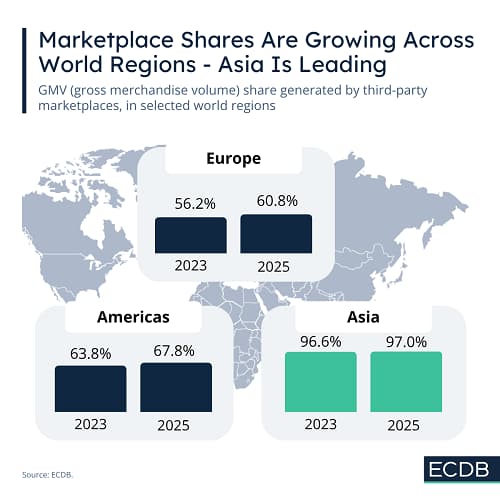
According to ECDB data, third-party marketplaces are steadily increasing their popularity worldwide. While marketplace penetration in Europe stands at 60.8%, a mixed picture emerges in the Americas. In Asia, 97% of e-commerce revenues are generated through marketplaces. 83.4% of global gross merchandise value is generated through marketplaces.

Marketplaces Dominate Global E-Commerce

Marketplaces are becoming increasingly widespread on a global scale. The share of revenue generated through third-party marketplaces within global e-commerce revenues is also increasing. In 2023, 19% of global e-commerce revenues were generated by online stores. This rate declined to 16.6% as of 2025. In contrast, revenues generated through global marketplaces increased from 81% to 83.4%.

Asia Leads in Marketplace Shares

Asia stands apart from all continents with its marketplace dominance. The share of marketplaces in Asia’s e-commerce revenues reached 97% in 2025. The reason for this is that major platforms played a central role in building e-commerce infrastructure in the region. Marketplaces created habits that continue to influence online shopping today.

Marketplaces Account for 61% of European E-Commerce

A large majority of online transactions in Europe take place through marketplaces. In 2025, marketplaces accounted for 60.8% of total e-commerce gross merchandise value (GMV). The GMV share of marketplaces in Europe stood at 56.2% in 2023. Europe still lags behind other parts of the world because many heritage brands on the continent traditionally focus on direct-to-consumer (D2C) sales or their own online stores.

A Mixed Picture Prevails in the Americas

In the Americas, the picture is more complex. North American brands still rely heavily on their own online stores. South American consumers prefer large marketplaces such as MercadoLibre and Shopee. In many emerging markets, most of the GMV flows through these ecosystems. The GMV share of marketplaces in the Americas reached 67.8% last year.

5 Strategic Gains as Ministry Advances E-Commerce Strategy with Regional Digital Trade Project

5 Strategic Gains as Ministry Advances E-Commerce Strategy with Regional Digital Trade Project

A government ministry has highlighted significant progress in its national e-commerce strategy while officially launching a new regional digital trade initiative aimed at accelerating economic integration and digital transformation.

The newly introduced “Digital Trade in the Southern Mediterranean Region” project represents a major step toward building a unified digital commerce ecosystem across multiple countries. The initiative is supported by the European Union and the German government, and implemented in partnership with international development agencies.

Strengthening Regional Digital Trade

The project will be rolled out across Jordan, Egypt, Morocco, and Tunisia, while also enabling knowledge exchange with countries such as Libya, Lebanon, Palestine, and Algeria.

Its primary objective is to enhance regional economic integration by improving countries’ readiness to participate in the global digital trade system. The initiative reflects a shared vision among participating nations to align with rapidly evolving global commerce trends and digital transformation priorities.

5 Key Pillars Driving the Strategy

The regional project is structured around five core pillars:

  • Development of national e-commerce strategies
  • Enhancement of digital tools and infrastructure
  • Facilitation of cross-border e-commerce
  • Empowerment of the private sector
  • Knowledge-sharing and regional collaboration

These pillars are designed to create a more inclusive and scalable digital economy, particularly for emerging markets.

Supporting SMEs and Digital Entrepreneurs

A major focus of the strategy is enabling small and medium-sized enterprises (SMEs) to enter and scale within the digital economy.

Programs such as EcomConnect and Click-Business have already supported businesses by providing access to e-commerce platforms, digital tools, and targeted training initiatives.

Additionally, collaborations with universities and institutions such as the TechForward initiative involving 12 universities are helping align education with private sector needs in areas like artificial intelligence, fintech, and digital platforms.

Building a Future-Ready Digital Economy

The ministry emphasized that these efforts are part of a broader strategy to ensure long-term economic resilience and competitiveness. By investing in digital trade infrastructure and cross-border collaboration, the initiative aims to position participating countries as active players in the global digital economy.

Source

Tabby’s UAE Wallet Licence Unlocks 3 Major Fintech Growth Opportunities

Tabby’s UAE Wallet Licence Unlocks 3 Major Fintech Growth Opportunities

Middle East fintech leader Tabby has taken a major step toward becoming a full-scale financial platform after securing a Stored Value Facilities (SVF) licence from the Central Bank of the UAE.

The licence allows Tabby to hold customer funds and offer a broader range of financial services, marking a strategic shift beyond its core Buy Now, Pay Later (BNPL) model.

A shift from BNPL to full financial ecosystem

With this approval, Tabby will introduce new products including spending accounts, payment cards, and money management tools.

This move signals a clear transformation: from a payments solution into a comprehensive financial super app. Users who already rely on Tabby for flexible payments will soon be able to manage daily financial activities from spending to transfers within a single platform.

The company’s CEO, Hosam Arab, emphasized that the licence enables Tabby to “serve customers beyond credit” and redefine how users interact with money in everyday life.

Strengthening regulatory position in the GCC

The UAE licence significantly strengthens Tabby’s regulatory footprint across the Gulf region.

The company already holds a BNPL licence in Saudi Arabia and has expanded its capabilities through the acquisition of a licensed digital wallet there.

Now, with direct regulatory approvals in both key markets, Tabby is positioned to build and deploy financial services independently across the GCC, rather than relying on third-party infrastructure.

Why this matters for fintech and e-commerce

Tabby currently serves millions of users and partners with over 65,000 brands globally, including major retail and e-commerce players.

This development reflects a broader industry trend:
BNPL providers are evolving into full-service financial platforms to deepen user engagement and unlock new revenue streams.

For the UAE and wider MENA region, it also highlights the growing maturity of the fintech ecosystem, where regulators are enabling innovation while maintaining strong oversight.

Outlook

With its new licence, Tabby is expected to accelerate product innovation and intensify competition in the region’s digital finance space.

As consumer demand shifts toward integrated financial experiences, Tabby’s transition into a multi-product platform could reshape how users manage money, not just how they pay.

Source

Latin America’s $191B E-Commerce Boom: 4 Strategic Trends Sellers Must Master

Latin America’s $191B E-Commerce Boom: 4 Strategic Trends Sellers Must Master

Latin America is rapidly emerging as one of the most attractive frontiers in global e-commerce. With projected online sales reaching $191 billion, the region is outpacing many mature markets and offering significant opportunities for brands willing to adapt to its unique dynamics.

However, success in Latin America is not simply about entering a new geography, it requires a fundamental shift in strategy, particularly across mobile, payments, logistics, and customer experience.

Mobile-First Is Not Optional – It’s Everything

In Latin America, mobile commerce dominates the landscape. Between 70% and 85% of transactions happen via smartphones, making mobile optimization a critical requirement rather than a competitive advantage.

Consumers are not just browsing on mobile, they are shopping, communicating, and completing purchases through platforms like WhatsApp and regional super apps. Businesses that fail to integrate into these ecosystems risk missing the majority of their potential audience.

Payment Localization Unlocks Growth

One of the defining characteristics of the region is its large unbanked population, estimated at around 40% of consumers.

To address this, alternative payment methods have become essential. Systems like Brazil’s Pix and Mexico’s OXXO, alongside Buy Now Pay Later (BNPL) options, are driving inclusion and significantly increasing conversion rates. Global brands entering the market must prioritize localized payment solutions to compete effectively.

Logistics Speed Defines Competitive Advantage

Logistics has historically been a major barrier in Latin America, but this is rapidly changing. The rise of micro-fulfillment centers in urban areas is transforming delivery expectations, enabling same-day shipping in major cities.

Rather than relying solely on centralized warehouses, companies are adopting decentralized models that prioritize proximity to customers. This shift not only reduces delivery times but also improves reliability, an essential factor in a region where customer loyalty can be fragile.

AI-Powered Personalization Becomes Standard

Artificial intelligence is playing an increasingly central role in shaping the customer journey. From conversational commerce via chatbots to personalized product recommendations, AI is becoming the backbone of customer engagement.

In Latin America, where messaging platforms dominate communication, AI-driven interactions are not just enhancing support, they are actively driving sales.

A Market That Rewards Localization

Latin America’s e-commerce growth is driven not by scale alone, but by adaptability. Brazil and Mexico account for over 70% of regional volume, making them the ideal entry points for international sellers.

The brands that succeed will be those that rethink their entire operating model, building for mobile-first users, integrating local payment systems, optimizing last-mile delivery, and leveraging AI to personalize experiences at scale.

For global e-commerce players, Latin America is no longer a secondary market, it is a strategic growth engine for the next decade.

Source

Chinese Sellers Gain 1 Big Advantage on Russia’s Fast-Growing Shopping Platforms

Chinese Sellers Gain 1 Big Advantage on Russia’s Fast-Growing Shopping Platforms

Chinese sellers are expanding their presence across Russia’s fast-growing shopping platforms, as cross-border e-commerce between the two countries continues to strengthen. A new CGTN report published on April 19 highlights how Chinese merchants are finding new momentum in Russia’s online retail market, supported by rising demand, improving logistics, and a broader shift in regional trade patterns.

This trend reflects more than just marketplace growth. It shows how digital trade is becoming a practical bridge between neighboring economies at a time when supply chains, payment systems, and market access are being reshaped. Russian consumers are increasingly turning to large online marketplaces for price-competitive goods, while Chinese sellers are responding with a wider product range and faster fulfillment options.

Why Every Seller Is Targeting Russia’s E-Commerce Growth

One of the key reasons behind this growth is infrastructure. As cross-border logistics routes improve, Chinese products can reach Russian buyers faster and more reliably than before. Warehousing, customs processing, and marketplace integration are becoming more streamlined, helping sellers operate at greater scale. That operational progress matters because online retail success increasingly depends not only on product pricing, but also on delivery speed, inventory visibility, and customer trust.

The development also underlines the growing strategic role of shopping platforms in international commerce. Marketplaces are no longer just sales channels; they are becoming ecosystems that connect merchants, consumers, logistics providers, and payment networks. In the Russia-China corridor, that ecosystem is giving Chinese sellers a stronger foothold in a market that continues to adapt to new trade realities.

For the wider e-commerce industry, this story is another sign that regional digital trade corridors are becoming more influential. As businesses seek growth beyond traditional Western markets, neighboring high-demand markets with scalable marketplace infrastructure are attracting greater attention. Chinese sellers thriving on Russia’s shopping platforms is therefore not just a bilateral trade story. It is also a signal of how e-commerce is evolving into a more regional, resilient, and platform-driven model of global retail.

Source

3 Dubai Unicorn Leaders Signal a Strong Innovation Future for the Digital Economy

3 Dubai Unicorn Leaders Signal a Strong Innovation Future for the Digital Economy

Dubai is strengthening its position as one of the world’s most ambitious innovation hubs, with leaders from several Dubai-based unicorn companies praising the city’s regulatory environment, digital infrastructure, and long-term vision for technology-led growth. Their comments reflect growing confidence in Dubai’s ability to support not just startup formation, but global scale-up in the digital economy.

According to statements published by the Government of Dubai Media Office on April 19, 2026, executives from Kitopi, Property Finder, and XPANCEO highlighted the emirate’s ability to combine business-friendly regulation, access to talent, and strong public-private alignment. Together, these factors are helping position Dubai as more than a regional commercial center. Instead, it is increasingly seen as a launchpad for digital companies with international ambitions.

A major theme across the executives’ comments was innovation at scale. Mohamad Ballout, CEO and Co-founder of Kitopi, said Dubai’s ecosystem has helped the company build, test, and scale quickly thanks to forward-looking regulation, strong infrastructure, and connectivity to regional and global markets. This combination, he suggested, has made Dubai a practical base for companies aiming to grow beyond the UAE.

Dubai builds innovation with policy and infrastructure

Property Finder’s Chief Product and Technology Officer, Fernando Fanton, also pointed to Dubai’s broader policy direction, including the Dubai Economic Agenda D33, digital-first governance, and paperless government progress. He noted that these frameworks help companies innovate with greater confidence while giving investors, regulators, and businesses a clearer path to scale. He also referenced AI-driven tools and digital real estate initiatives as examples of how the city is enabling next-generation business models.

XPANCEO Founder Roman Axelrod emphasized another dimension of Dubai’s innovation appeal: its support for deep tech, science, and AI. He described the city as a place where business, government, and academia work in close coordination, helping complex technology ventures grow faster. He also linked Dubai’s momentum to broader UAE efforts such as advanced AI infrastructure and long-term investment in future-focused sectors.

Taken together, the remarks underline a clear message: Dubai is no longer competing only as a business destination. It is increasingly competing as a global innovation platform designed to attract unicorns, high-growth startups, and technology pioneers looking for scale, stability, and strategic reach. That makes the emirate a market to watch closely as the digital economy evolves.

Source

Malaysia’s Online Shopping Boom Shows Strong 13% Growth Momentum

Malaysia’s Online Shopping Boom Shows Strong 13% Growth Momentum

Malaysia’s e-commerce sector continues to accelerate, driven by a sustained surge in online shopping behavior and increasing digital adoption across the country. The latest data highlights a strong upward momentum, positioning Malaysia as one of Southeast Asia’s most dynamic digital commerce markets.

The rapid growth is largely fueled by widespread smartphone usage, improved internet connectivity, and the rising confidence of consumers in digital payment systems. With more Malaysians shifting toward online platforms for everyday purchases, the country’s retail landscape is undergoing a significant transformation.

According to market insights, Malaysia’s e-commerce market is expected to maintain double-digit growth, supported by favorable government initiatives and a strong digital infrastructure. The sector is projected to grow at around 13% annually in the coming years, reflecting consistent expansion in both urban and emerging markets.

One of the key drivers behind this momentum is the country’s mobile-first consumer behavior. A large portion of online transactions are now completed via smartphones, making convenience and accessibility critical factors in shaping purchase decisions. Additionally, digital wallets and real-time payment systems are reducing friction, encouraging more users to shop online.

Mobile Shopping Behavior and Digital Payments Fuel Expansion

Malaysia’s young and tech-savvy population plays a central role in accelerating e-commerce adoption. Over 80% of consumers rely on mobile devices for shopping, while social commerce platforms such as live-stream shopping and in-app purchases are gaining traction.

At the same time, competitive dynamics among major platforms like Shopee, Lazada, and TikTok Shop are intensifying. These companies are investing heavily in user acquisition strategies, including discounts, free shipping, and integrated entertainment experiences. As a result, online shopping is evolving beyond simple transactions into a more engaging and interactive experience.

Another notable trend is the expansion of small and medium-sized enterprises (SMEs) into digital channels. Government-backed initiatives and improved access to financial tools are enabling more businesses to participate in the e-commerce ecosystem, increasing product diversity and market competition.

Despite the rapid growth, challenges remain. Rising customer acquisition costs and increasing competition are putting pressure on profitability. Additionally, logistical barriers in rural areas continue to limit nationwide accessibility.

Nevertheless, Malaysia’s e-commerce outlook remains highly positive. With continuous investment in infrastructure, digital payments, and innovation, the country is expected to sustain its growth trajectory and further strengthen its position as a key player in Southeast Asia’s digital economy.

Source

Palantir and the Securitization of AI: From Commerce to Power

For years, we told ourselves a comfortable story about technology.

Artificial intelligence was framed as a tool of efficiency, something that would help us sell better, recommend better, and optimize better. In e-commerce, this translated into higher conversion rates, smarter targeting, and increasingly frictionless customer journeys. AI became the invisible engine behind growth.

That story is now beginning to unravel.

Palantir Technologies has published a striking manifesto built around its “Technological Republic” vision, arguing that the role of technology companies should not be confined to consumer products or digital services. Instead, it positions artificial intelligence as something far more consequential: a foundation of national power.

This is not entirely new, but it is being articulated with unusual clarity.

Palantir is redefining AI

In Palantir’s view, the engineering talent and technological infrastructure that built the modern digital economy now carry responsibilities that extend beyond commercial growth. Silicon Valley, long focused on apps and engagement metrics, is portrayed as having drifted away from more strategic concerns. Namely, security, sovereignty, and long-term state capacity.

This is not abstract positioning. Palantir has spent years working alongside defence institutions and government agencies, building systems that operate far beyond the consumer layer of technology. What is new is not the activity, but the framing: AI is no longer presented as a tool of optimization, but as an instrument of geopolitical competition.

To understand this shift more clearly, it is useful to frame it conceptually.

What Palantir is effectively doing can be understood as a form of securitization of artificial intelligence. In the sense developed within International Relations, particularly through Securitization Theory, this involves shifting an issue from the realm of normal economic activity into that of security, where it is framed as strategic, urgent, and foundational to state power. Palantir repositions AI from a commercial enabler to a critical infrastructure tied to national strength and geopolitical competition. What makes this move particularly significant is that it is not driven solely by states but is actively articulated by a private technology firm, suggesting that large-scale technology actors are no longer responding to geopolitical dynamics but are increasingly participating in their construction.

This is not rhetoric. It is a reflection of where the global system is heading.

For more than a decade, Silicon Valley operated under a model that prioritised scale, engagement, and user growth. The most successful companies were those that captured attention and monetised behaviour. In that model, AI functioned primarily as an enabler, refining search results, improving recommendations, and increasing efficiency.

But the global context has shifted.

The United States is accelerating AI deployment through private-sector dominance. China is embedding AI into state-led industrial strategy. Europe, through frameworks such as the EU AI Act, has focused on governance, risk, and regulatory oversight.

What is emerging is a convergence: AI is no longer neutral infrastructure. It is becoming a determinant of geopolitical positioning.

This is where Palantir’s intervention matters.

It is not that others disagree. It is those few who articulate the implications so directly. By framing AI as an element of national strength, the company challenges the long-standing assumption that technology can remain detached from state power.

For those operating in e-commerce and digital trade, this shift should not be seen as distant.

The systems that underpin modern commerce, recommendation engines, demand forecasting models, and pricing algorithms are built on the same capabilities that power intelligence systems, predictive analytics, and large-scale data processing. The distinction lies not in the technology itself, but in its application.

This dual-use nature of AI is no longer theoretical. It is operational. And it has consequences.

Regulation will evolve as governments begin to treat AI as critical infrastructure rather than purely commercial tooling. Data will be redefined, shifting from a business asset toward something that may, in certain contexts, be treated as a national resource. Market access may become conditional, shaped not only by regulatory compliance but by alignment with broader strategic priorities.

None of this suggests that e-commerce will slow down. On the contrary, AI will remain central to growth, efficiency, and customer experience. But the environment in which it operates is becoming more complex and more political.

The real shift, therefore, is not technological. It is conceptual.

We are moving from a world in which AI was a competitive advantage to one in which it is a structural capability. Palantir’s statement does not create this reality. It makes it visible.

And for the digital economy, the implication is clear: the next phase of competition will not be defined solely by who builds the best products, but by who understands the broader system in which those products operate.

Those who recognize this early will not only adapt. They will shape the rules of the game.

The rest will continue optimizing for a world that no longer exists.

Digital Access Barriers Challenge Africa’s Development

Digital Access

Africa’s digitalization process presents a significant opportunity for economic growth and job creation. However, digital accessibility issues on the continent are preventing millions of individuals and businesses from fully participating in the digital economy.

The digital readiness of Africa was extensively discussed during the 2026 World Bank Group and IMF Spring Meetings. Policymakers, industry leaders, and development partners emphasized the importance of increasing digital access and making digital services more accessible.

Strategic Interventions for Digital Access

During the Knowledge Café session organized by the World Bank Group’s Digital & AI team, it was highlighted that digital access, infrastructure, and device costs remain major barriers. Participants pointed out that the costs of devices, data, and electricity are limiting Africa’s digitalization efforts. Nevertheless, progress in network coverage across the continent was acknowledged as a positive step.

It was emphasized that Africa’s digital strategies should be aligned with broader economic development goals. Stakeholders reiterated the importance of policy interventions and cross-sector collaboration to make digital access more affordable and inclusive.

Digital Transformation Expands Economic Opportunities

Digital transformation offers vast opportunities, especially for Africa’s rapidly growing workforce and youth population. Participants agreed that overcoming digital access barriers would make the continent’s workforce more productive and foster more entrepreneurs. The increase in digital skills and the provision of suitable digital infrastructure are seen as key factors that will enhance economic development and productivity across the continent.

Global Efforts to Expand Digital Access

The Spring Meetings provided a platform for global leaders to discuss how digital innovation and smart policies can support job creation and sustainable growth. Digitalization is playing an increasingly central role in expanding economic opportunities, particularly in Africa.

Overcoming digital readiness issues is crucial for Africa to achieve its sustainable growth goals. Global cooperation, sector-specific investments, and strategic steps by governments will accelerate the continent’s digitalization process and lay the foundation for future economic growth.

Amazon Launches Its First Smart Warehouse in Shenzhen

Smart Warehouse

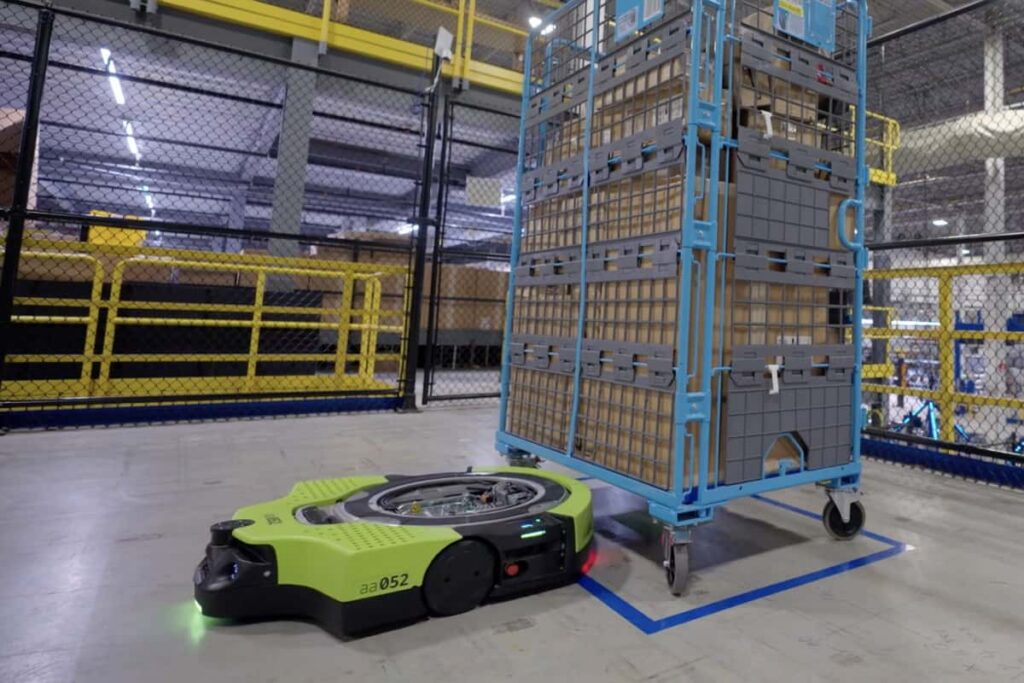
Amazon has launched its first smart warehouse in Shenzhen, China. The warehouse is designed to reduce storage costs for sellers by up to 45%.

With its smart warehouse model in China, Amazon aims to retain sellers amidst the increasing competition from Chinese rivals such as Shein and PDD Holdings’ Temu. According to the company’s statement, the smart warehouse will be Amazon’s first Global Warehousing and Distribution (GWD) center. The warehouse will serve as an all-in-one logistics hub for Chinese sellers targeting US customers, located at the heart of Shenzhen’s manufacturing base. The next-generation warehouse is designed to reduce storage costs for Chinese sellers by up to 45%.

Smart Warehouse Focuses on Sellers’ Entire Needs

Amazon’s GWD center in Shenzhen is designed to handle logistics management from the moment products leave factories in China until they reach Amazon’s warehouses in the US. This will allow Chinese sellers to automatically manage local storage, customs clearance, cross-border shipping, and inventory transfers—steps that sellers previously had to organize themselves.

Chinese Competitors Continue Their Investments to Compete with Amazon

With this move, Amazon aims to retain Chinese sellers. Competing with global e-commerce giants like Temu, Shein, and TikTok Shop in the region, Amazon is also responding to the rising competition among sellers, suppliers, and customers. Temu’s market share surged from under 1% to 24% last year, bringing it on par with Amazon. Additionally, Shein holds a market share of approximately 10%.

Chinese platforms are deepening their investments in supply chains. Shein’s founder Xu Yangtian committed to investing $1.4 billion in February to build a “smart supply chain system” in Guangdong Province.

Expanding the Smart Warehouse Model to Europe and Japan

Amazon announced plans to expand the smart warehouse model to the Yangtze River Delta, another major manufacturing hub, and extend its distribution to Europe and Japan. Shenzhen continues to remain at the center of this ecosystem. The city hosts more than half of China’s cross-border e-commerce sellers and has ranked first nationwide in cross-border trade for four consecutive years. Amazon’s expansion is placing pressure on Chinese platforms as regulations on low-value imports tighten in the US and Europe.