WORLDEF Istanbul 2026 - Upcoming Event

Register Now

Three digital economy priorities for Middle Eastern states

Digital Economy

For the Middle East, the digital economy should be considered a central pillar for long-term economic sustainability, geopolitical influence and global competitiveness.

Structural shifts in global energy markets, combined with the accelerating pace of technological advancements, have compelled many policymakers in the region to rethink traditional models of economic development. In this context, the digital economy is a foundation for national strategies that can help with diversification, resilience and modernization.

Countries such as Saudi Arabia and the UAE are at the forefront of this transformation. They have leveraged their financial resources and long-term strategic planning to position themselves as regional — and potentially global — leaders in digital innovation and the digital economy.

At the core of this transformation, nations should invest in three sectors: cybersecurity, financial technology and smart cities. These sectors serve as critical enablers of broader digital ecosystems.

These three sectors can boost the expansion of digital services, enhance economic efficiency and lead to more innovation across multiple sectors.

In addition, these domains are deeply interconnected. This means that advancements in one area reinforces progress in others. As such, they collectively form the backbone of a comprehensive digital strategy that can redefine the economic identity of the region.

Cybersecurity is undoubtedly a strategic imperative in the context of rapid digitalization across the Middle East. Since governments and private sectors increasingly rely on digital infrastructures — ranging from cloud computing and artificial intelligence to e-government platforms — the potential vulnerabilities related to cyber threats is increasing.

This area should be viewed as a central component of national security and economic policy. In countries such as Saudi Arabia, substantial investments are being directed toward building robust cybersecurity frameworks, developing indigenous capabilities and partnerships with global technology firms.

They collectively form the backbone of a digital strategy that can redefine the economic identity of the region

Dr. Majid Rafizadeh
Such efforts protect sensitive data and infrastructure but also establish trust in digital systems, which is critical for attracting foreign investment and enabling the growth of digital markets.

Cybersecurity plays a role in the credibility of digital economies. Amid increasing geopolitical tensions and the weaponization of cyber capabilities, the ability to safeguard digital infrastructure is directly linked to a nation’s strategic autonomy and stability.

Furthermore, as sectors such as finance, healthcare and energy become increasingly digitized, the potential economic costs of cyber disruptions grow exponentially. As a result, countries that succeed in developing advanced cybersecurity ecosystems will not only protect their own digital assets but also position themselves as trusted hubs for global data flows and digital services. This, in turn, enhances their attractiveness for foreign investments and multinational corporations seeking secure environments for their operations.

The second key domain is the fintech sector, which is a driver of financial transformation and economic diversification. The adoption of digital payment systems, mobile banking, blockchain technologies and decentralized financial platforms has expanded significantly in some Middle Eastern nations. In the Gulf, governments and central banks have actively supported the development of fintech ecosystems. This financial modernization is essential for integrating regional economies into the global digital marketplace.

Fintech is important because it reduces transaction costs, is more inclusive and enhances efficiency, enabling individuals and small businesses to participate more fully in economic activities. This is a kind of democratization of finance, which stimulates economic growth.

One of the important benefits of adopting this approach is to reduce nations’ susceptibility to external shocks

Dr. Majid Rafizadeh
The third vital issue is the development of smart cities. Smart cities address issues such as urban expansion, rapid population growth and environmental challenges. This is done by integrating advanced technologies into urban infrastructure and governance systems. Projects such as Neom in Saudi Arabia exemplify this, creating technologically advanced, sustainable and highly efficient urban environments that serve as hubs of innovation and economic activity.

Smart cities will attract global talent and investment. At the same time, they need the other two domains, robust cybersecurity and fintech. Therefore, strategic investment in all three areas is key to economic diversification in the Middle East.

One of the important benefits of adopting this approach is to reduce nations’ susceptibility to external shocks, which will also make them an attractive destination for multinational corporations, startups and investors. This, in turn, enhances the region’s role in the international economy.

As countries transition ever more to the digital economy, demand for high-skilled labor increases. This means that governments must invest in education and training programs aimed at equipping their populations with the necessary skills for a digital environment. These programs should focus on science, technology, engineering, mathematics and data analytics.

To successfully position themselves as leading digital and technological centers, Middle Eastern countries must pursue a multidimensional approach that includes creating an environment for innovation, adopting flexible and adaptive regulatory frameworks, and significant investments in digital infrastructure. Public-private partnerships and international collaboration play a critical role as well.

In a nutshell, for the future of the Middle East, cybersecurity, fintech and smart cities are three fundamental pillars for strategic investment because they play a critical role in creating diversified, resilient and globally competitive economies. Saudi Arabia is particularly well positioned to lead this transition, given its strategic vision and commitment to large-scale investment.

Dr. Majid Rafizadeh is a Harvard-educated Iranian-American political scientist.

Source: https://arab.news/556a2

1 Strategic Boost as Bulgaria Strengthens E-Commerce Logistics Through New Partnership

1 Strategic Boost as Bulgaria Strengthens E-Commerce Logistics Through New Partnership

Bulgaria’s e-commerce logistics sector is entering a new phase of development as euShipments.com partners with Speedy, one of the country’s leading courier companies, to strengthen last-mile delivery capabilities.

The collaboration aims to enhance delivery performance and expand service coverage for online merchants operating in Bulgaria. Through this partnership, euShipments’ clients will gain access to Speedy’s full delivery portfolio, including home delivery and out-of-home (OOH) options such as parcel lockers and courier offices.

This move reflects the growing importance of efficient last-mile logistics in a rapidly evolving e-commerce landscape, where delivery speed and flexibility directly impact customer satisfaction.

Expanding Delivery Options and Performance

The integration between euShipments and Speedy is designed to provide a more seamless logistics experience for both merchants and end customers. With Speedy’s extensive infrastructure, businesses can now offer more flexible delivery choices, improving convenience and increasing successful delivery rates.

Speedy currently holds a strong position in the Bulgarian courier market, handling over 50 million parcels annually and serving more than 1 million customers.

For online sellers, this means access to a reliable and scalable last-mile network an essential component for growth in competitive e-commerce environments.

The partnership was also driven by operational challenges experienced during peak periods, particularly in late 2025, highlighting the need for stronger and more resilient delivery solutions.

Strengthening Bulgaria’s E-Commerce Ecosystem

Bulgaria is increasingly becoming an attractive market for e-commerce, supported by steady growth in online shopping and improving digital infrastructure. However, logistics remains a key differentiator in market success.

By combining euShipments’ cross-border logistics expertise with Speedy’s local delivery network, the partnership creates a fully integrated end-to-end solution for both domestic and international merchants.

Additionally, the collaboration supports features such as cash-on-delivery (COD) a widely preferred payment method in the region and efficient returns management, both critical for maintaining customer trust and operational efficiency.

A Regional Signal for Logistics Innovation

This partnership highlights a broader trend across Central and Eastern Europe: logistics providers are investing heavily in localized last-mile solutions to support cross-border e-commerce growth.

As competition intensifies, the ability to offer fast, flexible, and reliable delivery is becoming a core competitive advantage not just an operational necessity.

For retailers and logistics providers alike, Bulgaria’s latest move signals a clear direction: strong partnerships and integrated networks will define the future of e-commerce logistics.

Source

73% of Portuguese Shoppers Drive Smart Price-Focused Growth in E-Commerce

73% of Portuguese Shoppers Drive Smart Price-Focused Growth in E-Commerce

Portugal’s e-commerce market is increasingly shaped by price-conscious consumers, with new data revealing that 73% of online shoppers are primarily driven by price when making purchase decisions.

According to recent research, competitive pricing remains the dominant factor influencing consumer behavior in Portugal’s digital commerce ecosystem. In addition, 71% of shoppers are strongly influenced by promotions and discounts, reinforcing the importance of value-driven strategies for online retailers.

These findings highlight a clear trend: Portuguese consumers are becoming more rational and selective, prioritizing affordability while navigating a rapidly evolving e-commerce landscape.

Discounts, Comparison, and Smart Shopping Behavior

The growing sensitivity to price is also reflected in how consumers shop. Around 51% of Portuguese shoppers actively use price comparison tools before completing a purchase, indicating a shift toward more informed and strategic buying decisions.

However, price is not the only factor. Consumers are also placing increasing importance on trust, platform usability, and overall shopping experience. This suggests that while competitive pricing is essential, it must be combined with reliability and convenience to win customer loyalty.

Marketplaces continue to dominate the Portuguese e-commerce ecosystem, with 81% of consumers preferring to shop through these platforms, followed by official brand websites and retailer-owned online stores.

E-Commerce Growth with Higher Expectations

Portugal’s digital commerce sector is expanding, but with more demanding consumers. While 63% of shoppers report increasing their online purchases over the past two years, expectations around transparency, trust, and service quality are also rising.

This creates a dual challenge for businesses: competing on price while maintaining strong brand credibility and seamless user experiences.

Notably, around 32% of consumers shop online every month, signaling that e-commerce is becoming a habitual part of everyday life rather than an occasional activity.

A Strategic Signal for Retailers

For brands and marketplaces operating in Portugal, the message is clear: price competitiveness is critical but not sufficient on its own.

Retailers must strike a balance between attractive pricing, promotional strategies, and trust-building measures. In a market where consumers are increasingly informed and selective, long-term success will depend on delivering both value and reliability.

As economic conditions continue to influence purchasing behavior, Portugal stands as a strong example of how price sensitivity is reshaping e-commerce strategies across Europe.

Source

89% Pressure: German E-Commerce Sellers Struggle Under Heavy Bureaucracy

89% Pressure: German E-Commerce Sellers Struggle Under Heavy Bureaucracy

Germany’s e-commerce sector is facing growing operational pressure, as new data reveals that nearly 9 out of 10 online sellers consider bureaucracy a major burden on their businesses.

According to a survey conducted by Händlerbund, one of Germany’s leading retail associations, 56% of online sellers describe regulatory requirements as “very heavy,” while another 33% say the burden is consistently high. Combined, this represents 89% of sellers struggling with administrative complexity.

The findings highlight a structural challenge in one of Europe’s largest digital commerce markets where growth is increasingly constrained not by demand, but by compliance.

Compliance Overload Slowing Growth

The most significant pressure points for sellers stem from product safety regulations and packaging requirements, both of which demand extensive documentation and monitoring.

For many businesses, especially SMEs, staying compliant requires substantial time, financial resources, and operational focus. Instead of investing in growth, innovation, or customer experience, companies are allocating increasing effort to navigating complex legal frameworks.

This shift reflects a broader European trend. With the expansion of regulations such as the Digital Services Act and sustainability-related policies, online sellers are facing a rapidly evolving compliance landscape. While these frameworks aim to protect consumers and ensure fair competition, they also introduce significant administrative overhead.

A Balancing Act for Europe’s Digital Economy

Germany’s regulatory environment has long been known for its strict standards, particularly in areas like data protection, product safety, and consumer rights. While this creates a high level of trust among consumers, it also raises barriers for businesses especially smaller merchants trying to scale.

At the same time, policymakers are aware of the issue. Recent initiatives at both national and EU levels aim to reduce bureaucracy and digitize administrative processes, signaling a potential shift toward a more balanced approach between regulation and innovation.

Still, for now, many sellers remain caught between compliance obligations and competitive pressures. The challenge is no longer just about selling products online but about navigating a complex regulatory ecosystem efficiently.

As Europe continues to refine its digital economy policies, the key question remains: Can regulators maintain high standards without slowing down e-commerce growth?

Source

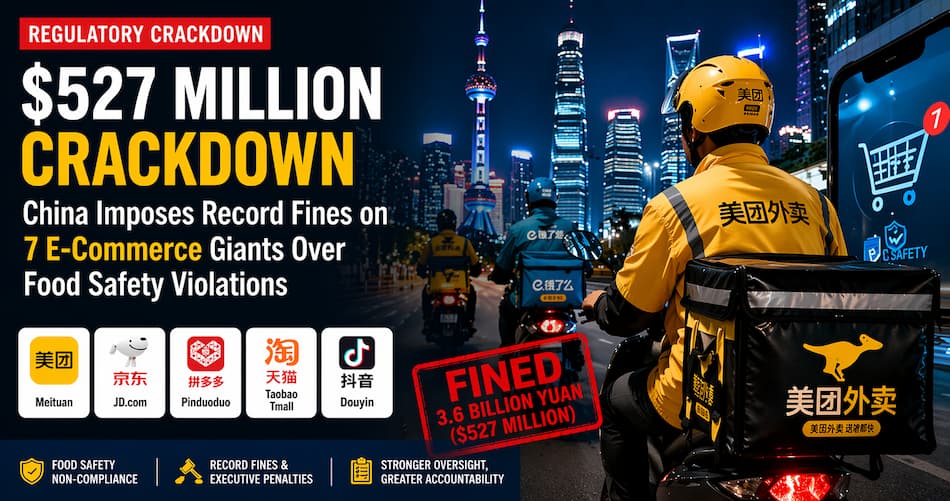
$527M Crackdown: China Imposes Record Fines on 7 E-Commerce Giants Over Food Safety Violations

$527M Crackdown: China Imposes Record Fines on 7 E-Commerce Giants Over Food Safety Violations

China has intensified its regulatory oversight of the digital commerce sector, imposing a massive 3.6 billion yuan ($527 million) fine on seven major e-commerce platforms in one of the most significant enforcement actions to date.

The penalties, announced by the country’s top market regulator, target leading platforms including Meituan, JD.com, Pinduoduo, Alibaba’s Taobao and Tmall, and ByteDance’s Douyin. The investigation revealed systemic failures in ensuring food safety compliance across their online delivery ecosystems.

Authorities found that these platforms failed to properly verify the licenses and qualifications of food vendors, while also neglecting essential consumer protection measures. The violations highlight growing concerns around the rapid expansion of online food delivery services and the risks associated with insufficient oversight.

Rising Pressure on Platform Accountability

This crackdown reflects a broader shift in China’s regulatory approach from rapid digital growth to strict enforcement and accountability. As online commerce continues to dominate consumer behavior, regulators are increasingly focused on platform responsibility rather than just merchant compliance.

In addition to the corporate fines, individual executives and food safety officers were also penalized, and platforms have been ordered to implement immediate corrective actions. Some services may face operational restrictions, including limits on onboarding new vendors until compliance standards are met.

The move comes amid a surge in consumer complaints related to online shopping and food delivery services. In 2025 alone, millions of complaints were filed, with food safety and service quality ranking among the top concerns.

A Clear Signal for the Global E-Commerce Industry

China’s latest enforcement sends a strong signal not only to domestic players but also to global e-commerce companies operating in or entering the Chinese market. Regulatory tolerance is narrowing, and compliance is becoming a core operational requirement rather than a legal formality.

For international businesses, the message is clear: platforms must actively monitor sellers, ensure transparency, and prioritize consumer protection at every stage of the value chain.

As one of the world’s largest e-commerce markets, China continues to shape global standards in digital commerce governance. This record fine underscores a new era where scale without compliance is no longer sustainable.

Source

National E-Commerce Portal Introduced in Palestine

E-Commerce Portal

An e-commerce portal has been launched under the Palestinian Ministry of Economy. The portal aims to digitize the economy and support Palestinian traders and producers. It also constitutes a practical implementation of the e-commerce law.

The Palestinian Ministry of Economy has launched a new e-commerce portal in order to accelerate the digital transformation of the country’s economy. Introduced with the broad participation of representatives from the public and private sectors, the platform aims to facilitate wider market access for local producers and traders. At the same time, the portal stands out as a concrete implementation of the e-commerce law that has entered into force.

A launch program was organized at the ministry headquarters for the introduction of the e-commerce portal. The meeting was attended by Palestinian Minister of National Economy Mohammed Al-Amour, under the patronage of Prime Minister Mohammed Mustafa, Minister of Communications and Digital Economy Abdurrazak Natshe, and Governor of the Palestinian Monetary Authority Yahya Shanar, as well as representatives from the public and private sectors.

A New Step Has Been Taken in the Digitalization Process

Minister of Economy Mohammed Al-Amour stated that the event represented “a new station in a national path of work, resilience, and construction.” Al-Amour emphasized that the project is not only a technology investment, but also a strategic step aimed at transforming the country’s economic structure. Stating that the e-commerce portal establishes a new connection between the local market and global trade, Al-Amour expressed that this initiative would play an important role in opening Palestinian products to international markets.

The Result of the Transformation Process That Started in 2024

The new portal is positioned as a continuation of the digitalization roadmap launched in 2024. In this process, electronic business platforms were first introduced, while the infrastructure was strengthened in 2025 through electronic signature applications and updates made in trade legislation. As of 2026, the goal stands out as transferring not only services but the entire economy to the digital environment.

Public-Private Cooperation Stands Out in the E-Commerce Portal

The close cooperation between the Ministry of National Economy and the Ministry of Communications and Digital Economy stands out in the development of the project. Authorities state that the e-commerce portal was built on a model that increases coordination among national institutions and encourages joint production. This approach is expected to contribute to economic growth and independence goals.

Digital Identity and Global Integration

The Palestinian administration is also focusing on strengthening the country’s digital identity within the scope of its digital economy strategy. In this direction, it is planned to expand the use of the “.ps” domain across all economic activities. Authorities state that this step will accelerate the country’s integration into the global digital economy.

Investment, Innovation, and Entrepreneurship Will Be Supported

Among the platform’s main goals are increasing the competitiveness of local businesses, expanding the visibility of products, and creating new investment opportunities. Minister of Communications and Digital Economy Abdurrazak Natshe stated that strengthening digital infrastructure, ensuring data security, and increasing user trust are priority areas. It was also announced that training and incentive programs will be introduced in order to support the entrepreneurship ecosystem.

During the launch event, practical presentations were made regarding the operation of the portal, while support mechanisms that will facilitate the integration of the private sector into the system were also shared. The new platform is expected to contribute to long-term growth by accelerating the digitalization process in the Palestinian economy.

Source: Sada News

E-Commerce Accounts for 35% of New Warehouse Demand in Central Asia

warehouse

Online marketplaces and the broader e-commerce sector accounted for 35% of new warehouse space demand in Central Asia.

According to data announced by IBC Global as part of the Central Asia Warehouse Summit Uzbekistan, the e-commerce sector accounted for 35% of new warehouse space demand in Central Asia at the beginning of 2026. Third-party logistics (3PL) providers and distribution companies ranked second with a 28% share of ware house demand. The delivery needs of traditional brick-and-mortar stores accounted for an additional 18% share.

Logistics Infrastructure Took a 12% Share in Warehouse Demand

The ongoing development of regional logistics infrastructure contributed approximately 12% to total ware house demand. The light industrial sector and multi-temperature storage facilities made up the remaining 7%.

At the summit, analysts also presented a comprehensive breakdown of the typical costs associated with constructing a new ware house. Internal engineering networks emerged as the largest expense item, consuming 27.3% of a project’s total budget. This was followed by load-bearing structures at 14.7% and site landscaping at 12.1%.

Other cost items required to complete a commercial facility included on-site utility networks at 8%, flooring at 6.1%, enclosing structures at 5.5%, external utility connections at 4.5%, and roofing at 4.2%.

Amazon Is Acquiring Globalstar for $11.6 Billion

Globalstar

Amazon announced that it will acquire the US satellite communications company Globalstar for $11.6 billion. The move is said to be aimed at competing with Starlink, the satellite internet service operated by Elon Musk’s SpaceX.

Satellite-based internet and direct-to-device (D2D) technologies are creating a new field of competition in the telecommunications sector. Technology giants are also accelerating their investments to position themselves more strongly in this market. In this context, Amazon announced that it will acquire Globalstar for approximately $11.6 billion as part of its growth plans in the D2D field.

With this acquisition, Amazon will gain access to Globalstar’s network of more than 20 low-Earth orbit satellites. The e-commerce giant also plans to use it to prepare for the full-scale rollout of its own low-Earth orbit satellite internet initiative, Leo. Amazon aims to connect satellite internet directly to the mobile devices of its e-commerce customers. It also plans to offer voice, data, and messaging services starting in 2028.

Amazon Launched 200 Satellites in 1 Year

Amazon has launched approximately 200 satellites since April 2025. The company is preparing to officially launch its low-Earth orbit satellite internet service by the end of this year. It also plans to launch approximately 7,700 satellites this year. However, delays in satellite deployment have disrupted this plan.

Globalstar Has 800,000 Subscribers

Globalstar was founded in Louisiana in 1991. As of the end of last year, it has 800,000 subscribers to its mobile satellite communications service. Following the news of Amazon’s acquisition, Globalstar shares rose by approximately 10% on Nasdaq, approaching $80. Apple, one of Globalstar’s major shareholders, also welcomed Amazon’s decision. Apple had acquired a 20% stake in the company by investing $1.5 billion in Globalstar in 2024.

As part of the collaboration with Apple, Amazon Leo will continue to provide infrastructure for the satellite features used on iPhones and Apple Watches. These features include functions such as emergency messaging and location sharing. The agreement will go through the approval process of the US Federal Communications Commission (FCC) and is expected to be completed around 2027.

Starlink Leads the Satellite Internet Market

Starlink, which Amazon sees as a rival, is currently the dominant player in the satellite internet market. The company has approximately 10,000 low-Earth orbit communications satellites and 9 million users.

Crisis Shakes Economic Indicators in the Middle East; A 2.2% Contraction Is Expected in 2026

Economi

Rising geopolitical tensions in the Middle East are putting significant pressure on regional economies, while growth expectations for 2026 have been revised sharply downward.

According to the latest Economic Update report published by ICAEW, the effects of the Iran-centered conflict are directly impacting the economic outlook of the Gulf Cooperation Council (GCC) countries.

The report states that the global economy is expected to grow by 2.6% this year. This figure points below the narrow 2.8% to 3.0% range seen over the past three years. However, the outlook for the Middle East is significantly weaker. The regional economy, which was projected to grow by 3.6% three months ago, is now expected to contract by 2.2% in 2026. This sharp revision is driven by the combined effects of volatility in energy markets, disruptions in trade flows, and a slowdown in the tourism sector.

GCC Economic Growth Forecast Revised Down to -0.2%

For GCC economies, a more limited but still notable contraction is expected. The region’s 2026 growth forecast has been lowered by 4.6 percentage points over the past three months to -0.2%. Analysts emphasize that this contraction will be more pronounced in economies that are more dependent on trade and tourism. However, a strong recovery is expected in 2027, with GCC economies projected to grow by 8.5% next year.

Brent Oil Prices May Reach $113

Energy markets are among the areas where the effects of the current crisis are most visible. As the conflict escalated, Brent oil prices have exceeded $100 per barrel since mid-March, with the second-quarter average expected to reach $113. While prices are projected to return to pre-crisis levels by 2028 in the long term, high volatility is expected to persist in the short term.

Natural Gas Prices Are 60% Higher

A sharper shock is being observed in natural gas markets. Due to disruptions in Qatar’s liquefied natural gas production, gas prices are reported to be approximately 60% higher compared to forecasts made three months ago. This situation continues to impact both regional and global economies through increased energy costs.

Disruptions in logistics lines are also among the key factors negatively affecting the economic outlook. Transit through the Strait of Hormuz, a critical route for global energy transportation, has been severely disrupted. Under normal conditions, 18 million barrels of oil pass through the strait daily, but approximately 7 million barrels of this volume are now being rerouted through alternative pipelines. However, countries such as Bahrain, Kuwait, and Qatar have limited alternative routes, leading to production cuts.

In line with these developments, the GCC oil sector is expected to contract by 5.8% in 2026. However, a strong recovery of 18.2% is projected for 2027.

Tourism Could Decline by 27%

The tourism and travel sector is also among the most affected areas of the crisis. Due to airspace closures and flight cancellations, the number of international visitors to the Middle East is expected to decline by between 11% and 27% this year. This decline corresponds to approximately 23 million to 38 million fewer visitors. The loss in tourism revenues is estimated to range between $34 billion and $56 billion.

On the consumer side, a slowdown in spending is anticipated due to declining confidence and rising inflation expectations. Household consumption growth in GCC countries is expected to fall to 1.4% in 2026, marking a 2.6 percentage point decline compared to forecasts three months ago. In contrast, consumption is expected to grow by 6% in 2027.

The inflation outlook in the region has also been revised upward. Inflation in GCC countries is expected to reach 2.5% in 2026, before easing to 2.4% in 2027. Rising costs are primarily driven by disruptions in logistics and imports.

Notable Declines in Dubai and Abu Dhabi Stock Markets

In financial markets, increasing geopolitical risks have created a more cautious investment environment. Significant declines have been observed in the Dubai and Abu Dhabi stock markets, while markets in countries such as Oman and Saudi Arabia have remained relatively more resilient.

The report also notes that Iran’s economy is expected to contract by 9.4% in 2026. At the same time, escalating conflicts in Lebanon and the displacement of 20% to 25% of the population are highlighted as major risks to regional recovery.

Overall, while the current crisis is creating significant short-term economic pressure, the region’s strong structural fundamentals and investment potential continue to support expectations of a medium-term recovery. However, the pace and scope of this recovery will largely depend on the course of geopolitical developments.

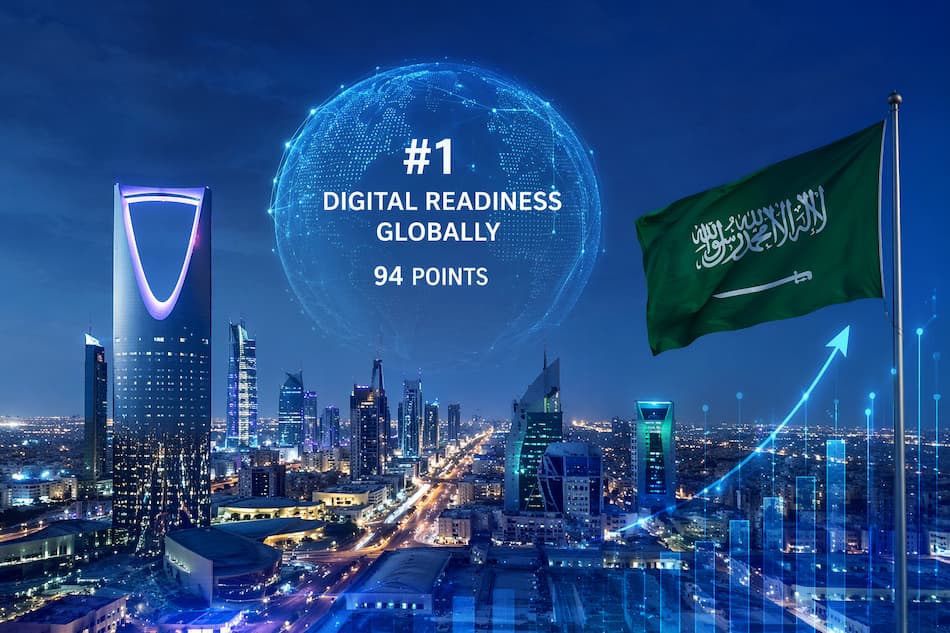
Saudi Arabia Leads with 94 Points in a Positive Global Digital Readiness Ranking

Saudi Arabia Leads with 94 Points in a Positive Global Digital Readiness Ranking

Saudi Arabia has secured the top global position in the International Telecommunication Union (ITU) Digital Readiness Index 2025, achieving a score of 94 out of 100. The ranking places the Kingdom in the “very high” category and reflects its rapid progress in digital infrastructure, connectivity, and technology-driven economic transformation.

The latest results mark a significant improvement from previous years, where Saudi Arabia ranked fourth globally with a lower score. The advancement underscores the country’s consistent investment in digital capabilities and its long-term strategy to position itself as a leading digital economy under Vision 2030.

Strong Performance Across Digital Infrastructure and Connectivity

The ITU Digital Readiness Index evaluates countries based on multiple indicators, including connectivity, digital infrastructure, and the effectiveness of digital services. Saudi Arabia’s high score highlights its strong performance across these areas, particularly in expanding access to high-speed networks and improving digital service delivery.

The Kingdom has made substantial progress in building advanced telecommunications infrastructure, which has been a key driver of its digital transformation. High mobile penetration rates, widespread broadband access, and ongoing 5G expansion have all contributed to strengthening the country’s digital ecosystem.

This infrastructure foundation has enabled both public and private sectors to accelerate digital adoption, supporting the growth of e-commerce, fintech, and digital services.

Digital Economy Driving Growth and Investment

Saudi Arabia’s leadership in digital readiness is closely linked to the rapid expansion of its digital economy. The ICT sector continues to play an increasingly important role in national economic growth, attracting both regional and international investment.

Government-led initiatives have focused on enhancing competitiveness, encouraging innovation, and creating a business-friendly environment for technology companies. These efforts are helping to position the Kingdom as a regional hub for digital commerce and emerging technologies.

The strong digital infrastructure and regulatory environment are also enabling businesses to scale efficiently, contributing to increased productivity and economic diversification.

Strategic Vision Behind the Transformation

The Kingdom’s achievement is largely driven by its long-term digital strategy under Vision 2030, which prioritizes technology as a key pillar of economic development. Investments in smart cities, digital government services, and innovation ecosystems have accelerated the pace of transformation.

Saudi Arabia has also focused on improving user experience in digital services, increasing accessibility, and fostering digital skills across the population. These initiatives ensure that digital transformation is not only infrastructure-led but also inclusive and sustainable.

Market Implications

Saudi Arabia’s top ranking in digital readiness signals a broader shift in the global digital economy, where countries with strong infrastructure, policy frameworks, and investment strategies are gaining a competitive edge.

For businesses operating in e-commerce and digital services, the Kingdom presents a rapidly evolving market with high growth potential. The combination of advanced connectivity, supportive regulation, and increasing consumer adoption creates a favorable environment for expansion.

As digital transformation continues to accelerate globally, Saudi Arabia’s progress highlights the importance of long-term strategy and sustained investment in building competitive digital economies.

Source:

Economy Middle East