WORLDEF ISTANBUL 2026 - Upcoming Event

Register Now

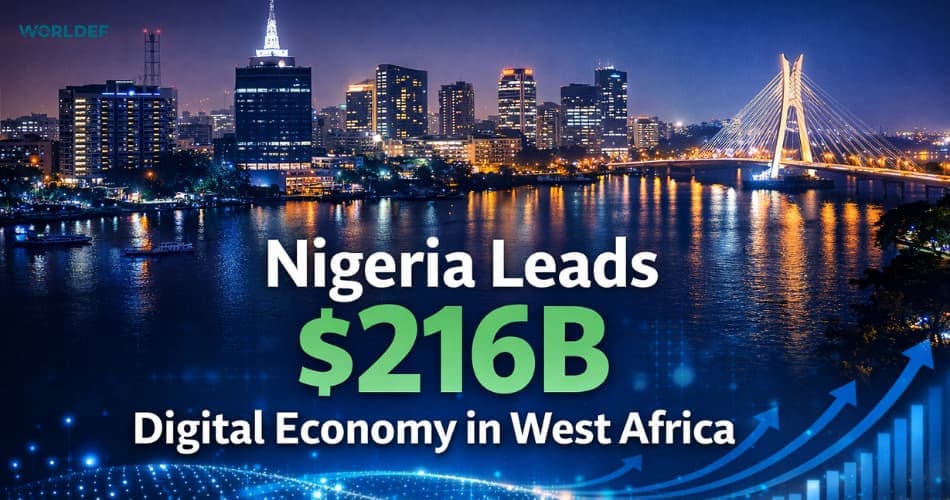
Nigeria’s Role in $216B Digital Economy Signals Positive Growth for West Africa

Nigeria’s Role in $216B Digital Economy Signals Positive Growth for West Africa

West Africa’s digital economy is rapidly expanding, now valued at an estimated $216 billion, with Nigeria emerging as the dominant force driving this growth. The development highlights the region’s increasing importance in the global digital landscape, as governments and regulators push for stronger coordination and innovation.

According to recent reports, Nigeria accounts for the largest share of digital activity in the region, supported by its population size, growing tech ecosystem, and expanding mobile connectivity. As the biggest economy in West Africa, the country continues to lead in areas such as fintech, e-commerce, and digital services, positioning itself as a regional hub for innovation.

This momentum is being reinforced by the efforts of the West Africa Telecommunications Regulators Assembly (WATRA), which is working to create a more unified and secure digital environment across its member states. Through regulatory alignment and collaboration, WATRA aims to unlock further growth potential and ensure that digital transformation benefits both businesses and consumers across the region.

Nigeria Leads West Africa’s Digital Economy Expansion

A key driver behind this growth is the rapid adoption of mobile technologies and digital financial services. Across West Africa, mobile connectivity continues to expand, enabling millions of users to access online platforms, digital payments, and e-commerce services. These technologies are not only improving financial inclusion but also creating new opportunities for startups and entrepreneurs.

Nigeria, in particular, has seen strong growth in fintech and digital platforms, attracting both local and international investment. The country’s digital ecosystem is increasingly supported by innovation hubs, government initiatives, and a young, tech-savvy population eager to engage with new technologies.

At the same time, regional cooperation is becoming more critical. WATRA’s recent initiatives focus on building a secure, inclusive, and resilient digital ecosystem, addressing key areas such as cybersecurity, 5G deployment, and infrastructure development. These efforts are essential for ensuring sustainable growth and reducing fragmentation across markets.

However, challenges remain. Regulatory differences, infrastructure gaps, and cybersecurity risks continue to pose barriers to full digital integration across West Africa. Addressing these issues will require ongoing collaboration between governments, regulators, and private sector stakeholders.

Looking ahead, the outlook remains highly positive. As digital technologies continue to evolve, West Africa is expected to play an increasingly important role in the global economy. With Nigeria leading the charge, the region’s $216 billion digital economy represents not just current growth, but a foundation for long-term transformation in commerce, finance, and connectivity.

Source

Vinted’s 47% GMV Surge Signals Positive Boom in Europe’s Resale Economy

Vinted’s 47% GMV Surge Signals Positive Boom in Europe’s Resale Economy

Europe’s second-hand fashion market is gaining serious momentum, and Vinted is at the center of this transformation. The Lithuania-based platform reported a 47% year-on-year increase in gross merchandise value (GMV), reaching €10.8 billion, marking a major milestone in the evolution of recommerce across the region.

The strong performance reflects a broader shift in consumer behavior. As inflation and rising living costs continue to pressure households, more consumers are turning to second-hand platforms to save money and generate extra income. This trend has positioned Vinted not just as an alternative shopping channel, but as a mainstream marketplace within Europe’s e-commerce ecosystem.

In parallel with GMV growth, Vinted’s revenue rose by 38% to €1.1 billion, underlining its ability to scale both transaction volume and monetization. The company has now firmly established itself as one of Europe’s leading digital marketplaces, with operations spanning more than 20 countries and a growing user base driven by affordability and sustainability.

Vinted Drives Resale Economy Growth Across Europe

A key driver behind Vinted’s growth is its continued expansion beyond traditional fashion categories. While women’s and children’s clothing remain core segments, the platform has increasingly diversified into areas such as sports equipment, collectibles, and electronics. This broader product offering is attracting new user segments and increasing transaction frequency.

At the same time, Vinted is investing heavily in infrastructure. Initiatives like Vinted Go (logistics) and Vinted Pay (payments) are designed to strengthen its ecosystem and reduce operational costs over time. The platform now provides access to hundreds of thousands of pick-up and drop-off points across Europe, improving convenience and delivery efficiency.

However, this aggressive growth strategy has come with trade-offs. Despite record GMV and revenue, profitability declined, with net profit falling to €62 million due to increased investments in expansion, logistics, and market development particularly in competitive regions like Germany.

Still, the long-term outlook remains strong. Vinted’s leadership emphasizes cost efficiency and ecosystem development as core pillars for making second-hand commerce the “first choice” for consumers. As resale continues to gain traction, the platform is well-positioned to capitalize on both economic and sustainability-driven demand.

Ultimately, the latest results highlight a fundamental shift in retail dynamics. Second-hand commerce is no longer niche – it is becoming a defining force in Europe’s digital economy, challenging traditional retail models and reshaping how consumers buy and sell goods online.

Source

TikTok Shop’s 6-Market Expansion Signals Positive Shift in Europe’s Social Commerce Race

TikTok Shop’s 6-Market Expansion Signals Positive Shift in Europe’s Social Commerce Race

TikTok is accelerating its push into Europe’s e-commerce landscape, with plans to launch TikTok Shop in Poland and the Benelux region, marking another major step in the platform’s rapid regional expansion. As social commerce continues to reshape online retail, this move highlights both growing opportunities and intensifying competition across Europe.

Following successful rollouts in markets such as the UK, Germany, France, Italy, Spain, and Ireland, TikTok Shop is now preparing to enter new territories where digital commerce adoption is strong but still evolving. Industry reports suggest that countries like Poland, the Netherlands, and Belgium are among the next strategic targets, as TikTok aims to scale its integrated shopping ecosystem further.

TikTok Shop Expansion Reshapes Europe’s Social Commerce Landscape

At the core of TikTok Shop’s model is its “content-first commerce” approach – blending entertainment, influencer marketing, and seamless in-app purchasing. Unlike traditional marketplaces, TikTok enables users to discover and buy products directly through short-form videos and live streams, significantly shortening the customer journey. This model has already proven effective in the UK, where both seller participation and user spending have grown rapidly over the past two years.

The expansion into Poland and Benelux could unlock substantial growth, particularly for small and medium-sized businesses. TikTok Shop lowers entry barriers for merchants by allowing brands and creators to sell without the need for complex infrastructure. Micro-brands, especially in categories like fashion, beauty, and lifestyle, are expected to benefit the most from this shift, leveraging organic reach and influencer partnerships to drive sales.

At the same time, TikTok is strengthening its logistics capabilities in Europe. Through initiatives like “Fulfilled by TikTok,” the company is investing in local warehousing and delivery systems to reduce shipping times and improve customer experience. This signals a strategic shift away from purely cross-border models toward localized fulfillment a move that aligns with broader industry trends.

However, the expansion also intensifies competition. TikTok Shop enters markets already dominated by strong local players such as Allegro in Poland and Bol.com in the Benelux region, alongside global giants like Amazon. Its arrival is expected to further disrupt pricing dynamics, marketing strategies, and customer acquisition channels across the region.

Despite these challenges, TikTok Shop’s continued growth reflects a larger transformation in consumer behavior. Social platforms are no longer just discovery tools they are becoming full-scale transactional ecosystems. As TikTok moves into new European markets, it is not only expanding geographically but also redefining how commerce is experienced in the digital age.

Source

TikTok & ICC Launch Free Training Across 10 Markets in Positive Move

TikTok & ICC Launch Free Training Across 10 Markets in Positive Move

TikTok and the International Chamber of Commerce (ICC) have launched a new initiative aimed at strengthening the digital capabilities of small businesses, marking a notable step in expanding access to digital commerce training globally.

The program, titled Digital Commerce Labs, will initially roll out across 10 emerging markets, targeting micro, small, and medium-sized enterprises (SMEs) that are increasingly looking to scale through digital channels. By combining TikTok’s platform expertise with ICC’s global business network, the initiative seeks to address a long-standing gap in practical, accessible digital education.

At its core, the program is designed to remove one of the biggest barriers facing SMEs: access. Offered free of charge, it provides structured learning opportunities without the cost constraints that often limit participation in such programs. Participants will be able to engage through a mix of self-paced modules, virtual sessions led by industry experts, and community-based learning environments that encourage knowledge sharing.

TikTok expands access to practical digital skills

Beyond foundational skills, the training focuses on practical application. SMEs will gain insights into building a digital presence, leveraging content for commerce, and navigating evolving online sales channels. There is also an emphasis on emerging technologies, including AI-driven tools, which are increasingly shaping how businesses interact with customers and scale operations.

The broader objective extends beyond education. TikTok and ICC are positioning the initiative as a catalyst for economic growth, aiming to help businesses unlock new revenue streams, expand into wider markets, and build long-term resilience in a competitive digital landscape. For many SMEs, particularly in emerging economies, these capabilities are no longer optional, they are essential for survival and growth.

What makes the initiative particularly significant is its scalability. Designed as a repeatable model, Digital Commerce Labs can be adapted and expanded across different regions through collaboration with local chambers and business communities. This approach allows global expertise to be effectively translated into local impact.

The launch also reflects a wider shift in the role of digital platforms. Increasingly, companies like TikTok are moving beyond providing tools and are investing in the broader ecosystem supporting education, capability building, and sustainable business growth.

As digital commerce continues to evolve, initiatives like this are likely to play a central role in shaping how small businesses participate in the global economy.

Source

Stay updated with global e-commerce insights and developments on WORLDEF.

Tehran E-Commerce Faces 100% Disruption Risk as Internet Restoration Urged

Tehran E-Commerce Sector Urges Immediate Internet Restoration as Crisis Deepens

Tehran’s digital economy calls for urgent action

Iran’s digital business community is calling for the immediate restoration of internet services as ongoing disruptions continue to impact economic activity across the country. The Tehran Electronic Commerce Association has issued a formal statement urging authorities to restore full connectivity, describing stable internet access as a critical foundation for both economic recovery and public confidence.

According to the association, the current situation is no longer just a technical issue but a structural challenge affecting thousands of businesses and millions of users who rely on digital services daily.

E-commerce operations under pressure

The disruptions have significantly affected key sectors of Tehran’s e-commerce ecosystem. Ride-hailing platforms, food delivery services, online marketplaces, and fintech applications have all experienced operational slowdowns or partial outages.

Many businesses report reduced transaction volumes and difficulties in maintaining customer communication. Small and medium-sized enterprises, in particular, are facing growing pressure as their ability to sell, market, and operate online becomes increasingly limited.

Despite these challenges, parts of the sector have continued to function at reduced capacity, highlighting the resilience of Iran’s digital entrepreneurs. However, industry leaders warn that this situation is not sustainable in the long term.

Limited access and global isolation

Authorities have relied on a restricted “national internet” infrastructure, allowing access primarily to domestic platforms while limiting global connectivity. This approach has created a digital divide, cutting businesses off from international markets, tools, and platforms.

In addition, restrictions on VPN services commonly used to bypass such limitations have further reduced access to global networks. As a result, many companies are unable to engage in cross-border trade or use essential digital services.

Economic impact continues to grow

The prolonged restrictions are contributing to broader economic challenges. Businesses are experiencing declining revenues, disrupted operations, and reduced productivity. While some financial services have resumed and certain regulatory deadlines have been extended, these measures offer only temporary relief.

Industry representatives stress that without full internet restoration, the damage to Tehran’s e-commerce sector could have lasting consequences.

A defining moment for digital economies

The situation in Tehran highlights a broader global reality: reliable internet access has become a fundamental pillar of modern economies. As pressure mounts from the business community, the coming period will be critical in determining the future stability and growth of Iran’s digital ecosystem.

Source

Stay updated with global e-commerce insights and developments on WORLDEF.

Uzbekistan Targets 11% E-Commerce Share in 2026 as Digital Growth Accelerates

Uzbekistan Targets 11% E-Commerce Share in 2026 as Digital Growth Accelerates

Uzbekistan sets new e-commerce growth target

Uzbekistan is aiming to increase the share of e-commerce in its retail trade to 9–11%, as part of a broader strategy to accelerate digital transformation and modernize its economy.

The target was outlined during a government meeting led by President Shavkat Mirziyoyev, where new proposals were presented to strengthen the country’s e-commerce ecosystem.

Market shows strong growth momentum

Uzbekistan’s e-commerce sector has already experienced rapid expansion in recent years.

The market has grown nearly 20 times over the past eight years, reaching an estimated value of $1.3 billion, reflecting increasing consumer adoption and digital infrastructure development.

Despite this progress, e-commerce currently accounts for only around 4–4.6% of total retail trade, significantly below the global average of approximately 22%.

New strategies focus on infrastructure and customs reform

To support further growth, the government is focusing on improving logistics and trade processes.

A key priority is the development of bonded warehouse infrastructure, which allows imported goods to be stored under customs control with deferred payment of duties and taxes.

In addition, authorities are considering a system where customs duties are paid at the point of sale. This approach is expected to simplify trade operations and improve the investment climate.

Investment potential and global alignment

Officials estimate that the proposed reforms could attract up to $500 million in investment, supporting the expansion of digital commerce and related infrastructure.

Similar customs and logistics models are already widely implemented in countries such as China, the UAE, the United Kingdom, and Germany, indicating Uzbekistan’s alignment with global best practices.

Strengthening the digital economy

The initiative forms part of Uzbekistan’s broader efforts to develop its digital economy and increase the role of online commerce in overall economic activity.

With a young and increasingly connected population, the country is positioning e-commerce as a key driver of future growth, while continuing to invest in infrastructure and regulatory improvements.

Source:
https://menafn.com

Dubai Free Zones Launch 4 Measures to Boost Business Stability

Dubai Free Zones Launch 4 Measures to Boost Business Stability

Dubai Integrated Economic Zones Authority (DIEZ) has introduced a package of measures aimed at supporting businesses operating across its free zones, as part of broader efforts to maintain economic activity and ease operational pressure.

The initiative applies to companies in major zones including Dubai Airport Freezone (DAFZ), Dubai Silicon Oasis (DSO), and Dubai CommerCity.

Measures focus on cost relief and flexibility

The newly announced support package includes a range of financial and operational incentives designed to improve liquidity and business continuity.

Key measures include:

  • Flexible rental payment options, including monthly instalments
  • Waivers on certain administrative and service fees
  • Deferred payment options for selected charges
  • Stable rental rates upon contract renewal

These steps are intended to reduce immediate financial pressure on companies while maintaining operational stability.

Part of a broader economic support strategy

The move follows Dubai’s wider economic support programme, which includes a AED 1 billion package introduced to strengthen business resilience amid ongoing regional challenges.

The measures are being implemented for a limited period, with the goal of enhancing flexibility and supporting both businesses and the broader economic ecosystem.

Supporting business continuity and investment

Authorities said the initiative is designed to ensure companies can continue operating efficiently while adapting to current market conditions.

Free zones play a key role in Dubai’s economy, offering benefits such as full foreign ownership, tax advantages, and streamlined business setup processes.

By introducing additional flexibility, Dubai aims to reinforce its position as a competitive global business hub and maintwain investor confidence.

Source

For more insights and updates on global e-commerce and business trends, read more on WORLDEF.

Vietnam’s $31B E-Commerce Market Holds 85% Untapped Cross-Border Opportunity

Vietnam’s $31B E-Commerce Market Holds 85% Untapped Cross-Border Opportunity

Vietnam’s e-commerce market has reached a defining moment. Valued at $31 billion, it is one of the fastest-growing digital economies in Southeast Asia driven by high internet penetration, mobile adoption, and a new generation of online consumers.

But behind this rapid growth lies a striking imbalance.

An estimated 85% of cross-border e-commerce potential remains untapped, revealing a significant gap between Vietnam’s domestic success and its global reach.

A Market Growing Inward, Not Outward

Vietnam has all the ingredients of a global e-commerce exporter. Its manufacturing base is strong, its workforce is competitive, and its digital adoption continues to accelerate.

Yet most of this growth remains concentrated within national borders.

While local platforms and domestic demand are expanding, international channels where higher margins and long-term brand value exist are still underutilized. For a country deeply integrated into global trade, this disconnect is increasingly difficult to ignore.

The Missing Link: From Production to Brand

One of the core challenges lies in how Vietnamese businesses operate globally.

A large portion of exports still follows a contract manufacturing model, where products are produced locally but sold under foreign brands. This limits visibility, pricing power, and long-term value creation.

Cross-border e-commerce offers a different path one where companies can build their own brands, engage directly with consumers, and control the full customer journey.

But making that shift requires more than supply it requires strategy.

Logistics Still Defines the Limits

Despite progress, logistics remains the biggest constraint.

Cross-border delivery costs, customs complexity, and fragmented infrastructure continue to slow down international expansion. For many SMEs, these barriers create uncertainty, making domestic growth the safer option.

At the same time, limited experience in digital marketing, marketplace management, and international compliance further widens the gap.

In other words, the opportunity is clear but execution remains uneven.

A Shift Already in Motion

There are early signs of change.

Vietnamese sellers are increasingly entering global marketplaces, particularly in categories like fashion, home goods, and lifestyle products. Awareness around cross-border opportunities is rising, and more businesses are exploring direct-to-consumer models.

The mindset is evolving from exporting products to building global businesses.

Policy Could Be the Turning Point

Government initiatives may accelerate this transition.

With a new e-commerce law expected to take effect in 2026 and a broader digital economy roadmap in place, Vietnam is working to create a more structured and supportive environment for cross-border trade.

If these efforts translate into better logistics, clearer regulations, and stronger SME support, the country could unlock a significant portion of its untapped potential.

From Opportunity to Advantage

Vietnam does not lack demand, supply, or capability.

What it lacks at least for now is full alignment between its domestic momentum and global ambition.

Closing that gap could redefine the country’s role in global e-commerce. Because in today’s market, success is no longer about how fast you grow locally but how effectively you scale internationally.

Source

UAE E-Commerce Growth 98% Digital Transactions Enable Faster Trade

UAE E-Commerce Growth 98% Digital Transactions Enable Faster Trade

The UAE continues to strengthen its position as a global e-commerce hub, demonstrating resilience and efficiency even amid regional uncertainties. While global trade routes face disruptions, the country’s advanced logistics, digital infrastructure, and regulatory systems are ensuring that cross-border e-commerce remains uninterrupted.

A System Built for Speed and Stability

At the core of the UAE’s success is a highly integrated ecosystem combining logistics, digital platforms, and government frameworks. Today, nearly 98% of customs transactions are processed electronically, significantly reducing delays and enabling faster trade operations.

In many cases, shipments are cleared within minutes rather than hours, with up to 72% of cargo processed before arrival in Abu Dhabi. This level of efficiency allows businesses to maintain reliable delivery timelines and lower operational costs.

Strong Infrastructure Supporting Growth

Behind the seamless flow of goods lies a powerful logistics backbone. Dubai International Airport handled around 2.2 million tonnes of cargo, while DP World processed 88.3 million TEU globally, reinforcing the UAE’s role as a major trade gateway.

This infrastructure ensures that supply chains remain stable, even during periods of geopolitical tension, strengthening confidence among global businesses and investors.

Strategic Location Driving Global Access

The UAE’s geographic advantage allows companies to reach major markets across the Middle East, Africa, and South Asia within an eight-hour flight radius. This connectivity positions the country not just as a transit hub, but as a central control point for international trade flows.

Digital Transformation Accelerating Trade

Platforms like Dubai Trade and advanced customs systems have transformed trade processes. Tasks that once took up to 48 hours can now be completed in less than 10 minutes, significantly improving efficiency and reducing friction in cross-border e-commerce.

This digital-first approach enables businesses to operate with greater predictability, which is critical in today’s volatile global environment.

Rapid E-Commerce Market Expansion

The UAE’s digital commerce sector is also experiencing strong growth. The market reached approximately Dh32.3 billion in 2024 and is projected to exceed Dh50.6 billion by 2029, reflecting steady long-term expansion.

Across the wider MENA region, e-commerce is expected to grow from $34.5 billion to nearly $57.8 billion within the same period, with the UAE playing a central role in enabling this growth.

An Integrated Ecosystem for the Future

What sets the UAE apart is the alignment between infrastructure, regulation, financial systems, and technology. Free zones, advanced banking systems, and business-friendly policies all contribute to a seamless trade environment.

Looking ahead, the adoption of artificial intelligence and automation is expected to further enhance logistics efficiency and compliance processes, strengthening the country’s position as a global leader in digital trade.

Source: Khaleej Times

1 Surprising Book Behind Amazon’s Massive E-Commerce Success

1 Surprising Book Behind Amazon’s Massive E-Commerce Success

From a Garage Startup to Global E-Commerce Leader

Long before Amazon became the world’s leading “everything store,” its journey began with a single, almost symbolic purchase.

In 1995, Amazon’s very first customer order was a book titled “Fluid Concepts and Creative Analogies” by Douglas Hofstadter, a work focused on artificial intelligence. At the time, the internet was still in its early stages, and Amazon operated as a small online bookstore from a garage.

This seemingly ordinary transaction has recently resurfaced online, going viral across social media platforms and reigniting discussions about the origins of modern e-commerce.

AI Before the AI Boom

What makes this story particularly striking today is its connection to artificial intelligence. Decades before AI became a global technology race, Amazon’s first-ever sale was already linked to the concept.

The viral post caught the attention of Jeff Bezos, who reacted with a simple acknowledgment, while Elon Musk described it as “the start of something great.”

The moment has sparked both nostalgia and irony, highlighting how a company that began with selling books is now deeply embedded in AI, cloud computing, and global digital infrastructure.

The Beginning of the “Everything Store”

Amazon officially launched in 1994 as an online bookstore, chosen for its scalability and wide product availability. Within months of opening in 1995, it expanded rapidly, reaching customers across the United States and dozens of countries.

What started with one book quickly evolved into a platform that reshaped retail, logistics, and digital commerce worldwide.

Today, that first purchase is more than just a historical detail, it represents the foundation of the modern e-commerce ecosystem.

Source: Financial Express, NDTV, Economic Times