WORLDEF Prime Antalya 2026 - Upcoming Event

Register Now

Dabogosa Launches Global E-Commerce Site to Fuel International Growth

South Korean lifestyle brand Dabogosa Inc. has unveiled its new global direct-to-consumer online store, www.dabogosa.com, as part of a strategic push to expand its footprint across the U.S., Europe and other international markets. Retail Insight Network+1

The newly launched Shopify-based platform enables Dabogosa to move beyond third-party marketplaces and engage customers directly through its own digital storefront. The site features the company’s proprietary product lines alongside curated lifestyle collections designed via consumer insights and Korean craftsmanship. GlobeNewswire+1

Founded in 2020, Dabogosa has already built a strong presence on major global marketplaces including Amazon and Walmart—garnering customer trust for its high-quality Korean-made essentials, such as the MAMISON brand of premium household gloves. GlobeNewswire

In its announcement, Dabogosa highlighted several features of the new global store: region-specific promotions, multilingual support, faster U.S. shipping for American customers, and integrated global payment systems including PayPal and major international credit cards. These enhancements reflect its intent to provide a seamless international shopping experience. en.acnnewswire.com

Strategic Rationale

The launch of the global site marks a strategic evolution for Dabogosa:

  • Greater brand control: By operating its own D2C channel, the company gains full control over branding, customer experience, data and direct customer relationships—rather than relying solely on marketplace platforms.

  • International market access: Targeting major consumer markets such as the U.S., Europe and Japan supports Dabogosa’s ambition to grow beyond its Korean base and tap into global demand for premium, design-driven everyday-use products.

  • Operational efficiency and localisation: The global store allows region-specific logistics, marketing and payment flows—supporting faster delivery and better localised experiences compared to standard cross-border marketplace listings.

Market Implications

For the lifestyle-and-consumer-goods sector, Dabogosa’s move highlights important dynamics:

  • Brands are increasingly bypassing aggregators and marketplaces to operate own-brand storefronts, seeking higher margins, richer first-party data and deeper customer engagement.

  • Korean design and manufacturing credentials continue to serve as a competitive advantage in global markets—especially for premium everyday-use goods.

  • The infrastructure required for global D2C—logistics, multilingual support, cross-border payments—remains a differentiator for those brands that succeed.

For consumers outside Korea, the launch offers increased choice: access to curated Korean household and lifestyle products through a brand-owned channel, rather than via intermediaries. Meanwhile, for regional e-commerce ecosystems, it signals rising standards of internationalisation among emerging brands.

Challenges & Considerations

While the global store launch presents opportunity, Dabogosa will need to address several challenges:

  • Customer acquisition cost: Outside of established marketplaces, building traffic and conversion will require effective digital-marketing strategies in unfamiliar markets.

  • Logistics and fulfilment: Ensuring timely delivery, handling returns, and managing international shipping costs will be crucial to maintaining customer satisfaction.

  • Brand-market fit: While Korean daily-use brands are gaining traction globally, adapting to local preferences and shopper behaviour is important.

  • Competition: The global D2C space is increasingly crowded, especially in lifestyle goods—differentiation through product innovation, customer experience and storytelling will matter.

Outlook & What to Watch

Key milestones to monitor for Dabogosa include:

  • Growth in mobile-site traffic, conversion rates and average order value from international markets.

  • Expansion of product categories and geographic shipping zones—for instance into Europe, Japan and Middle East.

  • Partnerships or collaborations with local fulfilment/logistics providers to improve delivery lead-times and regional cost structure.

  • Introduction of eco-conscious product lines or sustainable-manufacturing credentials, which the company has reportedly planned. GlobeNewswire+1

Conclusion

Dabogosa’s launch of its global e-commerce platform represents a significant step in its evolution from a strong Korea-based presence to a global lifestyle brand. By owning the customer experience end-to-end—product, brand, logistics and marketing—the company is positioning itself for international growth. Success will depend on execution, brand storytelling and operational excellence in new markets.


UAE’s Aldar Properties Acquires Industrial & Logistics Assets from AD Ports Group for US$155 Million

UK-listed real-estate developer Aldar Properties has agreed to acquire two institutional-grade industrial and logistics assets from a subsidiary of AD Ports Group for AED 570 million (approximately US$155 million). The deal was announced in November 2025. TradingView

The assets are located within the Khalifa Economic Zones Abu Dhabi (KEZAD) and include:

  • A logistics fulfilment centre occupied by e-commerce firm Noon; and

  • A manufacturing facility leased to fibre-optic solutions supplier Emtelle. TradingView

With this transaction, Aldar further boosts its recurring-income portfolio and enhances its presence in the industrial-logistics segment of the UAE market.

Rationale & Strategic Significance

Aldar cited the acquisition as part of its strategy to diversify from purely residential and commercial real-estate into higher-yielding, long-lease industrial assets. The logistics industry is being driven by e-commerce growth and supply-chain transformation in the UAE and wider Gulf region.

For AD Ports Group, the divestment enables capital recycling—unlocking value from its built-assets to redeploy into core port- and logistics infrastructure. For Aldar, the assets offer lease visibility, strong tenant credit (Noon and Emtelle), and alignment with Abu Dhabi’s industrial-logistics growth ambitions.

Deal Terms & Operational Context

  • Purchase price: AED 570 million (≈ US$155 million). TradingView

  • The assets are fully leased under institutional-grade tenancy terms, providing immediate cash flows.

  • Location: KEZAD, Abu Dhabi’s prime integrated industrial zone, supporting the UAE’s push to become a regional logistics hub.

  • Tenant mix: e-commerce fulfilment services (Noon) and manufacturing (Emtelle), reflecting diversification across occupier types.

Market Implications

The acquisition highlights several important trends:

  • Industrial assets as yield drivers: Real-estate developers and investment firms are increasingly targeting logistics/industrial properties for stable cash flows amid e-commerce expansion.

  • Value-chain integration: The deal demonstrates how ports, economic zones and real-estate platforms are aligning to build the UAE’s logistics-ecosystem.

  • Capital-recycling strategies: AD Ports’ disposal shows a move to monetise non-core assets to focus on infrastructure scale-up; Aldar’s purchase shows appetite from property platforms for operational real-assets.

Challenges & Areas to Watch

While the transaction is strategically sensible, future performance will depend on:

  • Maintaining high occupancies, lease renewal rates, tenant creditworthiness and adapting to tenant-mix evolution as logistics demand evolves.

  • Ensuring industrial-logistics infrastructure continues to meet tenant needs (e.g., automation, temperature-controlled storage, last-mile deliveries).

  • Managing macro-factors: supply-chain disruptions, warehousing oversupply, tenant demand shifts and regional economic growth.

  • Execution risk around integration of the assets into Aldar’s portfolio, including operations, maintenance standards and sustainability credentials.

Outlook

In the coming months stakeholders will monitor:

  • Announcements of further industrial/logistics acquisitions by Aldar, especially if the company is pivoting more broadly into this sector.

  • Any further divestment activity by AD Ports Group and how proceeds are deployed into its strategic growth areas.

  • Lease-renewal outcomes, tenant-mix shifts and occupancy metrics for the newly acquired assets.

  • Broader industrial-logistics rental-yield trends in Abu Dhabi/ UAE and how these affect institutional appetite for these asset classes.

Conclusion

Aldar’s acquisition of two grade-A industrial and logistics assets from AD Ports Group for around US$155 million marks a clear strategic shift: leveraging growth in e-commerce, manufacturing and logistics to generate stable, recurrent income streams. The deal exemplifies how real-estate platforms are adapting to meet supply-chain real-asset demand in the Gulf region. If managed well, the assets could amplify Aldar’s diversification while supporting the UAE’s ambition to become a regional logistics and industria

Chinese Firms Solidify Grip on Southeast Asia Online Shopping

Deliveroo has rolled out a new operational feature in Dubai called “Rider Check-In” that uses Near Field Communication (NFC) tags to accelerate the hand-off process between riders and restaurants, with the aim of cutting wait times and improving delivery efficiency. Logistics Middle East+1

Under the new system, when a rider arrives at a partner restaurant, they tap their phone on an NFC-tag-enabled terminal or sticker at the collection point. That action alerts the restaurant that the rider has arrived, prompting quicker order hand-over and reducing rider dwell time at pick-up. Deliveroo

Key Details

  • Dubai is the first city in the UAE to launch Rider Check-In, with plans to expand across Deliveroo’s regional network of Editions, Hop kitchens and merchant partners in the coming months. TradingView+1

  • The feature is positioned to support restaurants by improving visibility on rider arrivals and reducing congestion or bottlenecks at busy pick-up points. Logistics Middle East

  • For riders, the NFC tap removes the need to manually register arrival via the app and helps them exit the pick-up point more swiftly, enabling faster dispatch to customers. Deliveroo

Why This Matters

In the competitive food-delivery and quick-commerce landscape, “last-mile” execution is a key differentiator. By improving the pick-up workflow, Deliveroo is targeting one of the friction points in its network: rider wait times at restaurants. Reducing that wait time can contribute to faster overall delivery, enhanced partner relations and better customer experience.

Operationally, the data from each rider tap can also deliver real-time analytics on pick-up times, idle times, and hand-off efficiencies—giving Deliveroo and its merchant partners actionable insights to improve throughput and service reliability.

Strategic Implications

  • For Restaurants & Merchant Partners: The introduction of Rider Check-In means improved coordination with rider partners, potentially fewer idle riders, reduced congestion and better process control. For high-volume outlets or ghost kitchens where multiple riders arrive simultaneously, the benefit may be most pronounced.

  • For Deliveroo’s Network: This feature reflects Deliveroo’s continued investment in operational and technological innovation—moving beyond the front-end app user experience into the back-end logistics and partner-ecosystem layer. It may help to sharpen service differentiation in increasingly crowded delivery markets.

  • For the UAE & Gulf-region Market: Dubai’s adoption of this NFC-enabled workflow may set a standard for other Middle East markets, where rider density, multi-merchant zones and high-volume delivery hubs create acute needs for process optimisation.

Challenges & Considerations

  • Deployment & Adoption: Ensuring that all restaurant partner locations install the NFC tags properly and that riders consistently use the tap feature may require training, onboarding and monitoring.

  • Technology Compatibility: Not all rider devices may support NFC, so fallback workflows must be maintained to avoid service degradation. Deliveroo

  • Data & Privacy: Logging rider arrivals, timestamping pick-up hand-offs and integrating that into fulfilment analytics raises questions about how the data will be used, stored and protected across jurisdictions.

  • ROI & Scalability: The actual benefit in terms of reduced wait times, improved throughput or cost savings will need to be quantified over time. The rollout beyond Dubai will test scalability across different merchants and rider volumes.

What to Watch

  • Whether Deliveroo publishes follow-up metrics showing reductions in average rider wait times or improvements in order-to-customer-delivery intervals.

  • The pace of rollout across other UAE cities or Gulf markets and how restaurant partners adopt the NFC tag installation.

  • How the analytics from Rider Check-In are leveraged in upstream operations—such as ride-assignment algorithms, kitchen-staging optimisation and rider scheduling.

  • Whether competitors or other delivery platforms respond with similar features or alternative innovations targeting pick-up efficiency.

Conclusion

Deliveroo’s introduction of Rider Check-In in Dubai is a tactical yet meaningful innovation aimed at streamlining a key logistical node in food delivery—the rider pick-up moment. By applying NFC technology in a simple yet effective way, the company is improving rider flow, partner coordination and ultimately customer speed of service. While the impact will depend on scale and consistent adoption, this kind of incremental improvement may contribute to stronger operational resilience in a high-growth, high-expectation market.

SoleFit Debuts Flagship Store and E-Commerce Platform in UAE

Premium footwear brand SoleFit officially opened its first flagship store in the UAE at Deerfields Mall, and simultaneously launched its e-commerce platform (www.solefit.ae) to serve shoppers across the Middle East. Gulf News

SoleFit, which sources its craftsmanship from Brazil and Italy, offers stylish and comfortable shoes for men, women and children. The brand emphasises the journey-driven philosophy “dream, walk, repeat,” signifying a blend of ambition, style and reliable craftsmanship. Gulf News

Why This Expansion Matters

  • The dual launch (physical store plus online presence) positions SoleFit to cater to both experiential retail and digital shopping channels, aligning with UAE’s evolving consumer behaviours.

  • By producing in design-centres in Brazil and Italy, the brand emphasises international quality and craftsmanship—potentially appealing in the premium segment of the region’s footwear market.

  • The move into the UAE gives SoleFit visibility in a hub-market for fashion and retail in the Middle East, which may support further regional expansion.

Strategic Highlights

  • The flagship store is scheduled for official opening on 14 November 2025 at Deerfields Mall. Gulf News

  • The e-commerce site covers the UAE and broader Middle East region, allowing SoleFit to service both in-store clientele and online shoppers across key markets. Gulf News

  • Founder Khushi Bhatia describes the brand as a reflection of her entrepreneurial journey and family legacy, combining modern ambition with traditional craftsmanship. Gulf News

Market Implications

For consumers, the entry of SoleFit expands choice in premium footwear categories—especially for those seeking a blend of style and comfort backed by global design. For the wider retail ecosystem in the UAE:

  • The launch supports the trend of international brands establishing robust omnichannel models (physical + digital) in the region.

  • SoleFit’s entry may encourage local retailers and smaller players to elevate their own omni-channel capabilities to compete on both experience and e-commerce.

  • Given the regional growth of online fashion and footwear, the e-commerce platform may help SoleFit capture the rising mobile-shopping and digital-payment adoption trends across the Middle East.

Things to Monitor

  • How SoleFit balances traffic between its physical store and online platform over the next 12 months—whether one channel dominates or whether both grow in tandem.

  • Regional growth beyond the UAE—for example whether the brand expands into Saudi Arabia, Kuwait, Bahrain, Oman or Egypt via its online site.

  • Consumer reception and brand positioning: whether the market perceives SoleFit as a luxury-premium brand or a “premium-value” alternative, which will affect pricing strategies and customer segmentation.

  • Logistics and fulfilment efficiency: as the e-commerce site serves broader Middle East markets, fulfilment speed, returns process and regional shipping costs will become key differentiators.

Conclusion

The launch of SoleFit’s flagship store and e-commerce platform in the UAE marks a deliberate growth step into a region where omnichannel retail, mobile-driven commerce and premium lifestyle brands are increasingly important. If executed well, this dual-channel strategy could enable the brand to capture both the in-mall shopper and the digitally native consumer across the Middle East.

What Should E-Commerce Sellers Expect from Q4 2025?

The e-commerce ecosystem is gearing up for the final quarter of 2025 the busiest and most profitable period of the year. Sellers are approaching this season with both optimism and caution. But what exactly should e-commerce players expect from Q4 2025?

As global e-commerce continues to replace traditional retail, it also feels the impact of economic and geopolitical shifts more deeply than ever. The online retail sector is undergoing a massive transformation driven by artificial intelligence, while simultaneously facing regulatory challenges worldwide. The industry must also navigate global inflation, diplomatic tensions, the U.S. “de minimis” decision, supply chain disruptions, logistics challenges, shifting consumer behavior, and intense competition.

Despite all this, e-commerce remains resilient and continues to grow globally. Data from the first half of 2025 suggests even fiercer competition ahead. Brands that have embraced smart logistics and AI adaptation expect higher efficiency gains, while those that remain “traditional” are likely to face a tougher Q4.

Global E-Commerce Performance in the First Half of 2025

In the first six months of 2025, global e-commerce maintained steady growth though the rapid surge seen in the post-pandemic years has slowed. According to eMarketer and UNCTAD, global online sales reached $3.8 trillion as of June 2025, marking a 9.4% year-over-year increase.

Regions such as Southeast Asia, MENA, and Africa are leading with double-digit growth rates, driven by mobile commerce, social selling, and regional payment systems. In contrast, mature markets like the U.S. and Europe face growth limitations due to inflation and high interest rates. Sellers are focusing on efficiency over volume as storage, shipping, and digital advertising costs continue to rise.

The “De Minimis” Effect: A New Era for Global Supply Chains

As Q4 approaches, the U.S. removal of the “de minimis” exemption has sent shockwaves across the e-commerce landscape. This policy change eliminates the tax exemption for low-value international shipments, introducing new customs requirements and mandatory import duties.

For Asia- and Europe-based sellers, this means higher costs and longer delivery times. To offset these expenses, many have shifted from air freight to postal or hybrid logistics solutions. The shift has also accelerated mergers and restructuring among international logistics providers. For e-commerce sellers, diversifying logistics networks and proactive planning are no longer optional they’re essential.

Peak-Season Expectations for Q4 2025

Despite tightening regulations, Q4 2025 could be a record-breaking sales season. Major global campaigns Singles’ Day, Black Friday, and Cyber Monday will fuel momentum through the end of the year. Analysts predict that global e-commerce revenues will exceed $2 trillion in Q4 alone, representing more than one-third of annual online sales.

This surge will be powered by AI-driven personalization, live shopping trends, and omnichannel fulfillment strategies. Yet competition is fiercer than ever: customer acquisition costs remain high, and digital ad prices are expected to rise 12–15% during the quarter. To stay ahead, brands must focus on loyalty, automation, and customer retention.

Cautious Forecasts for the Holiday Season

At the same time, many analysts maintain cautious expectations compared to previous years. For the first time since the pandemic, holiday-season growth may remain in single digits.

Rising living costs, slowing consumer spending, and growing return rates are key factors dampening momentum. Adobe Analytics and eMarketer project global online sales growth of 6–8% in Q4 2025 well below the 12% increase seen in 2024. In the U.S., retailers expect tougher conditions for matching last year’s Black Friday and Cyber Monday records. In Europe, inflation is pushing average basket values down, while MENA and Asia are forecast to experience steadier growth.

Consumers Plan to Shop Less but Smarter

According to KPMG, 63% of consumers plan to make “fewer but more meaningful purchases” this holiday season. Discounts and free shipping remain the strongest purchase motivators.

Q4 2025 will also mark one of the first holiday periods where AI-powered personalization is used extensively. Platforms such as Amazon, TikTok Shop, Shopify, and Temu are leveraging recommendation engines to deliver more targeted campaigns and improve conversion rates.

In Türkiye, the UAE, and Saudi Arabia, e-commerce is expected to grow by double digits during the holiday period driven by rising investment and strengthened logistics infrastructure. Experts emphasize that 2025 will be less about “flash sales” and more about strategic sustainability. Higher operating costs and ad competition are pushing brands to be more precise in inventory planning, fast delivery, and customer experience.

Strategic Recommendations for Q4 2025

Strengthen logistics and customs compliance: Brands selling to the U.S. and EU should collaborate with logistics partners experienced in new customs regulations. Hybrid postal models and regional warehousing strategies can effectively reduce costs and delivery times.

Focus on AI-driven forecasting and personalization: AI-based systems now power nearly all major e-commerce platforms. Demand forecasting, inventory optimization, and personalized recommendations are among the most effective ways to boost conversions during peak season.

Leverage social commerce and live-stream selling: TikTok Shop, Instagram Checkout, and YouTube Live are driving impulsive purchase behavior. Live interactions increase average order values and brand visibility.

Invest in sustainability and consumer trust: In 2025, shoppers care more than ever about environmental impact and data privacy. Offering carbon-neutral shipping and ensuring data transparency can set brands apart in crowded markets.

What Lies Ahead for E-Commerce in 2026

As we enter 2026, e-commerce continues to evolve at the intersection of technology, regulation, and customer experience. Brands that adapt quickly to the post-de minimis environment, embrace automation, and integrate global trade compliance will gain a decisive competitive edge.

Therefore, Q4 2025 will not only mark a season of record-breaking sales but also a strategic turning point that defines the next era of digital commerce. The winners will not just be those who sell more but those who grow smartly, compliantly, and sustainably.

Adobe Predicts 520% Growth in AI Holiday Shopping

Qatar and Japan Launch US$2.5 Billion Private-Equity Fund to Deepen Economic Ties

The Qatar Investment Authority (QIA) and Japan’s ORIX Corporation have established a new private-equity fund totaling US$2.5 billion, marking Qatar’s first major investment in a fund exclusively focused on Japanese companies. Arab News

Under the partnership, QIA is expected to commit approximately US$1 billion (around 40 % of the fund’s capital) while ORIX will supply the remaining 60 %. The fund will be structured as OQCI Fund LP.
Arab News

The investment vehicle is designed to focus on Japanese corporates—particularly through corporate transfers, privatizations of listed firms, spin-offs of business divisions and selected high-growth firms. Individual investments could reach up to ¥30 billion (about US$200 million). Arab News

Qatar already holds roughly ¥100 billion (about US$650 million) in Japanese assets, including a 5 % stake in Kokusai Electric Corporation as well as residential real estate in Japanese cities. Arab News

Mohammed bin Saif Al-Sowaidi, CEO of QIA, described Japan as a long-term strategic destination for the sovereign wealth fund’s non-listed investments. He emphasized that disciplined valuations, a strong deal pipeline and growing global investor participation made this partnership timely and unique. Arab News

For ORIX, this marks its first international partner in a Japan‐focused PE fund in its 60-year history. Makoto Inoue, ORIX President & CEO, called the collaboration “a natural next step” and reaffirmed ORIX’s deep expertise in the Japanese private-equity market. Arab News

Strategic Significance

The fund signals a deepening of strategic economic and financial ties between the Gulf and Japan, moving beyond traditional energy and infrastructure linkages into private-markets investment and industrial partnerships. The co-investment model allows Qatar to access Japanese growth companies and private-equity opportunities while providing Japanese firms with access to Gulf-based capital.

For Qatar, the partnership diversifies the QIA’s portfolio into Japanese corporate carve-outs and growth firms, aligning with its goal of global investment reach and long-term value creation. For Japan, the fund supports industrial-policy objectives by connecting domestic firms with foreign capital, expertise and network.

What to Watch Next

Key points to monitor as the fund progresses:

  • Which Japanese companies become initial investments and the size and structure of those deals.

  • How the fund supports spin-offs and privatization opportunities in Japan, especially in sectors targeted for reform.

  • Any follow-on effects: whether Japanese firms further tap Gulf capital, whether similar PIF‐style funds emerge elsewhere, and how this influences Japan’s private-equity ecosystem.

  • The performance metrics: whether the fund delivers measurable value (corporate value-creation, exits, returns) and how it manages cross-border governance, cultural and regulatory challenges.

Walmart Heirs’ Family Office Commits $100 Million for Debt Swaps

The family office of Ben Walton, heir to the fortune of Walmart Inc., has committed US $100 million to a new financial-facility designed to expand the market for so-called debt-swaps aimed at financing climate and environmental projects. SWI swissinfo.ch+1

The commitment is made by ZOMA Lab, the Walton-family office, through its partnership with boutique credit fund Enosis Capital, which developed and will administer the facility. The mechanism allows private-capital providers to offer guarantees and credit enhancements to sovereign or quasi-sovereign issuers in emerging economies, enabling favourable debt-terms in exchange for commitments to deploy savings toward climate, nature-preservation or environmental-innovation projects. SWI swissinfo.ch+1

What’s Changing and Why

Debt-swap transactions have traditionally relied on development-finance institutions or multilateral development banks to provide credit enhancement so that countries can exchange higher-interest debt for new debt with lower servicing cost, allocating the savings to climate-oriented or nature-focused programmes. The new facility seeks to mobilise private capital rather than relying solely on public-sector guarantors. SWI swissinfo.ch+1

Enosis Capital’s managing partner, Ramzi Issa, said the move is intended to “reach a new asset base of flexible private capital,” beyond traditional development-finance channels. The ZOMA commitment is seen as a key anchor in that strategy. SWI swissinfo.ch

According to reporting, since the start of such debt-swap activity, more than US $1.4 billion in funding has been channelled to nature-projects and more than US $2 billion in debt-service savings have been generated for developing-country issuers. The new facility may aim to scale that significantly. SWI swissinfo.ch

Significance for Climate Finance and Philanthropy

The initiative reflects multiple strategic shifts:

  • A trend toward blended finance where private investors partner with philanthropic capital and public policy objectives to mobilise new funding flows for climate and nature.

  • An evolution in how ultra-wealth family offices engage: not just via grants or direct investment but through structured financial instruments with both environmental impact and financial returns.

  • A potential scaling of debt-swap mechanisms beyond multisided deals with official-sector backers into more market-driven platforms, enabling new classes of investors to participate.

Ben Walton and his wife Lucy Ana are among the global ultra-wealth families whose philanthropic efforts already emphasise conservation and climate impact. Their entry into this structured-finance format signals that family-office capital may increasingly move into credit-enhancement and guarantee vehicles rather than simply equity or grant funding. SWI swissinfo.ch

Operational Considerations & Challenges

While the model is innovative, several execution-risks and considerations apply:

  • Achieving impact requires rigorous tracking: the nature- or climate-projects must deliver measurable outcomes in addition to debt savings for sovereign borrowers.

  • Guarantee risk: the private-capital investors assume contingent-liability risk if the debt-swap does not perform or if the issuer defaults or the savings are not deployed properly.

  • Structuring complexity: cross-border, multi-party transactions involving sovereign issuers, guarantee providers, investors and impact-monitoring frameworks are complex and often bespoke.

  • Competition for deals: as more vehicles emerge, securing the most attractive sovereign counterparties or projects may become more difficult.

Outlook & What to Watch

Key developments to monitor include:

  • Announcement of the first deals under the new facility, including which countries or projects are involved and how guarantee-structures are designed.

  • Disclosure of investor participation beyond the anchor commitment, showing how widely the vehicle attracts private-capital interest.

  • Metrics of environmental and climate impact, such as avoided CO₂ emissions, biodiversity preservation, or nature-restoration outcomes tied to the savings generated by debt-swaps.

  • The regulatory treatment of guarantee-and-swap structures, especially in relation to sustainability-linked finance standards and investor disclosures.

  • The role of family offices and philanthropic capital in blended-finance credit-enhancement models: will other ultra-wealth families follow this path?

Conclusion

ZOMA Lab’s US $100 million commitment to a debt-swap vehicle represents a noteworthy bridge between large-scale private capital, structured climate finance and family-office philanthropy. By anchoring a facility that seeks to mobilise credit enhancements for sovereign issuers channelled into environmental projects, the initiative may open a new frontier in nature-finance, beyond conventional grants or equity investment. Whether it scales effectively, deliver s measurable impact and attracts broad investor participation will determine its significance for both climate-finance markets and the evolving role of ultra-wealth capital in sustainability.

Ex-Prop Trader’s $440 Billion Family Office Club Hires New CEO

The invitation-only club for ultra-high-net-worth family offices co-founded by former proprietary trader Lex Van Dam has announced a leadership change, part of its ongoing global expansion strategy. The organisation, known as SFO Alliance and reported to represent family offices collectively controlling around US$440 billion in assets, named 55-year-old Jeroen Vetter as its new chief executive officer. Bloomberg

Vetter, a former money-manager at Dutch insurer Aegon N.V., brings extensive experience in institutional client assignments and cross-border advisory roles. His appointment marks a transition for the Alliance from founder-led structure toward more institutionalised governance and global scalability. Bloomberg

What the Change Signals

The SFO Alliance, originally formed to facilitate peer-networking, research, and investment collaboration among the world’s largest family offices, has been quietly building out services beyond networking—encompassing research platforms, co-investing vehicles and concierge-style advisory for members. The hiring of a professional executive indicates the organisation’s ambition to evolve into a global platform servicing the growing “multi-family office” segment.

The cited US$440 billion figure positions the Alliance among the largest family-office networks globally, underscoring the scope of assets under the umbrella. The move to install Vetter also hints at a push toward broadening operations, raising formal membership criteria, and enhancing service offerings in areas such as alternative investments, private markets and next-gen wealth transition. Bloomberg

Strategic Focus & Operational Priorities

According to the announcement, Vetter’s mandate will include:

  • Scaling the Alliance’s geographic footprint, with a particular focus on Asia-Pacific and the Middle East, where family-office growth is fastest.

  • Strengthening research-and-data capabilities around family-office investment trends, governance and succession.

  • Launching new thematic platforms including generational transition, digital-asset strategies, ESG/impact investing and operational best-practices among ultra-wealth families.

  • Enhancing the Alliance’s advisory function, using both proprietary events and digital platforms to connect members, external specialists and global investment opportunities.

In his first public comments the new CEO said: “My role is to enable the world’s leading family offices to collaborate, learn and invest together—at scale and with global reach.” Bloomberg

Implications for the Family-Office Ecosystem

The leadership shift at SFO Alliance occurs against a backdrop of evolving family-office dynamics. Long considered bespoke and private-by-design, family offices are increasingly operating at institutional scale: adopting governance frameworks, committing to private-markets allocations, and participating in emerging asset classes like venture, crypto and impact. This trend has opened demand for peer networks, best-practice knowledge-sharing and platform services tailored for ultra-high-net-worth entities.

By positioning itself as a platform-of-choice for large family offices, the Alliance is tapping into this strategic gap. Its offering—networking + research + co-investment—addresses key pain-points: deal access, benchmarking data, operational excellence and succession planning. The new leadership may help the Alliance differentiate itself from traditional wealth-advisory firms by emphasising peer collaboration and institutionalised services.

For member family offices this could translate into access to curated investment opportunities, deeper cohort insights across geographies, and richer front-office/back-office support structures. It may also accelerate professionalisation of family-office operations—hiring dedicated CIOs, deploying alternative-asset frameworks, and formalising governance.

Challenges and Considerations

While the strategic direction is clear, several obstacles may impact implementation:

  • Family offices value privacy and bespoke relationships; scaling membership or standardising services can clash with bespoke culture.

  • As the network expands globally, regional regulatory, tax, and succession-law differences will create complexity in cross-border collaboration.

  • Service expectations are high: ultra-wealth families may demand bespoke deal-flow, differentiated research and measurable outcomes—delivering this at scale is non-trivial.

  • Differentiation matters: with multiple family-office platforms and networks vying for attention, the Alliance must demonstrate unique value beyond events and networking.

What to Watch

  • The timeframe and scale for the Alliance’s expansion into new markets (particularly Asia-Pacific and the Middle East) will indicate how aggressive the growth strategy is.

  • Launch of any new thematic platforms or investment forums (e.g., digital-assets, impact investing, generational wealth transition) will provide insight into service evolution.

  • Any publicly reported co-investments, club-deals or partnership frameworks involving member family offices will show whether the network is delivering concrete investment value.

  • Membership numbers, asset-under-membership growth and retention metrics—while private, any disclosure will serve as a proxy for platform traction.

  • Talent acquisitions, technology platform roll-out or data-capability enhancements—indicative of the shift toward institutionalised services for members.

Conclusion

The appointment of Jeroen Vetter as CEO of SFO Alliance, overseeing a network representing US$440 billion in family-office assets, signals a bold transformation in the family-office networking space. The change reflects how ultra-wealth groups are evolving toward collaboration, professionalisation and scale. Whether the Alliance can deliver differentiated services, deepen value for members and expand globally successfully will be the key test of its next chapter.

ASEAN’s Digital Economy Set to Surpass US$300 Billion in 2025

The latest edition of the e‑Conomy SEA 2025 Report, produced by Temasek, Google and Bain & Company, forecasts that Southeast Asia’s digital economy will exceed US$300 billion in gross merchandise value (GMV) in 2025 an acceleration driven by proliferating mobile usage, digital payments, video commerce and rising artificial-intelligence adoption. Temasek Corporate Website English

The report expands its coverage to ten Southeast Asian nations for the first time, including Brunei, Cambodia, Laos and Myanmar in addition to the usual six (Indonesia, Malaysia, Philippines, Singapore, Thailand and Vietnam). Temasek Corporate Website English

Key Metrics & Trends

  • Over the past decade, the region has achieved a 7.4 × growth in GMV and 11.2 × growth in revenue, highlighting the scale of transformation in digital commerce. Temasek Corporate Website English

  • In 2025 forecasts, e-commerce GMV is projected at US$185 billion, while revenue across digital economy sectors is estimated at US$135 billion. Temasek Corporate Website English

  • Video commerce is now estimated to account for roughly 25 % of total GMV, underlining the shift in consumer behaviour towards live-streaming and creator-led shopping experiences. Temasek Corporate Website English

  • Digital financial services are significantly maturing: multiple national unified-QR systems are operational, embedded lending is expanding, and digital wealth platforms are scaling in several markets. Temasek Corporate Website English

  • Private-funding flows in the digital economy have reached approximately US$8 billion in 2025 (up ~15 % YoY), with a clear tilt toward late-stage deals, software and services, and fintech/digital-financial-services plays over early-stage high-risk bets. Temasek Corporate Website English

Drivers of Growth

Mobile-first population: With more than 680 million people in the ten-country region and high smartphone penetration, digital commerce has become deeply embedded in daily life. Temasek Corporate Website English

Video commerce and social-commerce convergence: Platforms are increasingly enabling livestream and creator-driven shopping; in Singapore, the number of sellers using video commerce rose 125 % YoY in one example detailed in the report. Temasek Corporate Website English

Advanced digital-payments and embedded finance: Over 60 % of all payments in Southeast Asia are now digital; cross-border QR interoperability and embedded-credit services accelerate consumer adoption and ecosystem depth. Temasek Corporate Website English

AI infrastructure investment: Data-centre capacity is projected to grow more than 180 % across Southeast Asia, with over US$2.3 billion invested in AI-startups in the past twelve months alone. Temasek Corporate Website English

Regional Highlights

Singapore remains a regional benchmark: its digital-economy GMV is forecast to reach US$29 billion in 2025 (+7 % YoY) with strong growth in online-media, transport & food-delivery, and digital wealth. The city-state also posted US$1.31 billion in AI-funding in H1 2025—highest in the region. Temasek Corporate Website English

Emerging markets such as Vietnam, Indonesia and the Philippines are leading user-growth and transaction-volumes, particularly in livestream shopping and mobile commerce. Offline to online migration and young demographics underpin this expansion.

Implications for Stakeholders

For retailers & brands: Online sales are no longer just incremental; platforms are evolving into video-first, AI-enabled experiences. Brands must optimise for mobile, live-commerce funnels, data-driven personalisation and rapid fulfilment.

For tech and infrastructure providers: The demand for cloud services, data centres, AI-tools, secure payments and logistics is intensifying. Southeast Asia presents a growth frontier for global players seeking to embed in the next-wave digital-economy infrastructure.

For investors: The shift toward later-stage deals and capital discipline suggests investors are now backing business models with revenue traction and profitability paths. The region’s digital economy is maturing—early-stage speculation is receding.

For policymakers & regulators: With rapid growth comes regulation: data-privacy regimes, creator-commerce governance, cross-border payment frameworks and AI ethics will increasingly attract attention. Governments must balance enabling innovation and safeguarding consumers.

Challenges & Risks

Despite strong momentum, the region faces several structural risks:

  • Logistics and delivery infrastructure still varies widely across islands and rural zones, raising fulfilment costs and complicating scalability.

  • Intense competition and discounting in video-commerce and live-shopping may squeeze margins for smaller players.

  • Regulatory and policy environments remain heterogeneous—privacy laws, digital-taxation regimes, and cross-border trade rules differ markedly between countries.

  • Private funding, while recovering, remains concentrated; the early-stage ecosystem may face capital constraints if exit pathways lag.

Outlook & Key Indicators

Looking ahead, critical metrics and trends to monitor include:

  • Share of video commerce in GMV across key markets.

  • Average order value, fulfilment cost and repeat purchase rate in mobile-first shopping segments.

  • Growth rates in digital-financial-services metrics: digital-loans, digital-wealth AUM, number of active fintech users.

  • Investments and exits in AI-and-deep-tech startups, and how these translate into regional-scale business models.

  • Policy evolution across ASEAN around data-governance, creator-economy regulation and digital-taxation frameworks.

If current trajectories hold, Southeast Asia will not only grow in size but also accelerate in quality—shifting from high-growth, low-profit models into a more sustainable, technology-enabled digital economy.

Conclusion

The e-Conomy SEA 2025 report underscores a pivotal shift: Southeast Asia is no longer an emerging digital frontier—it is rapidly becoming a mature and innovation-driven digital economy. With GMV projected to surpass US$300 billion in 2025 and strong momentum across video commerce, AI infrastructure and digital-finance adoption, the region is gaining global relevance. The question for stakeholders is not if but how they will participate, adapt and capitalise in this evolving ecosystem.

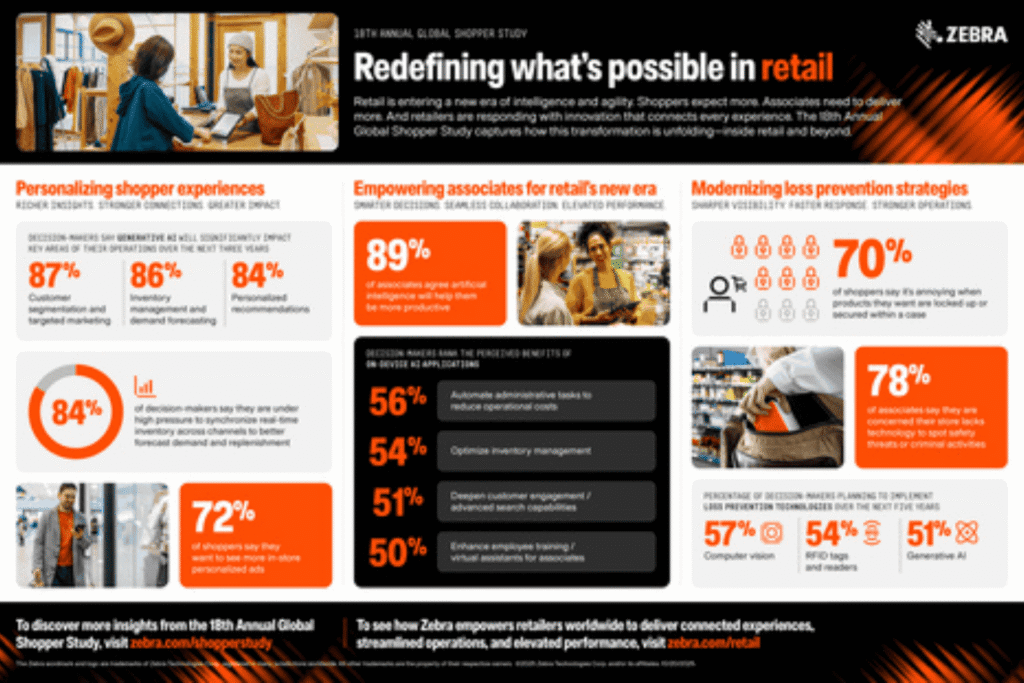
87 % of Retailers Say Generative AI Will Significantly Impact Loss Prevention

A new study by Zebra Technologies Corporation reveals that 87 % of retail decision-makers now believe generative artificial intelligence (Gen AI) and automation solutions will play a major role in loss-prevention efforts. The findings come from Zebra’s 18th Annual Global Shopper Study, published in November 2025. Business Wire+1

Key Findings

  • 87 % of retailers identified Gen AI and automation as “significant tools” for loss prevention. Business Wire

  • Shopper satisfaction is declining: satisfaction for in-store experiences fell to 79 % and online to 73 % globally. Business Wire

  • Associates are also facing challenges: 88 % of store associates reported difficulty obtaining timely assistance or information (up from 82 % last year). Business Wire

  • Inventory challenges remain a pain point: 84 % of retailers cited real-time inventory synchronisation as a top priority. And 51 % (vs 57 % last year) of shoppers said they left stores without all items they intended to purchase. Business Wire

Why This Matters

Loss prevention has become a critical area for retailers amid rising costs, supply-chain disruptions and changing shopper behaviours. The fact that nearly nine in ten retail executives expect Gen AI to impact this function signals that AI is shifting from experimentation to operational deployment. The study suggests retailers are no longer looking at AI solely for marketing or personalisation—they now see it as a tool to protect margins and inventory integrity.

Moreover, the study’s findings on declining shopper satisfaction for both in-store and online channels highlight the added pressure on retailers to improve operational reliability, staff support and inventory availability. The connection to Gen AI adoption implies that reducing shrinkage, improving accuracy and automating workflows will be key differentiators in the next phase of retail competition.

Strategic Implications for Retailers

1. Deployment of AI-Driven Loss Prevention Tools
Retailers are likely to invest in systems powered by Gen AI such as computer-vision-based analytics to detect theft, automation of exception workflows, predictive-analytics alerts for shrinkage risks, and advanced data-feeds tying product movement, returns and inventory.

2. Integration of Associate Tools and Frontline Workflows
With 88 % of associates flagging challenges in accessing information, retailers will need to deploy AI assistants and real-time insight platforms—reducing friction in store operations, improving productivity and supporting loss-prevention routines.

3. Enhanced Inventory and Visibility Control
Since inventory gaps remain a major driver of consumer dissatisfaction and margin loss, Gen AI solutions that integrate sensors/RFID, supply-chain data and predictive models will become essential. 84 % of retailers cited real-time inventory synchronisation as a key priority.

4. Optimization of Omnichannel Operations
Loss prevention is not a store-only issue anymore—returns, online fraud, click-and-collect and fulfillment gaps all contribute. Retailers that extend Gen AI tools across channels stand to gain an edge.

Challenges & Considerations

  • Data Readiness & Integration: Deploying Gen AI for loss prevention requires clean, high-quality data—inventory movement, transaction logs, video feeds, exception history—and integration across store, online and logistics systems.

  • Change Management: The shift to AI-led loss-prevention workflows requires training, change in role definitions, and aligning staff with new tools and metrics.

  • Privacy & Ethical Implications: Using AI for surveillance and shrinkage prevention raises questions around consumer consent, privacy, bias in detection systems and regulatory compliance.

  • Measuring ROI: While the intent is clear, retailers must develop robust metrics to measure how much shrinkage has been prevented, how recovery has improved and whether AI-tool costs are justified.

What to Watch

  • The percentage of major retailers publicly reporting shrinkage reduction tied to Gen AI tools.

  • Investment levels by region and size of retailer in “intelligent operations” projects addressing loss prevention.

  • Case studies illustrating AI-driven store associates improving productivity, reducing exceptions and improving customer service while also managing loss risks.

  • Evolution of AI-loss-prevention regulation and best-practice frameworks, especially in Europe, North America and Asia-Pacific.

Conclusion

The Zebra study highlights that loss prevention is rapidly becoming a strategic priority for retailers—and that Gen AI is seen as a core tool in the effort. With 87 % of decision-makers signalling its importance, the industry appears to be moving beyond hype toward tangible deployment of AI in frontline and operational roles. Retailers that invest in the right data, workflows and change management stand to improve margin protection, customer experience and operational resilience in an increasingly complex retail environment.