WORLDEF Prime Antalya 2026 — Super Early Bird Discounts

Register Now

1 Surprising Book Behind Amazon’s Massive E-Commerce Success

1 Surprising Book Behind Amazon’s Massive E-Commerce Success

From a Garage Startup to Global E-Commerce Leader

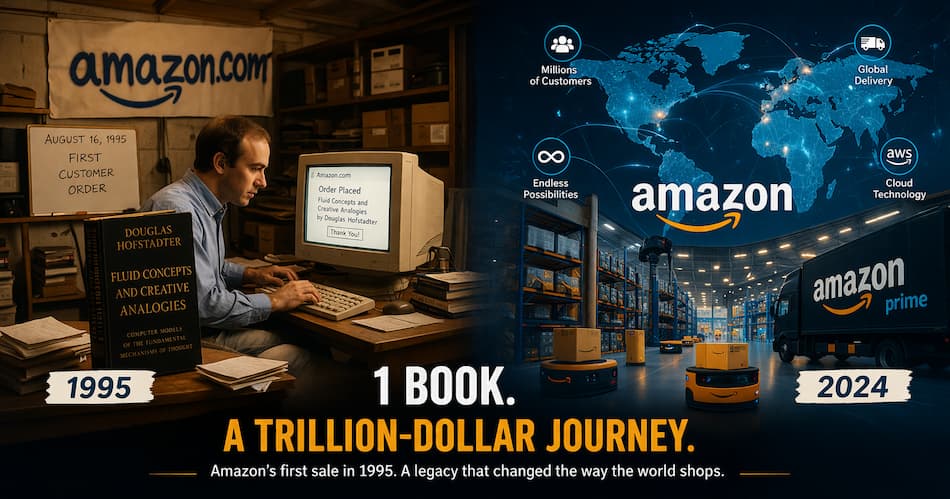
Long before Amazon became the world’s leading “everything store,” its journey began with a single, almost symbolic purchase.

In 1995, Amazon’s very first customer order was a book titled “Fluid Concepts and Creative Analogies” by Douglas Hofstadter, a work focused on artificial intelligence. At the time, the internet was still in its early stages, and Amazon operated as a small online bookstore from a garage.

This seemingly ordinary transaction has recently resurfaced online, going viral across social media platforms and reigniting discussions about the origins of modern e-commerce.

AI Before the AI Boom

What makes this story particularly striking today is its connection to artificial intelligence. Decades before AI became a global technology race, Amazon’s first-ever sale was already linked to the concept.

The viral post caught the attention of Jeff Bezos, who reacted with a simple acknowledgment, while Elon Musk described it as “the start of something great.”

The moment has sparked both nostalgia and irony, highlighting how a company that began with selling books is now deeply embedded in AI, cloud computing, and global digital infrastructure.

The Beginning of the “Everything Store”

Amazon officially launched in 1994 as an online bookstore, chosen for its scalability and wide product availability. Within months of opening in 1995, it expanded rapidly, reaching customers across the United States and dozens of countries.

What started with one book quickly evolved into a platform that reshaped retail, logistics, and digital commerce worldwide.

Today, that first purchase is more than just a historical detail, it represents the foundation of the modern e-commerce ecosystem.

Source: Financial Express, NDTV, Economic Times

WTO E-Commerce Talks Stall as 66 Members Push Interim Global Digital Trade Framework

WTO E-Commerce Talks Stall as 66 Members Push Interim Global Digital Trade Framework

Global e-commerce is entering a critical phase as WTO negotiations continue to stall, exposing deep divisions over the future of digital trade. While discussions remain unresolved, 66 member countries have taken a proactive step by advancing an interim framework to move forward without full consensus.

This shift signals a growing reality: global e-commerce can no longer wait for unanimous agreements. Instead, leading economies are beginning to shape the rules independently, accelerating the transition toward a fragmented but evolving digital trade system.

A Shift from Consensus to Coalition

The WTO has traditionally operated on consensus, but the current deadlock highlights the limitations of this model in a fast-moving digital economy. By pushing an interim framework, participating countries are effectively redefining how global e-commerce governance may evolve through coalitions rather than universal agreements.

With at least 45 members required for the framework to take effect, the initiative reflects both urgency and strategic alignment among key players in digital trade.

Why This Matters for E-Commerce

For global businesses, the implications are significant. A coalition-driven approach could lead to:

  • Faster implementation of digital trade rules
  • Increased regional alignment
  • Potential fragmentation in global standards

This creates both opportunities and risks. While companies may benefit from clearer rules in participating markets, differing frameworks across regions could complicate cross-border operations.

The Bigger Picture

The WTO’s stalled negotiations are not just a policy issue they reflect a broader transformation in how global e-commerce is governed. As digital trade grows faster than traditional regulatory systems, countries are being forced to adapt in real time.

The interim framework may not solve all challenges, but it marks a decisive step toward a new era of e-commerce governance one that is more flexible, faster-moving, and potentially more fragmented.

Source

Azerbaijan E-Commerce Dominates as Traditional Payments Fall Behind in 8.2 Billion Market

Azerbaijan E-Commerce Dominates as Traditional Payments Fall Behind in 8.2 Billion Market

Azerbaijan is experiencing a rapid shift toward digital payments, with e-commerce emerging as the dominant force in the country’s cashless economy.

According to the Central Bank of Azerbaijan, non-cash transactions reached 8.2 billion manats in February 2026, marking a 15% year-on-year increase. Notably, e-commerce accounted for 7.17 billion manats, representing 87.5% of all cashless payments.

POS terminals contributed 1.026 billion manats, while self-service terminals remained minimal at just 3 million manats.

Digital Payments Accelerate Across Azerbaijan

The growth reflects a broader transformation in consumer behavior, with digital channels increasingly replacing traditional payment methods. Since the beginning of 2026, domestic non-cash transactions using payment cards have made up nearly 70% of total card activity, highlighting strong adoption of digital finance solutions.

At the same time, payment infrastructure continues to expand rapidly. The number of POS terminals surged by 49.1%, while ATMs increased by 7%, improving accessibility nationwide.

Card Usage Trends Signal Market Shift

As of March 1, the total number of payment cards in circulation reached 22.3 million, reflecting steady growth both monthly and annually. Debit cards continue to dominate the market, rising by 12.8% year-on-year, while credit card usage declined by 8.5%.

This trend indicates a preference for direct spending and tighter financial control among consumers, aligning with broader global patterns in digital payments.

What It Means for E-Commerce

The overwhelming share of e-commerce in non-cash transactions underscores its central role in Azerbaijan’s digital economy. As infrastructure expands and consumer confidence grows, the sector is expected to continue driving financial innovation and shaping the future of commerce in the region.

Source: AzerNews

The Digital Kickoff: How the 2026 World Cup Will Affect E-Commerce

The Digital Kickoff

As we head toward 2026, the FIFA World Cup isn’t just arriving in North America; it’s arriving at the precise moment our region’s e-commerce ecosystem is primed for a major leap forward. I can tell you this: events of this scale don’t just move merchandise, they move markets.

We’re talking about a month-long tournament that will touch 16 cities, draw more than 6.5 million fans in person, and reach billions more online. According to FIFA and the World Trade Organisation, the 2026 World Cup could generate up to 40.9 billion dollars in total global economic activity, with roughly 17 billion of that expected to be spent within the United States. That’s not just stadium sales or hospitality spending, it’s a full-system boost rippling across logistics, fintech, media, and retail.

But here’s where it gets interesting for those of us who live in the e-commerce ecosystem: This World Cup will be the first true digital-first tournament. The 2018 and 2022 editions hinted at it, record mobile engagement, influencer activation, and real-time campaigns, but 2026 will be where those trends mature into the main event. Live commerce, ultra-fast fulfillment, connected event tech, and data-driven fan engagement will converge into a new retail model that blends emotion, experience, and immediacy.

Every World Cup drives spending, but 2026 arrives at the perfect technological moment. E‑commerce penetration in the U.S. is approaching 20 percent, and mobile commerce alone is expected to exceed 900 billion USD by then. Mexico’s Mercado Libre has reported over 30 percent year‑on‑year growth, while Canada forecasts nearly 4 billion CAD in GDP contribution tied directly to tournament‑related activity.

FIFA’s own digital engagement from Qatar 2022 exceeded 5 billion interactions. In 2026, those same behaviors will merge with smarter advertising, retail media networks, and live shopping ecosystems. InternetRetailing projects a 10.5 billion USD surge in global ad spend during the event, with retailers capturing the lion’s share through programmatic, AI‑driven placement. 

The World Cup will therefore act as a real‑time pressure test on supply chains, customer experience, and cross‑border commerce, the foundational pieces of our industry.

A New Chapter: The First AI World Cup

What makes 2026 distinct from any previous tournament is intelligence. This will be the first truly AI‑powered World Cup, where almost every part of the experience is guided by machine learning.

FIFA and its partners, including IBM, AWS, and Cisco, are deploying predictive systems for ticketing, transport, and venue logistics. These tools analyse live mobility and weather data to forecast demand and automate decisions on staffing, security, and fan flow. What fans will feel is smoothness: faster entry lines, accurate routing, stable connectivity, and instant mobile services.

Behind the scenes, broadcasting will be equally transformed. Generative AI will automatically create highlight reels, translate commentary into multiple languages, and tailor content to individual viewers. A Canadian fan streaming on a phone might receive local sponsor offers and French commentary, while a viewer in Mexico sees Spanish narration and Mercado Libre product links during the same live moment.

For e‑commerce professionals, this is where the real revolution begins. 2026 will mark the rise of agentic commerce transactions, initiated and optimised by AI agents acting on behalf of both consumers and retailers.

Imagine landing in Los Angeles for a match and finding that your phone’s digital assistant has already assembled your essentials: official team merchandise, local SIM card, transit pass, and travel insurance, all checked out with one approval. These are intelligent systems predicting your needs before you articulate them.

Major platforms are already preparing. Amazon’s conversational assistant can now generate entire product ensembles via voice. Mercado Libre experiments with AI chat agents that compare prices in real time, while Walmart tests predictive replenishment based on event calendars and social sentiment. During the World Cup, these systems will merge with fan data streams, creating live, contextual commerce that feels spontaneous yet highly orchestrated.

On the operations side, machine learning will manage availability and logistics. Demand forecasting will integrate ticket scans, match schedules, weather forecasts, and online chatter. Inventory will shift dynamically to warehouses nearest to trending teams. The result is a supply chain that thinks.

AI‑Supported Commerce in Action

  • Predictive pricing models will adjust merchandise costs minute‑to‑minute based on score lines, player performance, or local crowd demand.
  • Image‑recognition tools will link on‑screen gear, a star’s boots or kit, directly to instant purchase options.
  • Chatbots integrated with social platforms will act as personal sports concierges, arranging transport, accommodation, and event tickets through one conversational interface.
  • Payment systems will use biometric verification and blockchain‑based settlement for faster, fraud‑resistant cross‑border transactions.

According to PYMNTS, these fintech upgrades could expand North American cross‑border payments volume by 40 percent during the tournament.

The Infrastructure Behind the Magic

All this intelligence requires muscle. Logistics providers in Mexico City and Los Angeles are already constructing micro-fulfillment hubs within thirty minutes of stadium zones. In Canada, predictive route optimisation is being built to manage weather‑related delays. Drone delivery trials are quietly expanding in Guadalajara and Dallas.

Hospitality is equally data‑driven. Hotels are adopting AI yield‑management systems that balance real‑time demand with sustainability goals. Expect to see personalised offers delivered to guests’ phones during matches, everything from last‑minute suite upgrades to curated local experiences.

Why World Cup 2026 Matters?

Major events have always pushed commerce forward. The 2008 Beijing Olympics accelerated mobile payments in China; the 2014 Brazil World Cup reshaped global social advertising. The 2026 edition will fuse those lessons into a single ecosystem: AI‑driven, real‑time, and borderless.

For North America, it’s also a test of integration. The tri‑nation hosting model means harmonizing currencies, taxes, freight corridors, and data standards across three regulatory environments. If this collaboration succeeds, it could become the blueprint for next‑generation regional trade.

Beyond the Pitch: The Legacy of 2026

Living in Dubai for the past five years, I’ve watched as data and AI have turned the city into a living retail laboratory. What’s happening here, predictive logistics, cryptocurrency payments, and autonomous store models, offers a glimpse of what North America will experience in 2026. The same intelligence driving Expo 2020 or GITEX showcases will now power one of the world’s most emotional events.

This is no longer about “e‑commerce” versus “traditional retail.” It’s about commerce itself becoming aware, understanding intention, reacting instantly, and connecting supply to emotion faster than any manual system ever could.

By the time the final whistle blows in 2026, the winners will not only be on the pitch. They will be the retailers, platforms, and innovators who prepared early, built intelligent systems, and turned fan passion into sustainable digital growth.

The World Cup has always celebrated human performance. This one will celebrate human creativity amplified by the intelligence of machines.

Global E-Commerce Gets a Boost as China Announces 5 Cross-Border Trade Measures

Global E-Commerce Gets a Boost as China Announces 5 Cross-Border Trade Measures

China has unveiled a new policy framework aimed at strengthening its e-commerce sector, with a particular focus on cross-border trade and global market expansion. The move reflects Beijing’s effort to balance domestic growth with increasing international pressures and competition.

The guidance, jointly issued by multiple government bodies including commerce, industry, and cyberspace regulators, outlines a coordinated approach to improving both regulation and promotion within the digital economy.

A Strategic Push for Global E-Commerce Integration

At the core of the policy is the ambition to better align China’s domestic e-commerce ecosystem with global markets. Authorities emphasized the need to integrate the digital and real economies while maintaining a balance between efficiency, fairness, and regulatory oversight.

This comes shortly after increased scrutiny from international partners, particularly the European Union, over issues such as product safety, market access, and competitive fairness.

5 Key Measures Driving China’s E-Commerce Strategy

The new guidance introduces several major initiatives shaping the future of China’s e-commerce landscape:

  • Pilot zones for cross-border e-commerce to test new policies and accelerate innovation
  • Development of international rules and standards to align with global trade practices
  • Expansion of Chinese platforms into overseas markets to strengthen global reach
  • Encouragement for companies to establish procurement bases abroad
  • Streamlined import channels for high-quality global products entering China

These measures aim to position China as a more integrated and competitive player in global digital trade.

Addressing Global Trade Tensions

The policy also reflects broader geopolitical dynamics. Recent discussions with EU lawmakers highlighted concerns about unsafe products and limited access for foreign businesses in China.

While the new framework does not directly address these disputes, it signals China’s willingness to improve coordination and potentially ease tensions through regulatory refinement and market openness.

What It Means for the Global E-Commerce Ecosystem

China remains the world’s largest e-commerce market, and its regulatory direction has a significant impact on global supply chains and digital trade flows.

By promoting cross-border e-commerce, improving standards, and encouraging international expansion, the country is reinforcing its role as a central hub in global online commerce.

However, experts suggest that while the policy is a positive step, it may not fully resolve deeper trade imbalances and regulatory concerns between China and its international partners.

Source: Reuters

AI Boom Accelerates as E-Commerce Tech Drives 100% Surge in Foundational Funding

AI Boom Accelerates as E-Commerce Tech Drives 100% Surge in Foundational Funding

The global investment landscape is undergoing a major shift as foundational AI startups attract unprecedented levels of capital, signaling a new phase for digital commerce infrastructure.

According to Crunchbase data, funding to foundational AI companies – including firms developing large-scale generative models – reached $178 billion in Q1 2026 alone, doubling the $88.9 billion raised across all of 2025.

This sharp increase highlights how artificial intelligence is rapidly becoming the backbone of e-commerce, powering everything from personalization and search to logistics optimization and customer service automation.

E-Commerce Transformation Accelerates with AI Investment Boom

The surge in funding is heavily concentrated among a small group of dominant players. Companies such as OpenAI, Anthropic, and xAI are capturing a disproportionate share of global capital, reflecting a growing “winner-takes-most” dynamic in the AI ecosystem.

OpenAI alone has raised over $120 billion, marking one of the largest private funding rounds in history. Meanwhile, Anthropic secured $30 billion, and xAI raised $20 billion, reinforcing their positions as leading forces shaping the future of digital infrastructure.

Beyond the scale, the structure of funding is also shifting. While fewer deals are being made – just 24 major transactions in Q1 2026 – the average deal size has grown significantly, indicating that investors are placing larger, more concentrated bets on a limited number of AI leaders.

This trend comes after years of broader but less focused venture investment. In contrast, today’s capital allocation strategy prioritizes companies building foundational models that can be applied across industries, including e-commerce platforms, marketplaces, and payment systems.

The impact on e-commerce is already visible. AI-driven tools are enabling faster product discovery, smarter recommendation engines, automated customer support, and more efficient supply chain operations. As these technologies mature, they are expected to redefine how online businesses operate and scale globally.

At the same time, the dominance of a few major players raises concerns about market concentration. With a significant portion of venture funding flowing into just a handful of companies, smaller startups may face increasing challenges in accessing capital and competing at scale.

Still, investor confidence remains strong. AI-related startups accounted for nearly 50% of global venture funding in 2025, underscoring the sector’s central role in the future of digital economies.

As the AI race intensifies, the connection between foundational models and e-commerce will only deepen. What was once considered a supporting technology is now becoming the core infrastructure powering the next generation of online commerce.

Source: Crunchbase

E-Commerce Faces Checkout Challenge as 3 Payment Options Drive 30% More Conversions

E-Commerce Faces Checkout Challenge as 3 Payment Options Drive 30% More Conversions

Checkout has become the most critical battleground in e-commerce, where even small friction points can determine whether a sale is completed or abandoned. New data shows that payment flexibility is now one of the strongest drivers of conversion.

According to research from ACI Worldwide, nearly 70% of online shoppers abandon their carts, contributing to an estimated $4 trillion in lost sales globally. The key issue is no longer pricing or shipping it is the lack of preferred payment options.

Retailers that rethink their payment strategy can significantly improve performance. Offering the right mix of payment methods rather than just one or two can increase conversion rates by up to 30%, highlighting how crucial payment choice has become in modern e-commerce.

E-Commerce Growth Is Now Driven by Flexible Payment Options

The shift is being driven by three key payment categories: digital wallets, account-to-account (A2A) payments, and alternative options such as Buy Now, Pay Later (BNPL). These methods reduce friction and align better with how consumers prefer to shop, especially on mobile devices.

Mobile commerce remains the weakest link in conversion performance despite generating 68% of total traffic. High friction at checkout particularly manual entry of payment details pushes abandonment rates as high as 85% on mobile.

Solutions such as one-click checkout, biometric authentication, and stored payment credentials are helping address this issue. Digital wallets, in particular, allow users to complete purchases instantly without entering card details, significantly improving user experience.

Consumer expectations are also evolving rapidly. In 2024, 61% of shoppers abandoned purchases because their preferred payment method was not available. Despite this, more than one in five e-commerce websites still offer only a single payment option a gap that directly impacts revenue.

Each additional relevant payment method can increase conversions by an average of 7%, meaning that a well-optimized combination of three options can deliver substantial cumulative gains.

Beyond convenience, trust is becoming a decisive factor. Bank-backed solutions like Paze are gaining traction by offering secure, tokenized transactions without requiring app downloads. This addresses growing concerns around security, with 82% of consumers trusting bank-based payment systems more than third-party providers.

For retailers, the message is clear: more payment options do not necessarily mean better outcomes but the right, localized mix does. Successful merchants are increasingly using data-driven strategies to tailor payment methods based on customer behavior, geography, and device usage.

As e-commerce continues to scale, payment infrastructure is also evolving. Cloud-based systems, intelligent routing, and AI-driven authentication are enabling businesses to deliver faster, more seamless checkout experiences while maintaining security and performance.

In this new landscape, payment is no longer just a backend function. It has become a strategic growth lever one that can directly influence conversion rates, customer trust, and long-term revenue.

Source: E-Commerce Times

TikTok Shop Sees Strong 32% Higher Online Spending in Germany After 1 Year

TikTok Shop Sees Strong 32% Higher Online Spending in Germany After 1 Year

TikTok Shop is strengthening its position in Germany’s e-commerce market just one year after launch, with new NielsenIQ data showing that the platform is attracting more users, generating more frequent purchases, and expanding beyond its early niche. It now ranks 15th among online retailers tracked by NIQ in the country.

Adoption has risen steadily over the past year. Around six months after launch, 10.5% of online shoppers in the NielsenIQ panel had made at least one purchase on TikTok Shop. That figure has now climbed to just over 15%, suggesting that more consumers are not only trying the platform but continuing to shop through it.

TikTok Shop Expands Beyond Gen Z to Become Mainstream Channel

The category mix is also becoming broader. While beauty and personal care remain important, fashion now generates the largest share of TikTok Shop revenue in Germany at 17%. Electronics follow at 16%, while home and household-related products account for 14%. Other categories, including culture, games, appliances, food, and pet supplies, are also gaining momentum.

One of the most notable shifts is in audience behavior. Although Generation Z remains a major user group, it is no longer the only driver of platform growth. Generation Z and Generation X each make up 33% of buyers, while shoppers aged 47 to 66 generate the highest share of revenue at 37%. This points to TikTok Shop evolving from a youth-led social commerce channel into a broader mainstream retail platform.

Customer engagement is rising as well. Purchase frequency increased from 2.3 orders in October 2025 to 3.3 orders in recent months, indicating that TikTok Shop is becoming part of regular shopping routines rather than being used only occasionally.

The spending gap is another strong signal for e-commerce players. Consumers who shop via TikTok spend an average of €2,564 annually online, compared with €1,939 among non-users, a difference of around 32%. They also shop roughly every eight days, although their average basket value of €56.50 remains slightly below the wider e-commerce average.

For the wider e-commerce industry, the German market offers a clear message: TikTok Shop is no longer just an experimental channel. Its growth is being supported by repeat purchases, rising user adoption, and expanding product demand across multiple generations. As social commerce continues to mature, TikTok Shop is becoming a more established force in Europe’s digital retail landscape.

Source

E-Commerce Growth Accelerates as DP World Expands End-to-End Logistics Across 100+ Countries

E-Commerce Growth Accelerates as DP World Expands End-to-End Logistics Across 100+ Countries

DP World is strengthening its logistics footprint in Mexico by rolling out an integrated end-to-end supply chain model, as the company leverages its presence across more than 100 countries to streamline global trade flows.

The move comes as e-commerce and nearshoring trends reshape supply chains, pushing companies to seek faster, more reliable logistics solutions across North and Central America.

A Fully Integrated Supply Chain Model

DP World’s end-to-end logistics model connects every stage of the supply chain from origin to final delivery within a single ecosystem. This includes freight forwarding, warehousing, customs clearance, and last-mile delivery.

By minimizing intermediaries, the company aims to improve efficiency, reduce delays, and offer greater cost predictability for businesses operating in Mexico and beyond.

The expansion builds on DP World’s growing presence in the country, including new freight forwarding operations in Mexico City designed to enhance regional connectivity.

Mexico’s Role in a Shifting Global Supply Chain

Mexico is rapidly emerging as a strategic logistics hub, fueled by nearshoring and its proximity to the US market.

As manufacturers relocate production closer to North America, demand for integrated logistics services continues to rise. DP World’s infrastructure investments, including warehousing and distribution facilities, are positioned to support this transformation.

Its global network spanning 100+ countries allows the company to connect Mexican supply chains with international markets more efficiently.

What It Means for E-Commerce

For e-commerce businesses, the shift toward integrated logistics is critical.

DP World’s model enables:

  • Faster order fulfillment
  • Improved inventory visibility
  • More efficient returns
  • Seamless omnichannel operations

By combining first- and last-mile capabilities, the company helps reduce delivery times while improving customer experience – key factors in competitive e-commerce markets.

A Strategic Shift in Logistics

As global trade becomes more complex, logistics providers are evolving into full-service supply chain partners.

DP World’s expansion in Mexico reflects a broader transformation: logistics is no longer just infrastructure-it is a core driver of e-commerce growth.

Source

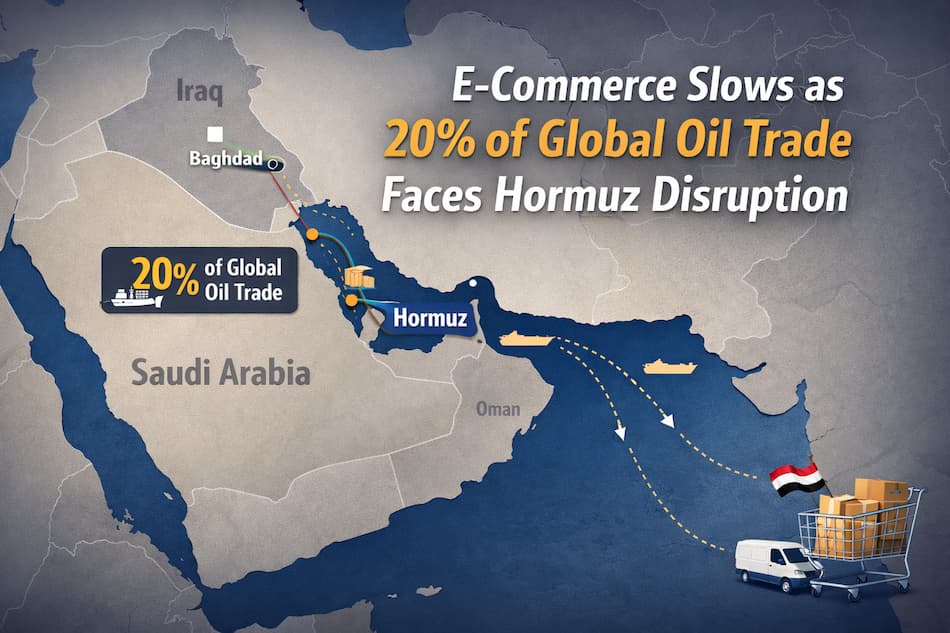
E-Commerce Hit by Hormuz Crisis as 20% of Global Oil Trade Is Affected

strait-of-hormuz-disruption-slows-iraqi-e-commerce-as-costs-rise-and-deliveries-delay

The ongoing disruption in the Strait of Hormuz is beginning to ripple through Iraq’s digital economy, with e-commerce businesses facing rising costs, delayed deliveries, and increasing order cancellations.

Online retailers across Iraq report mounting logistical challenges as shipments-many routed through key global trade corridors are slowed or rerouted. The impact is particularly visible in delivery timelines, once considered a competitive advantage for e-commerce platforms.

Delivery Delays and Rising Cancellations

Small and medium-sized online sellers are among the hardest hit. Many rely on imported goods from international suppliers, particularly in Asia, making them highly dependent on stable shipping routes.

Retailers say delayed shipments have triggered a surge in cancellations, as customers opt out of purchases when delivery times become uncertain. Sellers are also absorbing additional operational pressure, balancing customer expectations with limited control over supply chain disruptions.

Transport costs have increased significantly, squeezing already thin margins. Some businesses are choosing to maintain prices to remain competitive, even as profitability declines.

Supply Chain Pressure Hits Core E-Commerce Model

The Strait of Hormuz is one of the world’s most critical maritime trade routes, handling a substantial share of global energy and cargo flows. Any disruption quickly translates into higher fuel prices and shipping costs globally, directly impacting online retail.

Economists warn that e-commerce built on speed, affordability, and product availability is especially vulnerable to such shocks.

Higher oil prices are already driving up logistics expenses across both air and sea freight. This, in turn, is increasing product prices, reducing consumer purchasing power, and weakening demand in price-sensitive markets like Iraq.

Reduced Variety and Slower Market Activity

Beyond delays, the disruption is also affecting product availability. Import-dependent markets are seeing reduced variety as supply chains slow, particularly for goods sourced from China and India.

This shift is forcing e-commerce platforms and sellers to rethink inventory strategies, promotional campaigns, and pricing models. Some larger players may pass costs directly to consumers, while smaller sellers risk losing market share.

Experts note that emerging markets tend to feel the impact more sharply due to their reliance on imports and limited logistical alternatives.

A Structural Challenge for Digital Commerce

The situation highlights a broader vulnerability in global e-commerce: dependence on key geopolitical chokepoints.

As disruptions in the Strait continue, Iraqi e-commerce is likely to remain under pressure, with longer delivery cycles, higher prices, and reduced competitiveness shaping the market in the near term.

For the sector, the crisis serves as a reminder that digital commerce is only as resilient as the physical infrastructure behind it.

Source