WORLDEF Prime Antalya 2026 — Super Early Bird Discounts

Register Now

Alibaba Unveils Qwen 3.8 Max, Escalating the Global AI Race

Alibaba Unveils Qwen 3.8 Max, Escalating the Global AI Race

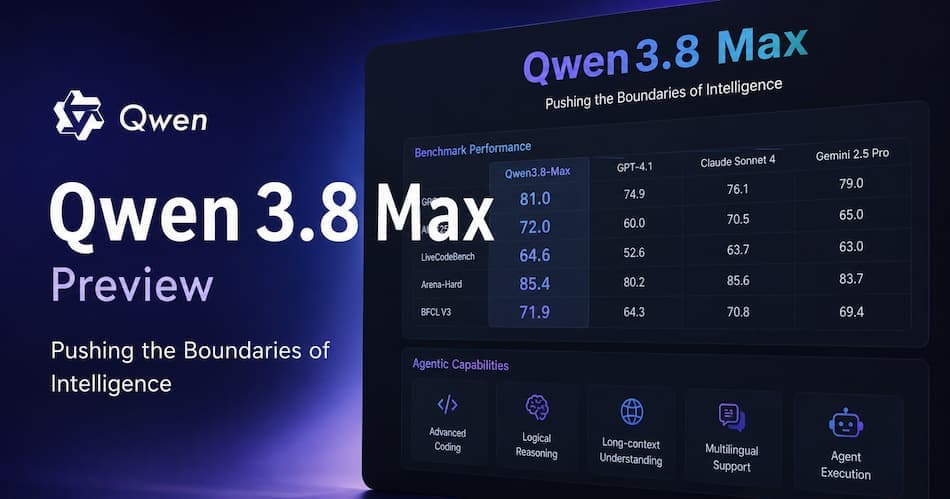
Alibaba has officially unveiled a preview of Qwen 3.8 Max, describing it as its most capable artificial intelligence model to date and positioning it among the world’s leading foundation models. The announcement marks another significant milestone in China’s rapidly evolving AI landscape, where competition among major technology companies continues to intensify. 

The company stated that Qwen 3.8 Max delivers major improvements in reasoning, coding, multilingual understanding, and agentic capabilities, enabling AI systems to perform increasingly complex tasks with greater accuracy and efficiency.

Strong Focus on Agentic AI

According to Alibaba’s latest announcements, Qwen 3.8 Max has been designed for the next generation of AI applications, where intelligent agents can independently plan, reason, and execute multi-step workflows.

The company highlighted advances across several areas, including:

  • More advanced logical reasoning
  • Enhanced software development and coding performance
  • Improved long-context understanding
  • Better multilingual capabilities
  • Stronger AI agent execution

Alibaba also emphasized that the new model is intended to support both enterprise deployments and developer ecosystems through its expanding Qwen platform.

Benchmark Results Target Global Competitors

Alibaba claims Qwen 3.8 Max achieves competitive results across multiple industry benchmarks, placing it among the strongest AI models currently available.

While independent evaluations are still emerging, the company says the model has demonstrated significant improvements over previous Qwen releases in coding, mathematical reasoning, scientific knowledge, and complex instruction following. 

The launch further intensifies competition with leading AI developers including OpenAI, Google, Anthropic, xAI, Meta, and other Chinese AI companies.

Open Ecosystem Remains a Strategic Priority

Alongside the model preview, Alibaba reaffirmed its commitment to expanding the Qwen ecosystem through continued investment in developers, enterprise AI adoption, and open innovation.

Recent updates shared by the Qwen team highlight ongoing improvements to model capabilities, infrastructure, and deployment options aimed at accelerating real-world AI applications across industries.

The strategy reflects Alibaba’s broader ambition to strengthen its position as one of the world’s leading AI technology providers while supporting businesses building AI-powered products and services.

China’s AI Competition Continues to Accelerate

The release of Qwen 3.8 Max comes as Chinese technology companies are accelerating investments in large language models and enterprise AI infrastructure.

With increasingly capable models entering the market, competition is shifting beyond chatbot performance toward AI agents capable of automating business workflows, software development, research, customer service, and enterprise productivity.

As global AI innovation continues to accelerate, Alibaba’s latest model signals that competition among leading AI companies is entering an even more advanced phase.

Source

Mastercard Launches the Era of AI-Powered Payments in ASEAN

Mastercard

Mastercard has taken a significant step to expand AI-powered payment systems in Southeast Asia (ASEAN). The company has rolled out “agentic” transactions meaning authenticated transactions initiated by artificial intelligence across multiple markets, including Singapore and Malaysia, while also announcing that it will establish a new AI Centre of Excellence in Singapore.

The new system announced by Mastercard enables AI agents to carry out transactions securely on behalf of users. Through technologies such as tokenization, verifiable intent, and end-to-end auditability, it ensures that every transaction is aligned with user authorization.

The first pilot implementations were carried out in collaboration with UOB, one of the region’s leading banks. These tests demonstrated that a scalable and secure payment infrastructure is possible across different countries.

Mastercard’s New Payment Ecosystem Based on Data and Trust

The “Agent Pay” system developed by Mastercard places trust at the center of AI-powered commerce. The “Verifiable Intent” technology, developed together with Google, protects against manipulation by recording which transactions users have authorized.

According to experts, this approach will play a critical role in maintaining user trust as automation in e-commerce increases. In a world where AI agents can transact on behalf of consumers, transparency and auditability are becoming fundamental requirements.

An AI Center to Be Established in Singapore

Mastercard aims to increase innovation capacity in the region with the AI Centre of Excellence it will launch in Singapore later this year. This center will become one of the company’s largest R&D hubs in cybersecurity, data analytics, and artificial intelligence.

The company has already been using artificial intelligence for more than a decade in areas such as fraud prevention and risk management. With the new center, these capabilities are planned to be applied on a broader scale.

A New Era in E-Commerce Begins

According to experts, ASEAN is one of the fastest-growing regions for AI-powered commerce, thanks to its young population, rapid digitalization, and strong mobile payment adoption. Mastercard’s move is considered a step that could shape not only regional but also global e-commerce trends. In the coming period, AI systems that shop on behalf of users and cross-border integrated payment solutions may become standard in digital commerce.