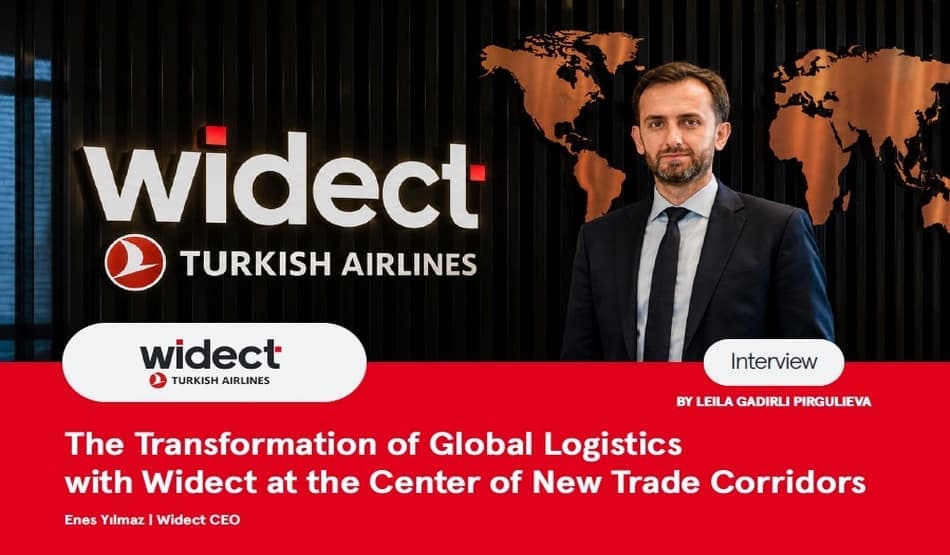
In the new era of global trade, logistics is no longer merely an operational field that moves products from one point to another; it has become one of the key determinants of growth, customer experience, and international competitiveness. In particular, the rapid growth of cross-border e-commerce is transforming the logistics sector into a more integrated, more technology-driven, and more flexible structure. Geopolitical developments, changing trade corridors, new customs regulations, and rising customer expectations are forcing companies to move beyond traditional operational models.
One of the companies at the center of this transformation is Widect. Powered by Turkish Airlines’ global flight network, the company brings air cargo, e-commerce logistics, and door-to-door delivery solutions together under a single structure, standing out with its goal of turning Istanbul into a global e-commerce logistics hub. Widect aims to respond to the new needs of cross-border trade by bringing together technology, operational flexibility, and international network management, beyond being merely a logistics player that provides transportation services.
We spoke with Widect CEO Enes Yılmaz about Widect’s growth strategy, its plans for the MENA region, its artificial intelligence investments, changing supply chain dynamics, and the transformation the air cargo sector will undergo over the next five years. We also listened to the details of the vision that will strengthen Istanbul’s role on the global logistics map and Türkiye’s e-export potential!
What positioning strategy do you pursue as Widect in the global air cargo and logistics ecosystem? What are the key competitive advantages that differentiate you?
As Widect, we build our positioning on three core concepts that are also included in our brand name: Wide, Direct, and Connect. Turkish Airlines’ extensive flight network spanning 140 countries gives us the “Wide” vision. Our ability to offer direct door-to-door transportation solutions, combined with Widect’s logistics expertise and operational capabilities, forms our “Direct” approach. Our goal of connecting sellers, buyers, cultures, and markets in different parts of the world represents our “Connect” philosophy.
Within this framework, our strategy is to combine Turkish Airlines’ global network strength and Türkiye’s strategic location with door-to-door solutions tailored to the needs of e-commerce and cross-border logistics. The most important competitive advantage that differentiates us is our strong brand reliability, extensive global network, air cargo expertise, and our ability to transform this structure into end-to-end logistics solutions.
How have the recent increasing geopolitical crises and changing trade corridors in the Middle East affected your operational processes? What kind of strategic structure have you built for such risks?
Recent geopolitical developments have directly affected global logistics supply chains through factors such as airspace closures, capacity constraints, route changes, and rising operational costs. From time to time, we faced processes that required rapid action, similar to the pandemic period. As Widect, our most important advantage during these periods was our ability to act flexibly and adapt quickly to changing conditions.
We focused on maintaining our operations in the most efficient way possible through both air transport and integrated air-road solutions. Our strategic approach to such risks is shaped around building a flexible structure that continuously monitors open corridors, changing trade routes, and operational dynamics, can make quick decisions, and can activate different transportation models.
The air cargo sector has become more critical than ever with the rise of e-commerce. What structural transformations do you expect in the sector over the next 5 years?
In the coming period, we believe the air cargo sector will evolve into a more integrated, more technology-driven, and more customer experience-centered structure, especially with the growth of cross-border e-commerce. In e-commerce, speed, visibility, cost optimization, and regulatory compliance have become elements that can no longer be evaluated separately. In this context, we expect models in which fulfillment centers are more closely integrated with air cargo and distribution networks to come to the forefront. In cross-border shipments, not only the transportation of products, but also their storage, sorting, labeling, management of customs processes, and traceable delivery all the way to the end user will become critical.
In addition, the differentiation of tax, customs, and legal regulations between countries will require logistics players to develop more flexible and compliant solutions. Therefore, value-added services, smart customs solutions, data analytics, automation, and artificial intelligence-supported operational management will be among the main transformation areas of the next five years.
The Gulf and the broader MENA region hold great potential in terms of logistics. What is your growth strategy in this region as Widect?
Although the Gulf and the broader MENA region have been affected by war, they are among the strategically important markets for Widect in terms of both the size of consumer demand and cross-border e-commerce potential. Our efforts to consolidate and develop our services in this region through different sub-models continue. In the short and medium term, our goal is to strengthen the quality of the services we provide to almost all MENA countries and to offer more integrated solutions for the region.
In addition, we are not limiting ourselves only to Türkiye-origin operations; we are also working on third-country transit models. In other words, we aim to create a broader regional network by activating Widect capabilities in operations directed toward the MENA region from markets outside Türkiye.
In which areas do you use AI technologies at Widect, and what has been the contribution of these investments to operational efficiency?
As Widect, we evaluate artificial intelligence and data-driven technologies to increase efficiency both in our parcel delivery operations and in our internal processes. Operational planning, shipment tracking, process optimization, capacity management, and more accurate analysis of customer needs are among the leading areas. Through our software development efforts, we aim to make our operations faster, more visible, and more scalable. Artificial intelligence-supported solutions provide significant contributions, especially in terms of accelerating decision-making processes, identifying operational bottlenecks in advance, and responding more flexibly to the needs of different markets.
What solutions have you developed to optimize air cargo operations within the triangle of speed, cost, and reliability?
In order to ensure the balance of speed, cost, and reliability in air cargo operations, it is first necessary to have a flexible and adaptable operational structure. As Widect, we can quickly adapt our systems and operations according to the regulations, customs, and distribution practices of different countries. In this context, we differentiate our operational flows according to the destination country and shipment type; we design the most suitable solution according to demand, capacity, and legal regulations.
Thanks to the software infrastructures we have developed with Turkish Technology and our own teams, we focus on making our processes more efficient, measurable, and optimizable. Our aim is not only to provide fast transportation, but to offer end-to-end solutions that together ensure the right route, the right cost, the right operational model, and reliable delivery.
Considering changing customer expectations in cross-border e-commerce, what digital or operational innovations do you have to improve customer experience?
Customer expectations in cross-border e-commerce are no longer limited only to delivery speed. Shipment visibility, predictability of the delivery process, ease of returns, proper management of customs processes, and end-user experience have become just as important as speed. As Widect, we develop flexible solutions according to different demands and needs in destination countries. Thanks to our extensive flight network, we separate shipments at our operations center based on destination country, city, and distribution model, creating more efficient flight and distribution services.
This approach contributes to improving transit time efficiency and enhancing the customer experience. In addition, we continue to respond to the changing needs of the sector by using our know-how and integrated service capabilities not only in Türkiye-origin operations, but also in operations centered in different countries.
Disruptions in global supply chains are directing companies toward more flexible models. What role does Widect play in this transformation?
Disruptions in global supply chains have shown companies that uniform and fixed logistics models are no longer sufficient. Today, having a flexible, scalable, and integrated infrastructure suited to the needs of both customers and logistics stakeholders has become the most critical element. In this transformation, Widect assumes the role of a platform that combines air cargo strength with door-to-door logistics solutions. While developing end-to-end solutions according to the needs of our customers in different markets, we also focus on establishing integrated and sustainable business models with our logistics stakeholders. Thanks to this approach, we offer a structure that is more resilient against supply chain disruptions, capable of creating alternative corridors, and able to adapt quickly to changing conditions.
How would you define Widect’s long-term vision? What will be the most critical steps that will make you a strong player not only regionally but also globally?
At the center of our long-term vision is turning Istanbul into a global e-commerce logistics hub. Turkish Airlines’ global flight network, Türkiye’s strategic location, and our country’s e-export potential form the strongest building blocks of this vision. Our investments in the Widect Operations Center at Istanbul Airport are also one of the most important steps we have taken in line with this goal.
Since our Widect operations began in 2023, we have defined our goal not only as growing regionally, but as becoming one of the world’s leading e-commerce logistics brands. In this direction, we continue our efforts to transform the global network strength of Turkish Airlines into a strong logistics brand that provides door-to-door, end-to-end services. In the coming period, establishing similar operational structures in different countries, connecting these centers with integrated services, developing fulfillment capabilities, and strengthening technological infrastructure will be among our critical steps. Our aim is to make Istanbul not only a transfer point, but a center that exports services on a global scale in terms of e-export logistics, fulfillment, and value-added services.