WORLDEF Prime Antalya 2026 — Super Early Bird Discounts

Register Now

NjiaPay Unveils One-Click Payments to Speed Up South Africa’s E-commerce Checkout

NjiaPay Unveils One-Click Payments to Speed Up South Africa’s E-commerce Checkout

New solution aims to reduce cart abandonment and improve payment success for online merchants

South African fintech NjiaPay has introduced a new one-click payment solution designed to streamline e-commerce checkout experiences by enabling returning customers to complete purchases without repeatedly entering their card details or undergoing additional authentication steps.

The launch addresses one of the biggest challenges facing online retailers in South Africa – checkout friction – which continues to contribute to high cart abandonment rates. According to the company, its payment-provider-agnostic technology allows merchants to offer a seamless repeat-purchase experience regardless of which payment service provider (PSP) they use, eliminating the limitations of traditional one-click payment systems tied to a single provider. 

Tokenisation replaces stored card data

The company, which is PCI DSS Level 1 compliant, said the approach enhances security because the stored token cannot be used outside the merchant’s own platform, even in the event of a security breach. 

Rather than storing customers’ payment card information, NjiaPay uses secure tokenisation after a shopper completes their first authenticated transaction and consents to saving their payment details. The generated token is unique to each merchant, allowing future purchases to be completed with a single click while reducing the risk of exposing sensitive financial information.

Helping merchants recover lost sales

NjiaPay believes the solution can significantly improve conversion rates by removing unnecessary checkout steps that often discourage customers from completing purchases.

The company estimates merchants could see a 5% to 10% increase in successful card-on-file transactions through the simplified checkout process. The solution is particularly aimed at e-commerce businesses, subscription services and retailers with high volumes of repeat customers.

According to NjiaPay, South African ecommerce businesses experience cart abandonment rates of up to 83%, with payment failures, repeated form filling, redirects and authentication requirements among the leading causes. The company also noted that 3-D Secure authentication succeeds only around 80% of the time, creating additional friction during checkout. 

Payment orchestration beyond a single provider

Unlike conventional checkout solutions, NjiaPay operates as a neutral payment orchestration layer that sits above merchants’ existing PSP infrastructure. Its API enables businesses to connect multiple payment providers through a single integration while intelligently routing transactions to improve payment performance.

The platform currently supports card payments, digital wallets and supported variable recurring payment methods, including Capitec Pay VRP. By giving merchants greater flexibility and reducing dependence on a single payment provider, the company aims to improve reliability while maintaining a fast and consistent checkout experience.

Source

Yalla Secures UAE Central Bank Approval to Expand Digital Payments

Yalla Secures UAE Central Bank Approval to Expand Digital Payments

Yalla Financial Solutions has received in-principle approval from the Central Bank of the UAE (CBUAE) for a Retail Payment Services (RPS) Category II licence, marking a significant milestone in its regional expansion and positioning the company to broaden its digital payments offering in one of the Middle East’s fastest-growing fintech markets. 

The approval, granted under the CBUAE’s Retail Payment Services and Card Schemes Regulation, allows Yalla to move closer to launching regulated payment services in the UAE once it fulfils the remaining regulatory requirements and secures its final licence. 

Strengthening payment infrastructure

Following final regulatory approval, Yalla plans to expand its payment capabilities for consumers, merchants and enterprises across the UAE. The company aims to provide faster, more secure and locally compliant payment services while supporting the country’s ambitions to become a global hub for digital finance. 

According to the company, the future portfolio will include:

  • Payment gateway services
  • Payment aggregation
  • Online and in-store merchant payment acceptance
  • QR code payments
  • SoftPOS solutions
  • Payment orchestration
  • Tokenisation services
  • Recurring payment capabilities
  • Value-added payment services 

CEO highlights UAE fintech ambitions

Waleed Sadek, CEO and Founder of Yalla Financial Solutions, described the approval as an important milestone for the company.

He said the decision reflects Yalla’s commitment to building secure, innovative and compliant payment infrastructure while supporting the UAE’s vision of becoming one of the world’s leading digital economies. Sadek added that the company will continue working closely with the central bank to complete the remaining licensing requirements before launching its expanded services. 

Supporting digital commerce

Yalla currently operates across Egypt, the UAE, Saudi Arabia and Pakistan, offering digital payment solutions for consumers, merchants and financial institutions. The company said the UAE approval aligns with its broader strategy of investing in next-generation payment infrastructure, accelerating digital commerce and improving financial inclusion across the region. 

The move comes as the UAE continues to strengthen its regulatory framework for digital payments, encouraging innovation while ensuring payment providers meet strict compliance and security standards. The country’s central bank has recently approved several fintech initiatives aimed at expanding the local digital payments ecosystem.

Source

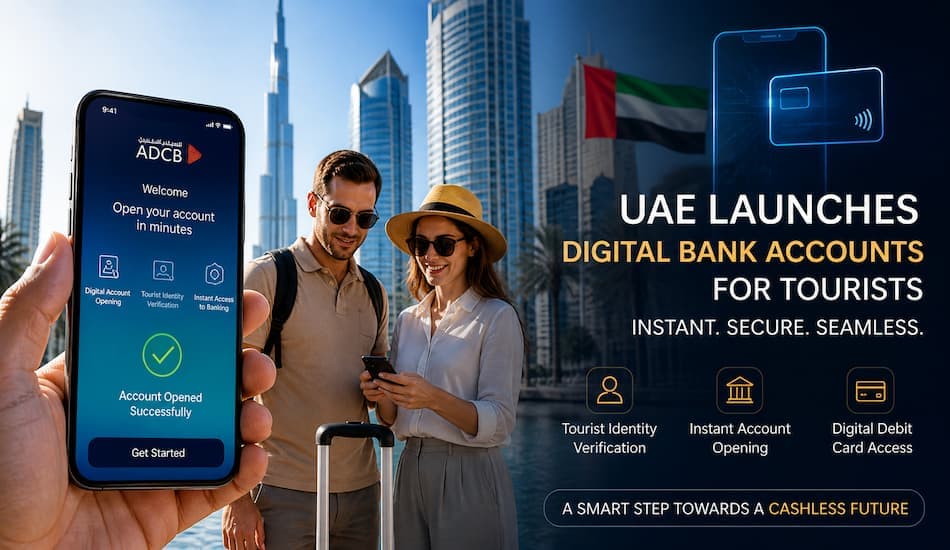
3 Powerful Gains as UAE Launches Digital Bank Accounts for Tourists via “Tourist Identity”

3 Powerful Gains as UAE Launches Digital Bank Accounts for Tourists via “Tourist Identity”

The Central Bank of the UAE (Central Bank of the UAE), in collaboration with the Federal Authority for Identity, Citizenship, Customs and Port Security and Abu Dhabi Commercial Bank, has introduced a groundbreaking digital banking service that enables tourists to open bank accounts instantly using a newly developed “Tourist Identity” system.

Announced on April 30, 2026, the initiative represents a major advancement in the UAE’s digital economy strategy, combining fintech innovation with government-led identity infrastructure to enhance the overall visitor experience.

Instant Account Opening Without Friction

At the core of the initiative is the ability for international visitors to open a fully functional digital bank account within minutes. The process is powered by a secure digital identity created through biometric verification and facial recognition technologies.

By integrating the national identity platform with ADCB’s digital banking infrastructure, the service removes traditional onboarding barriers such as physical documentation and in-branch verification. Tourists can complete the entire process remotely and gain immediate access to essential banking services.

Expanding Access to Digital Financial Services

The rollout introduces a new level of accessibility for non-resident users, allowing them to participate directly in the UAE’s financial ecosystem. Once onboarded, users can:

  • Access digital banking services instantly
  • Receive and activate virtual debit cards
  • Conduct secure cashless transactions across the country

This approach not only improves convenience but also aligns with global trends toward frictionless financial services and mobile-first banking experiences.

Accelerating the UAE’s Cashless Economy Vision

The initiative is closely aligned with the UAE’s ambition to build a fully cashless and digitally integrated economy. By extending financial access to tourists, the system supports increased adoption of digital payments across retail, hospitality, and service sectors.

At the same time, the framework strengthens regulatory compliance and consumer protection by ensuring that all accounts are created through verified and secure identity channels.

Reinforcing Global Leadership in Fintech Innovation

With this launch, the UAE further solidifies its position as a leading hub for digital finance and innovation. The collaboration between regulatory authorities and financial institutions demonstrates a scalable model for integrating public infrastructure with private-sector banking services.

The “Tourist Identity” initiative also reflects a broader strategic direction, bridging tourism, fintech, and smart government services to deliver a seamless, tech-driven experience for international visitors.

A Strategic Step Toward Seamless Travel Experiences

As global competition intensifies in both tourism and financial services, the UAE continues to differentiate itself through innovation-led policies. Enabling instant bank account access for tourists is not just a convenience feature, it is a strategic move that enhances the country’s attractiveness as a destination for both leisure and business travelers.

By combining secure digital identity with real-time banking capabilities, the UAE is setting a new benchmark for how financial services can be embedded into the travel experience.

Source

Saudi Arabia’s 85% E-Payments Milestone Signals Positive Digital Payment Boom

Saudi Arabia’s 85% E-Payments Milestone Signals Positive Digital Payment Boom

Saudi Arabia is rapidly moving toward a cashless economy, with electronic payments now representing 85% of total retail transactions in 2025, marking a significant leap in the Kingdom’s digital transformation journey. This milestone highlights the accelerating adoption of fintech solutions and the success of long-term government strategies aimed at reducing cash dependency.

The growth builds on strong momentum from previous years. In 2024, electronic payments already accounted for 79% of retail transactions, up from 70% in 2023, reflecting a steady and consistent shift toward digital payment methods.

This rapid adoption is largely driven by Saudi Arabia’s Vision 2030 initiative, which prioritizes financial innovation and aims to create a fully digital economy. Government-backed programs, combined with the expansion of payment infrastructure, have made digital transactions more accessible and convenient for both consumers and businesses.

E-Payments Drive Saudi Arabia’s Digital Economy Transformation

A key factor behind this growth is the widespread use of mobile wallets, contactless payments, and real-time banking solutions. Platforms like mada, SADAD, and sarie have significantly improved transaction speed and reliability, encouraging consumers to move away from cash. At the same time, smartphone penetration and internet accessibility have enabled seamless adoption across urban and rural areas.

E-commerce growth has also played a major role. As online shopping continues to expand in the Kingdom, digital payment methods have become the default option for transactions. Retailers are increasingly integrating advanced payment technologies to meet consumer expectations for speed, security, and convenience.

In addition, the rise of fintech companies is intensifying competition and innovation within the sector. Saudi Arabia had over 200 licensed fintech firms by 2024, with ambitions to significantly increase this number in the coming years. This dynamic ecosystem is contributing to the development of new payment solutions, including buy-now-pay-later (BNPL), embedded finance, and cross-border payment systems.

Despite this strong progress, challenges remain. Cybersecurity concerns, regulatory complexities, and the need for continuous infrastructure upgrades require ongoing attention. However, collaboration between regulators, banks, and fintech players continues to strengthen the overall ecosystem.

Looking ahead, Saudi Arabia is well-positioned to become one of the leading digital payment markets globally. The shift toward cashless transactions is not just a technological change, it represents a broader transformation in consumer behavior and financial systems. As adoption continues to rise, digital payments are expected to play an even more central role in shaping the future of commerce in the region.

Source

Growth in E-Commerce Slows in 2026 as Infrastructure Becomes a Critical Barrier

Growth in E-Commerce Slows in 2026 as Infrastructure Becomes a Critical Barrier

As global e-commerce continues to expand, a new limitation is becoming increasingly clear: growth is no longer driven solely by demand, but constrained by operational infrastructure.

Industry experts highlight that many e-commerce businesses are reaching a point where their internal systems-ranging from logistics and fulfillment to customer service and data management – are struggling to keep pace with rising order volumes. This shift signals a turning point for the sector, where scaling operations has become just as critical as driving sales.

Infrastructure Becomes the Real Growth Bottleneck

For years, e-commerce growth strategies focused on customer acquisition, digital marketing, and conversion optimization. However, as transaction volumes grow, operational capacity is emerging as the primary constraint.

From inventory management to last-mile delivery, inefficiencies across the supply chain can slow expansion and negatively impact the customer experience. Companies that fail to invest in scalable systems risk delays, higher operational costs, and reduced customer satisfaction.

Logistics, Data and Systems Under Pressure

Modern e-commerce relies on complex, interconnected systems that integrate logistics, payments, inventory, and customer experience. When these systems are outdated or fragmented, they create bottlenecks that limit scalability.

Experts emphasize that operational infrastructure should no longer be viewed as a background function. Instead, it is becoming a strategic driver of performance, profitability, and long-term competitiveness.

Shift Toward Sustainable Scaling

The industry is also moving away from “growth at all costs” toward more sustainable expansion models. Businesses are increasingly prioritizing operational efficiency, cost control, and resilience.

This shift reflects a broader understanding that scaling without strong infrastructure can lead to operational breakdowns. As a result, companies are investing more in automation, integrated platforms, and data-driven decision-making to support long-term growth.

A New Priority for E-Commerce Leaders

As the e-commerce landscape evolves, operational infrastructure is becoming a central focus for executives and investors alike. Businesses that build strong, scalable systems will be better positioned to handle future growth and adapt to changing market dynamics.

Those that fail to modernize their infrastructure may struggle to remain competitive in an environment where speed, efficiency, and reliability are essential.

Source: Forbes
Image credit: rawpixel.com / Freepik

For more insights on global e-commerce trends and industry developments, visit WORLDEF.