
Emirates Cargo Crash in Hong Kong
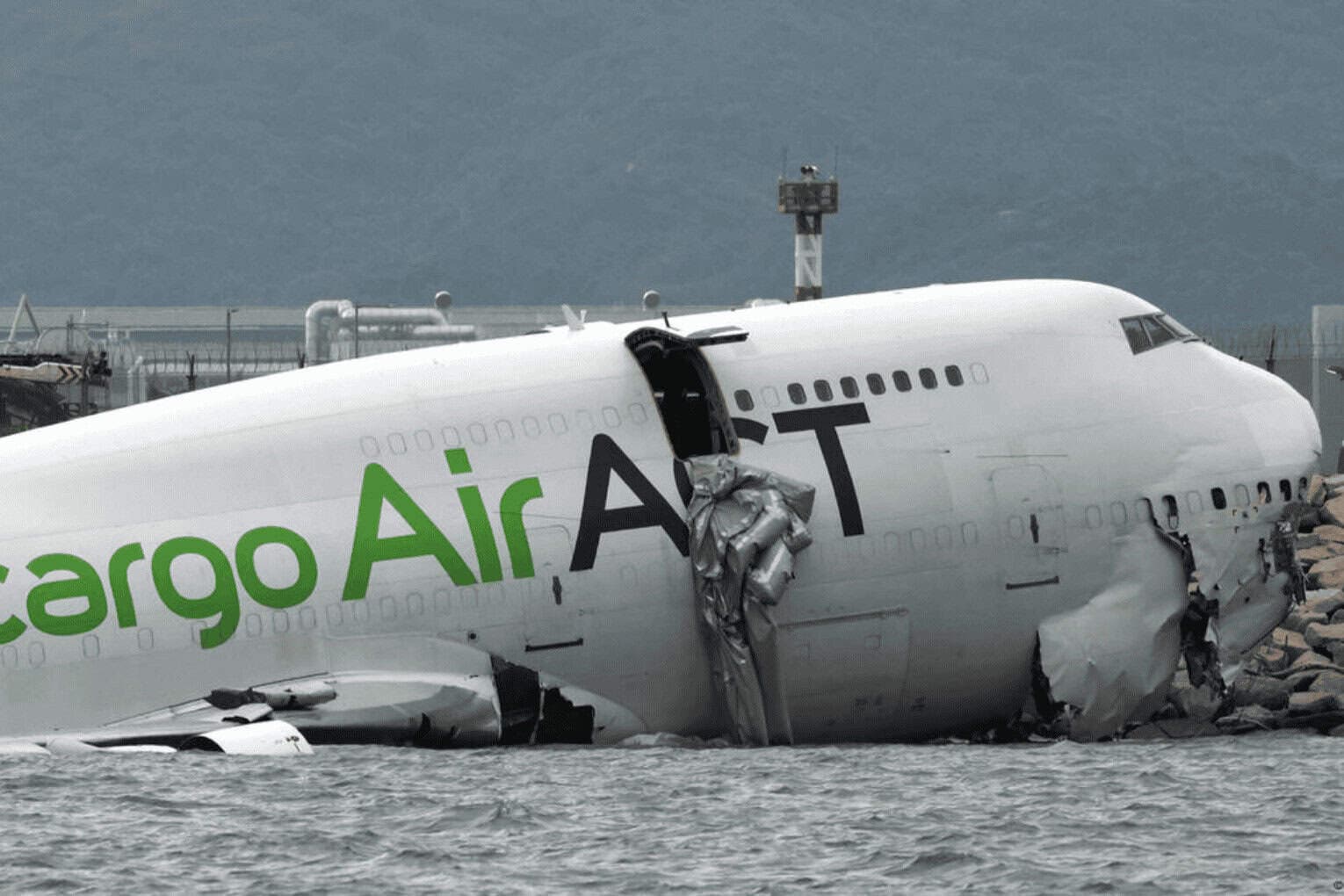
Two airport staff were killed and four crew members injured when a cargo aircraft operated for Emirates skidded off the runway at Hong Kong International Airport and plunged into the sea early Monday morning. The incident, involving a Boeing 747-400 freighter leased from ACT Airlines, has prompted a full-scale investigation by aviation authorities in both Hong Kong and the United Arab Emirates.
(thenationalnews.com)
According to Hong Kong’s Airport Authority, the accident occurred at approximately 3:50 a.m. local time as the cargo jet arrived from Dubai’s Al Maktoum International Airport. While landing on the northern runway, the aircraft veered off the tarmac, broke through a security fence, and collided with a ground-service vehicle before ending up partially submerged in the sea near the runway’s end.
Sequence of Events
Authorities stated that visibility and weather conditions were fair at the time of landing. The aircraft reportedly touched down normally but began to drift off centerline during rollout. Investigators will examine whether braking issues, pilot response times, or runway surface conditions played a role in the incident.
The security vehicle struck by the aircraft was operating in a designated area adjacent to the runway, and officials confirmed that it was not violating any operational procedures. Both ground personnel in the vehicle aged 30 and 41 suffered fatal injuries. They were pronounced dead at Princess Margaret Hospital shortly after being transported from the scene.
All four crew members on board the captain, first officer, and two loadmasters managed to escape before the aircraft became fully submerged. Emergency responders treated them for minor injuries and shock.
Emirates Statement
Emirates confirmed in a public statement that the flight, designated EK9788, was a cargo operation under its SkyCargo division. The aircraft was operated by ACT Airlines (AirACT), a Turkish carrier contracted under a wet-lease arrangement. Emirates said there was no cargo on board at the time of the crash, as the jet was repositioning to Hong Kong to collect freight.
In its message of condolence, Emirates expressed its “deep regret and sympathy” for the families of the two ground staff who lost their lives. The company stated that it was “working closely with local authorities to determine the cause of the accident” and to provide support to the affected families and its flight crew.
Investigation Underway
The Hong Kong Civil Aviation Department announced that its Air Accident Investigation Authority has launched a comprehensive inquiry into the crash. Teams have recovered the aircraft’s flight data recorder and cockpit voice recorder, which will provide crucial information about the final moments of the landing.
Investigators will examine factors such as aircraft maintenance history, pilot workload, approach stability, and braking systems. Early reports indicate that the plane was in service for more than 30 years and had logged thousands of flight hours since entering operation in the early 1990s.
Authorities will also assess ground safety procedures, including the location and movement of vehicles near runways. Questions have been raised about whether additional buffer zones or alert systems might prevent similar tragedies in the future.
Airport Operations
Following the crash, Hong Kong International Airport temporarily closed its northern runway for inspection and cleanup, while the other two runways remained operational. Airport officials stated that the incident caused minimal disruption to passenger flights, thanks to swift coordination between rescue and control tower teams.
The wreckage of the Boeing 747 was visible in shallow water for several hours before cranes began recovery operations. Divers and engineers worked through the morning to secure the fuselage and prevent environmental contamination from leaking fuel.
Industry Context
The accident marks Hong Kong’s deadliest aviation ground incident in more than two decades and one of the most serious cargo-related runway excursions globally in recent years. Experts say the event highlights the operational risks faced by large freighter aircraft, particularly at airports located near coastlines.
Aviation analysts noted that freighter operations, though following the same safety regulations as passenger airlines, often face unique challenges including heavy weight loads, variable center of gravity, and nighttime scheduling. Such conditions demand precise handling during landing and rollout.
Former airline pilot and aviation consultant David Yip told The National that “freighters like the 747-400 are powerful and reliable, but even small deviations in speed or alignment can create serious hazards, especially on runways bordered by water.”
ACT Airlines and Safety Record
ACT Airlines, also known as MyCargo, is a Turkish air freight carrier that provides wet-lease services to major airlines, including Emirates and Qatar Airways. The company has previously maintained a solid safety record, though it was involved in a 2017 crash in Kyrgyzstan that killed 39 people after a cargo plane overshot the runway during landing.
The recurrence of an incident involving the same operator will likely prompt regulators to scrutinize its fleet maintenance and operational oversight procedures. Both Turkish and UAE aviation authorities are expected to participate in the Hong Kong-led investigation.
Reactions and Condolences
News of the crash spread quickly through the aviation community. Colleagues and ground staff at Hong Kong International Airport held a brief moment of silence for the two victims. Emirates SkyCargo staff in Dubai also observed a private tribute.
Hong Kong’s Chief Executive issued a statement expressing sorrow for the loss of life and commending the emergency response teams for their professionalism. “The rapid coordination between airport staff, rescue personnel, and firefighters prevented what could have been a far greater tragedy,” the statement read.
Safety Measures and Next Steps
Aviation experts say the incident could lead to a review of runway safety protocols at major international airports, especially those with water-end runways similar to Hong Kong’s. Possible upgrades include improved friction measurement systems, enhanced lighting, and expansion of runway end safety areas.
Hong Kong’s Airport Authority said it is fully cooperating with investigators and will implement any recommendations issued by the Air Accident Investigation Authority. Emirates has pledged to enhance its oversight of partner-operated cargo flights and share technical data with regulators to aid the investigation.
Broader Implications
The crash comes amid growing demand for air freight across Asia, driven by e-commerce expansion and global supply chain shifts. Airlines are increasing cargo capacity to meet this demand, often by extending the operational lifespan of older aircraft. Safety analysts warn that while maintenance standards remain high, aging airframes require more rigorous inspection cycles to prevent incidents related to mechanical wear.
At the same time, industry observers believe that the strong emergency response in this case demonstrates how far airport safety systems have evolved. Despite the loss of life, the quick containment of the crash and minimal flight disruption reflect the effectiveness of modern coordination between airport authorities, airlines, and local emergency services.
Conclusion
The crash of the Emirates-operated Boeing 747 cargo jet in Hong Kong is a tragic reminder of the complexities and risks of global air cargo operations. While the loss of two airport staff has cast a shadow over one of the world’s busiest airports, the survival of the flight crew and the swift response from local teams prevented further disaster.
As investigations continue, authorities in Hong Kong and Dubai will seek to uncover the precise cause of the accident and ensure that future operations maintain the highest possible standards of safety
Read more on
About the author
WORLDEF Editors
921 stories on WORLDEF since January 2025.
More from WORLDEF Editors →Related
Russian E-Commerce Market Faces Loss of 400 Million Orders and 400 Billion Rubles in Revenue

YouTube and Amazon Form Major E-Commerce Partnership: Videos Turn Into Shopping Channels

IGEXX 2026 to Bring Global E-Commerce Leaders to Istanbul

Dubai Economic Zones Reach 96% Occupancy as Company Numbers and AI Activity Surge
The week in commerce, before your competitors.
1,458 stories since January 2025, distilled into three newsletters. Pick the ones you want.