
The 2026 E-Commerce Playbook: Four Structural Shifts We Are Underestimating
The future of e-commerce will not be decided on the storefront, but behind it. As global demand continues to expand, operational discipline, data quality, and fulfillment infrastructure are becoming the true determinants of sustainable growth.
— Burak Yalım writes.

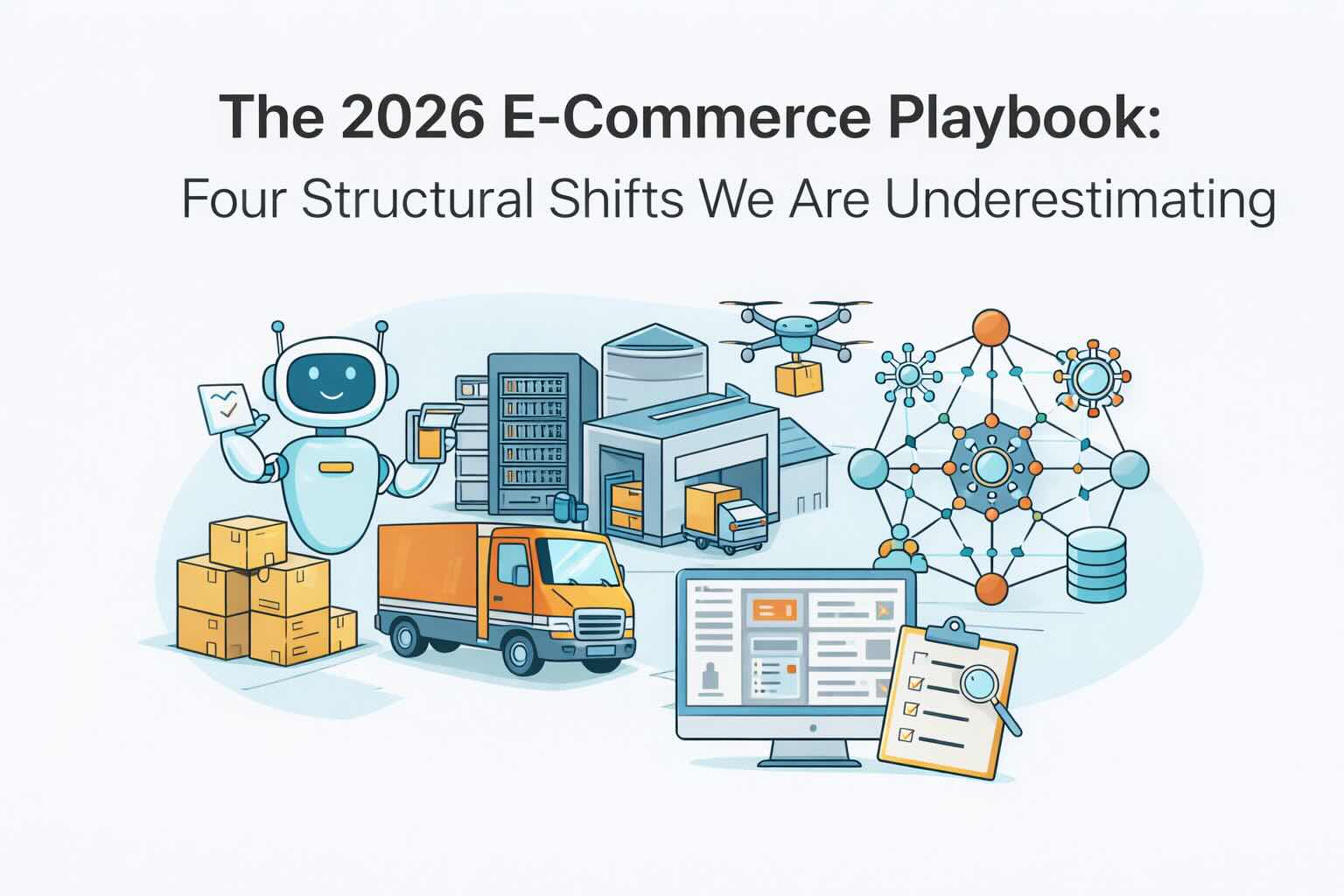
The 2026 E-Commerce Playbook
Each year, e-commerce enters the new calendar with a familiar ritual: predictions, trend lists, and bold claims about the “next big thing.” In recent years, that conversation has been almost entirely absorbed by artificial intelligence. Chatbots, personalization engines, and generative content tools dominate conference stages and LinkedIn feeds alike.
Yet, from where I stand, observing the industry across regions, platforms, and supply chains, the most consequential transformation of e-commerce is not taking place on the screen. It is happening behind it.
In 2026, e-commerce will no longer be defined by how effectively brands attract demand, but by how well they can absorb, process, and deliver that demand without breaking their operational backbone.
Most global outlooks now converge on one reality; nearly all established brands expect continued growth in cross-border and platform-based order volume. Demand, in other words, is not the problem. The real question is whether existing operational models are structurally capable of carrying that demand profitably and sustainably.
The following four shifts are not speculative. They are already unfolding. What is surprising is how many businesses are still unprepared for them.
From Storefront Excellence to Operational Credibility
For more than a decade, e-commerce success was measured primarily at the front end. Traffic acquisition, conversion optimization, and brand storytelling defined competitive advantage. In 2026, this logic no longer holds.
The decisive battlefield has moved from the digital storefront to the warehouse, the routing system, the compliance workflow, and the data layer connecting them all. The 2026 E-Commerce Playbook
What we increasingly observe is a widening imbalance. Many brands have rapidly adopted artificial intelligence in marketing and customer engagement, yet far fewer have applied the same intelligence to logistics planning, inventory orchestration, or cross-border execution. The result is an ecosystem that generates demand faster than it can fulfill it efficiently.
In this environment, fulfillment is no longer a back-office function. It actively shapes demand. Delivery speed, reliability, and post-purchase experience now influence platform visibility, marketplace algorithms, customer trust, and repeat purchase behaviour. Operational readiness has become a growth multiplier or a growth ceiling.
Entering new markets is no longer the hard part. Delivering consistently within them is.
Asian Platforms Are Rewriting Global Expectations
Platforms originating from Asia are not merely expanding geographically. They are exporting an entirely different logic of commerce.
TikTok Shop, Shein, and Temu operate on a fundamentally different premise from traditional search-driven marketplaces. Demand is no longer initiated by deliberate intent. It is algorithmically constructed through content, discovery, and impulse. The purchase often precedes conscious recognition of need.
This shift matters because consumer expectations do not reset between platforms. Speed, price transparency, and frictionless fulfillment become baseline assumptions everywhere else. The 2026 E-Commerce Playbook
What we are witnessing is not platform competition, but psychological conditioning at scale. As consumers become accustomed to instant gratification and seamless delivery loops, tolerance for operational friction disappears. This places extraordinary pressure on brands whose supply chains were designed for slower, more predictable demand curves.
The long-term consequence is clear. The more commerce becomes algorithm-driven, the less forgiving it becomes of operational weakness.

The Customer Is No Longer Human Only
One of the most under-discussed transformations in commerce is the rise of machine decision-makers. Algorithmic agents that browse, compare, and select products on behalf of users are no longer theoretical. They are already shaping visibility and conversion across platforms.
This introduces a profound shift in how products must be presented to the market. The 2026 E-Commerce Playbook
A human customer can be influenced by emotion, storytelling, and aspiration. An algorithm cannot. It evaluates structure, completeness, consistency, and risk. In this emerging environment, product data is no longer a support function. It is the primary interface between brand and buyer.
If product attributes are incomplete, inconsistent, or poorly structured, algorithms simply bypass them. Visibility is not lost gradually. It disappears entirely.
Brands are therefore transitioning from persuasion-based marketing to machine readability. The question is no longer how compelling your product page looks, but whether it can be fully understood, classified, and trusted by non-human decision systems.
Returns Are No Longer a Failure Signal
Returns have historically been treated as a necessary cost of doing business online. In the emerging commerce model, this perspective is increasingly outdated.
In an environment shaped by impulse purchasing and algorithmic discovery, a clear and frictionless return process becomes a trust mechanism. It lowers psychological barriers to purchase. But more importantly, returns generate one of the most valuable data streams a brand can access. The 2026 E-Commerce Playbook
Every return is a documented mismatch between expectation and reality. Whether the cause is sizing, imagery, description, or usage context, it reveals precisely where the sales narrative failed.
Brands that systematically analyse return reasons are not merely reducing costs. They are refining product design, improving content accuracy, and increasing conversion at the source. Returns, when treated correctly, are not a loss. They are operational feedback loops with measurable return on investment.
The 2026 E-Commerce Playbook: A Final Question for 2026
The unifying theme across all these shifts is structural maturity.
The future of e-commerce is not defined by louder marketing, faster content, or newer tools. It is defined by quieter capabilities: logistics discipline, data integrity, operational resilience, and system-level thinking.
Global demand will continue to grow. That is not in doubt. What remains uncertain is which organizations have built foundations strong enough to carry that growth without turning it into operational risk.
As we move toward 2026, every brand should ask itself one honest question:
Is our operational infrastructure designed to amplify growth, or is it the very thing that will eventually constrain it?
I believe this is the conversation that matters most.
Burak Yalım – Editor in Chief
The 2026 E-Commerce Playbook – The 2026 E-Commerce Playbook – The 2026 E-Commerce Playbook