Stripe AI Commerce Strategy Targets Southeast Asia’s $100B Digital Economy

Stripe AI commerce initiatives are expanding across Southeast Asia as the global payments platform explores artificial intelligence-driven commerce and stablecoin payments.
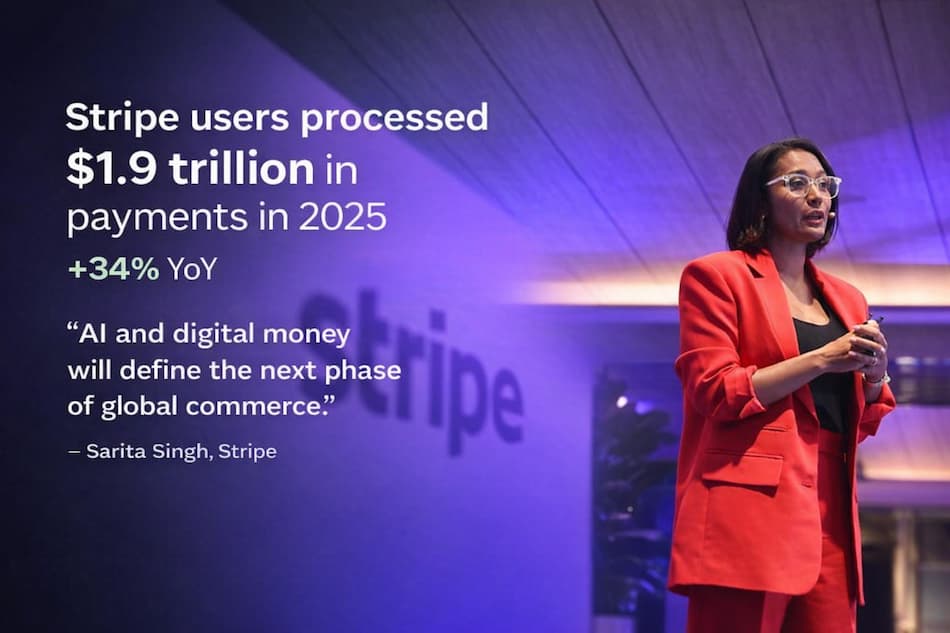
In an interview with TNGlobal, Sarita Singh, Regional Head and Managing Director for Southeast Asia and Greater China, reflected on Stripe’s performance in 2025 and outlined the company’s priorities for 2026.
The fintech infrastructure provider processed $1.9 trillion in total payment volume in 2025, representing a 34 percent year-on-year increase, according to Singh. The figure is equivalent to roughly 1.6 percent of global GDP, highlighting the scale of transactions flowing through the platform.
Stripe, headquartered in San Francisco and Dublin, provides programmable financial infrastructure used by millions of businesses worldwide to process payments, manage revenue streams, and scale digital operations.
Stripe AI Commerce Strategy in Southeast Asia
Stripe also reported record growth in new companies joining its platform during 2025.
More than 57% of newly onboarded businesses were based outside the United States, reflecting the increasing globalization of online entrepreneurship and the growing importance of emerging digital markets.
Across Asia, many startups are now launching with international expansion built into their strategy from day one.
Stripe supports a range of fast-growing “global-by-default” companies, including Aspire, Halara, Manus AI and Shoplazza. Meanwhile, cross-border payments processed through the platform grew by more than 30 % in key regional hubs such as Singapore, underscoring Southeast Asia’s role as a major center of digital trade.
AI-Powered “Agentic Commerce” Emerging as Next Digital Payments Frontier
A major development for Stripe in 2025 was the rise of agentic commerce, a model where artificial intelligence agents can autonomously complete transactions on behalf of users.
Stripe said it has been working with partners including OpenAI and Microsoft to build frameworks enabling AI systems to transact securely while merchants maintain control over pricing, brand identity, and risk management.
The company believes AI-native commerce models will reshape how businesses interact with customers online, enabling faster transactions and more automated purchasing experiences.
Stripe is currently developing infrastructure such as the Agentic Commerce Protocol, designed to support secure AI-driven transactions across ecommerce platforms and payment networks.
Stripe Aims to Simplify Southeast Asia’s Fragmented Payments Landscape
Looking ahead to 2026, Stripe says one of its main goals in Asia is helping businesses navigate the region’s complex and fragmented payments ecosystem.
Rather than replacing local payment systems, the company aims to unify them through a single programmable payments infrastructure layer, allowing merchants to operate across multiple markets without managing the complexities of different payment methods, compliance frameworks and regulations.
Singh noted that many businesses still operate with underperforming payment infrastructure, a situation Stripe founders describe as “low revenue mode.”
In such cases, weak payment conversion rates, lower authorization performance and inefficient fraud management can significantly reduce revenue potential.
Optimizing payment infrastructure, Singh said, remains one of the most effective ways businesses can unlock additional growth.
Stablecoins Expected to Transform Global Money Movement
Another major focus for Stripe is the increasing adoption of stablecoins in cross-border payments and digital commerce.
According to the company, global stablecoin payment volumes doubled to around $400 billion last year, with approximately 60 percent linked to business transactions.
Stripe’s research indicates that nearly half of Asian businesses plan to begin using stablecoins within the next four years, largely due to their ability to enable faster and cheaper cross-border money transfers.
The company says it is positioning its infrastructure to support the growing integration of stablecoins into global commerce.
Southeast Asia’s Tech Ecosystem Set for Next Decade of Growth
Singh remains optimistic about the long-term outlook for Southeast Asia’s technology sector.
The year 2026 marks ten years since Stripe launched operations in Singapore, a period that coincided with the rapid expansion of the region’s internet economy.
According to Singh, the past decade of digital growth across Asia was largely driven by improvements in payments infrastructure, logistics networks and digital marketplaces.
The next phase, she said, will be shaped by programmability – the ability for businesses to build and scale global digital commerce through unified financial infrastructure.
Analysts say Stripe AI commerce strategy could accelerate digital payments and AI-driven retail innovation across Southeast Asia.
Source
© TNGlobal