
The Global Data Center Market: A 900% Capacity Surge Reshaping E-Commerce Infrastructure

The Global Data Center Market
The physical “operating system” of the global digital economy is undergoing a massive transformation. As e-commerce platforms and AI-driven logistics become more computationally intensive, the infrastructure supporting them is experiencing unprecedented growth.
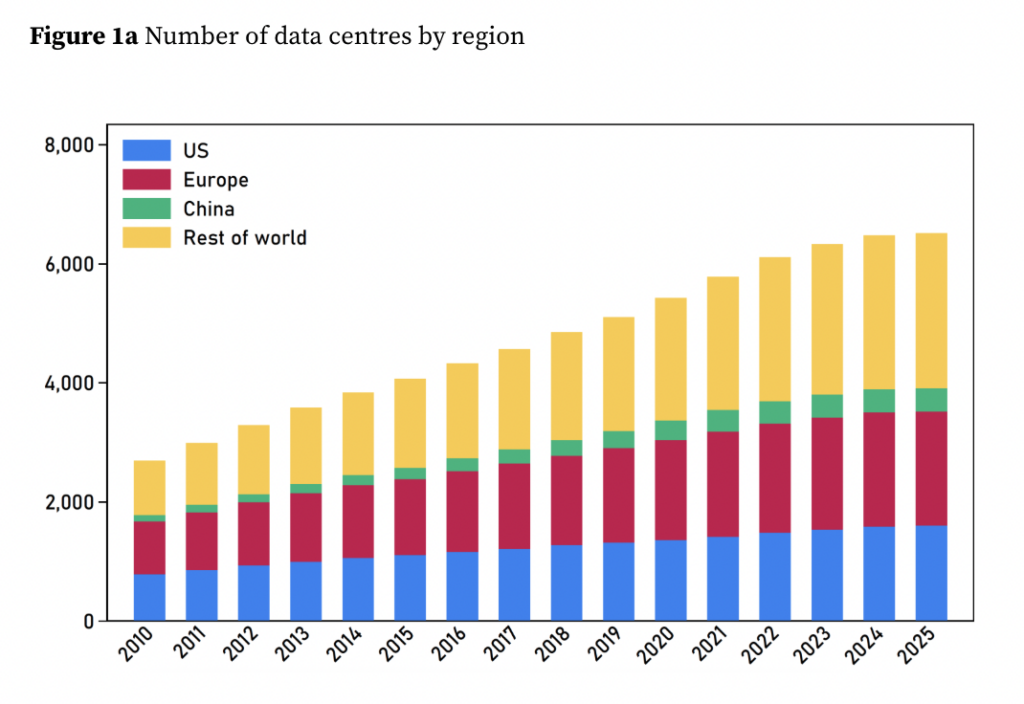
In a newly released analysis for VoxEU, economists Fabrizio Ferriani and Andrea Gazzani of the Bank of Italy highlight a staggering shift: while the number of facilities has grown steadily, the global data center market capacity has surged by 900% since 2010.
For the e-commerce community, this isn’t just a technical stat; it is the new frontline of digital sovereignty and market resilience.
US Dominance and the Rise of the “Hyperscalers”
In the race to power the next generation of AI and cross-border trade, the geographical concentration of power is stark. The United States currently controls 50% of global IT capacity, followed by Europe at 18% and China at 10%.
However, the real story lies in who owns the hardware. A small group of US-based “hyperscalers”, AWS, Google, Meta, and Microsoft, now account for approximately 70% of global self-built IT capacity. For global e-commerce, this means the vast majority of cloud-based retail operations and AI model training are tethered to a handful of providers.
Energy Constraints: The New Friction in the Digital Economy
Data centers are no longer invisible warehouses; they are major industrial energy consumers. This “power hunger” is creating new friction points in the global data center market:
- Localized Price Pressure: In data-intensive regions like Virginia, these facilities now account for 26% of total electricity supply, driving up retail prices for local businesses.
- The AI Multiplier: A single 10 MW data center now consumes as much electricity as 20,000 European households.
- Infrastructure Shifting: Governments are moving toward a “pay-to-play” model. The authors note that the US Ratepayer Protection Pledge now requires tech firms to secure their own generation capacity rather than relying solely on the public grid.
Why This Matters for MENA and Strategic Autonomy?
As we look at the UAE’s role as a “global operating system,” the resilience of our digital infrastructure is paramount. Ferriani and Gazzani suggest a looming challenge of strategic autonomy. As AI becomes central to economic productivity and e-commerce logistics, relying on foreign-controlled infrastructure presents risks to data governance and long-term cost stability.
For regions like MENA, which are rapidly building out logistics hubs like Jebel Ali, the “energy-for-data” trade-off is becoming a central policy pillar. The transition from colocation (renting space) to self-built hyperscale facilities is raising the barriers to entry for sovereign digital infrastructure.
The Future of E-Commerce: Global Data Centers in 2026 and Beyond
The expansion of the global data center market is the “engine room” of the next phase of e-commerce. As we track market trends this year, the narrative is shifting. The question is no longer just about who has the best algorithm, but who has the most reliable access to the grid and the physical hardware to run it.
To sustain growth in an era when “friction is inevitable,” businesses must closely examine their infrastructure providers. The rules of the game have quietly changed, and power is the new currency of the digital trade.
Ultimately, the data from Ferriani and Gazzani serves as a wake-up call for the e-commerce ecosystem. We are moving away from a world of “cloud-first” toward “infrastructure-certainty.” For brands and platforms, 2026 will be the year when supply chain resilience is measured not just by the speed of a delivery truck but also by the stability of the server rack. As the digital and energy transitions collide, the winners will be those who treat data center capacity as a strategic asset rather than a utility bill.