
Print on Demand: The E-Commerce Model Where AI Directly Drives Revenue

By Muhammet Emin Kantarci | CEO, Podbul Inc.
Imagine an e-commerce business model where you don’t need to hold inventory, you don’t deal with 3PL warehousing, shipping, or logistics, and international tariff wars keep raising prices, but you are not directly affected because your products are produced domestically. You can expand to global markets faster because you don’t tie your capital to inventory and can allocate most of it to marketing and growth. Sounds too good to be true? Well, it is not, and I am not talking about dropshipping. The Print on Demand (POD) business model, where products are manufactured only after a sale is made, is exactly that.
In simple terms, Print on Demand is an e-commerce fulfillment model where a product is produced only after a customer places an order, allowing sellers to test designs, various products, enter new markets, and scale without carrying inventory upfront. You don’t need inventory because your product is produced after you have already made a sale. You don’t need warehousing because you don’t hold inventory.
You are also not immediately affected by unexpected import tariffs, like the ones we have witnessed frequently in the U.S. over the past year, because you work with a local U.S. print provider like Podbul, which handles production, shipping, and fulfillment directly within the U.S. and delivers the products to your customers.
The Print on Demand model covers a wide range of categories
Not every product category is suitable for the Print on Demand business model, but it does cover a wide range of categories. From a personalized first Father’s Day shirt for a new dad, to wall art featuring a French bulldog reading a newspaper, or a Christmas ornament for a newlywed couple, the possibilities are endless. One out of every three products sold on Etsy marketplace, which is one of the leading marketplaces for this business model, is a personalized product. As such, the sky is the limit.
Entrepreneurs selling with the POD model solely focus on trend following and making designs that go on physical products like shirts, wall art, phone cases, and ornaments. If they make a sale, their Print on Demand provider, like Podbul, prints their design on the physical product and ships it locally and directly to their customer.
The entrepreneur is happy because they do not deal with the biggest problem areas of e-commerce: sourcing, shipping, logistics, or international tariffs. The end consumer is happy because they get a familiar product with a local “ship from” address within a quick time frame compared to international shipping. But the design is the product itself that the POD seller sells. So, does one have to be a designer to run this model successfully?
Until recently, you had to be a graphic designer, or at least technical enough to use design software such as Adobe Photoshop or Adobe Illustrator. You had to manually vectorize artwork files and place them on realistic product mockups like T-shirts or posters. The rapid advancement in artificial intelligence image generation models in 2025 changed this completely. Advanced AI models like Nano Banana Pro, Flux 2.0, and more recently Image GPT 2.0, can now do much of the hard work and provide ready-to-print, ready-to-sell artwork for print on demand. Additionally, there are now AI models that can even vectorize a design for ease of customization.
As such, the Print on Demand business model is one of the few areas of commerce where AI directly drives revenue. I am not talking about increasing productivity, better SEO, automating tasks, etc. In Print on Demand, the design and artwork are the product itself. People don’t go on Etsy because they want a nice red T-shirt that matches their white shorts.
They go on Etsy to buy a red first Mother’s Day gift for their best friend. Until the advancement of AI, a person who was not a designer or technical enough to use design tools could not easily make a customizable design that could be sold and bought. But designing alone is not enough. You must have a reliable print partner that will produce and send your finished products to your customer in a timely and efficient manner, with a price point where they are not the only one making a profit.
At Podbul, we fix a major problem. The barriers to enter the U.S. e-commerce space were too high. Entrepreneurs needed to tie a lot of capital to physical products, make their own shipping arrangements, secure storage, use 3PL warehousing, and deal with constantly changing tariff regulations. For an experienced seller, those are already difficult problems to overcome, but for someone just starting out, they could be the deal breaker. There were already internationally known major Print on Demand providers with billion-dollar valuations, but their pricing was just not right for the e-commerce seller. They also lacked a proper understanding of how e-commerce works at a marketplace level, like Etsy and Amazon, and left their sellers alone to figure out how to be successful.
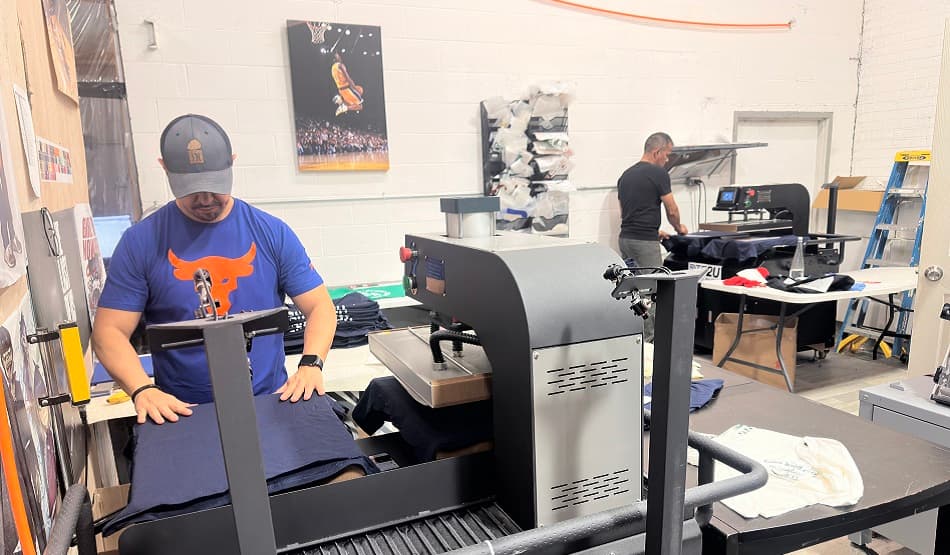
Today, our software connects our high-volume New York-based production center to 1,000 entrepreneurs in Türkiye and around the world. It is our own production line; we don’t do print brokerage or add commissions on someone else’s production. Since we produce on our own, we also own any mistakes or responsibility and can take rapid action when manufacturing challenges arise.
On top of this, the advanced AI models that are already integrated with Podbul are fine-tuned for the perfect Print on Demand design. Our users do everything within the Podbul platform, from designing to mockup generation to listing on Etsy and Shopify. Finally, we provide educational content, courses, and in-person events so our sellers can go on to the next level. These courses cover a wide range of topics, from selling on Etsy to selling on Amazon, U.S. company formation, and more. Everything an entrepreneur would need to start their e-commerce journey is at Podbul.
The U.S. print-on-demand (POD) market is experiencing rapid expansion and is expected to reach $15.5 billion by 2033. Our mission is to have Podbul lead the way as a fully vertical solution, not just as a print provider, but as a full Print on Demand ecosystem that allows entrepreneurs from Türkiye and across the globe to take a piece of this tremendous market.