
87 % of Retailers Say Generative AI Will Significantly Impact Loss Prevention
A new study by Zebra Technologies Corporation reveals that 87 % of retail decision-makers now believe generative artificial intelligence (Gen AI) and automation solutions will play a major role in loss-prevention efforts.

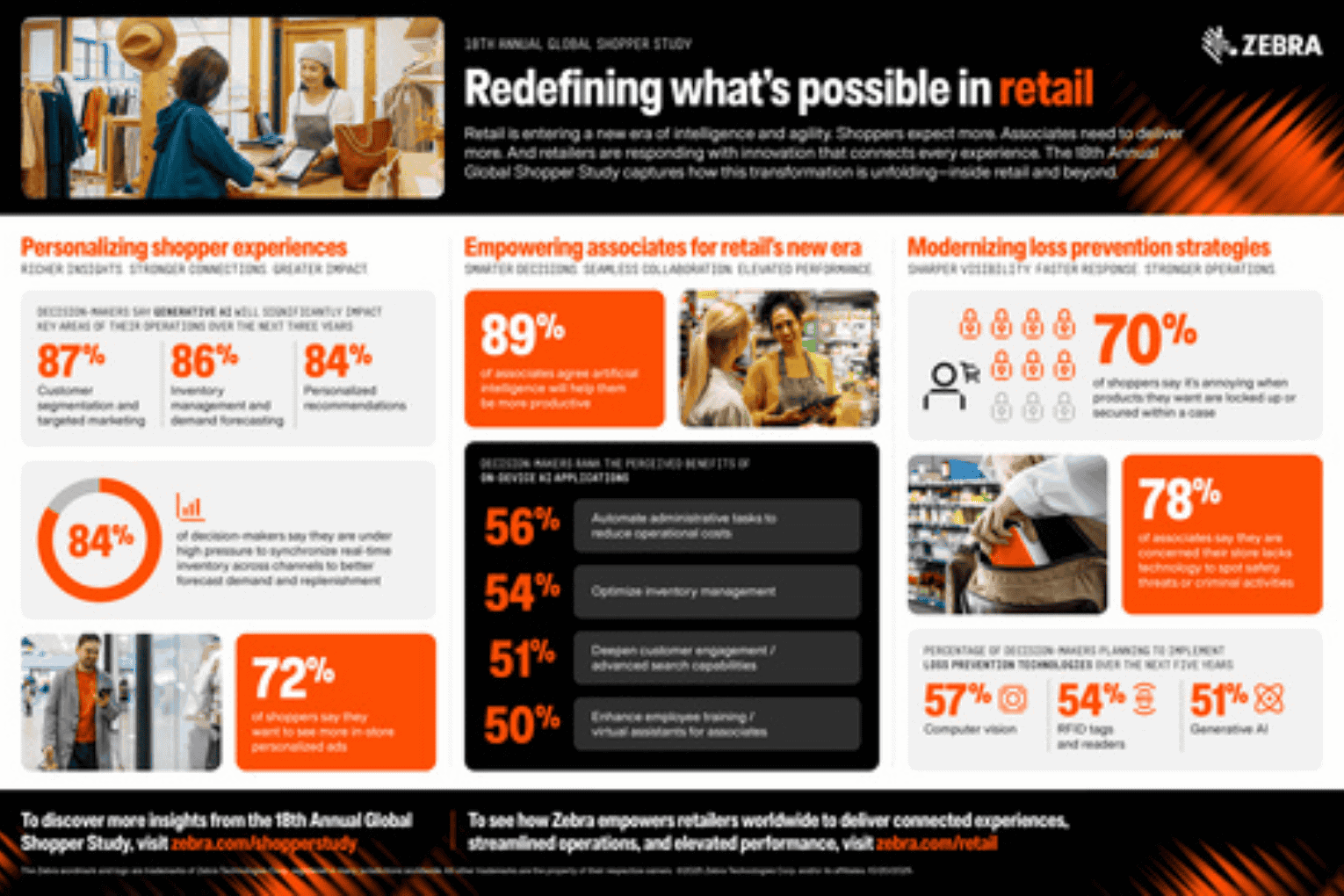
A new study by Zebra Technologies Corporation reveals that 87 % of retail decision-makers now believe generative artificial intelligence (Gen AI) and automation solutions will play a major role in loss-prevention efforts. The findings come from Zebra’s 18th Annual Global Shopper Study, published in November 2025. Business Wire+1
Key Findings
-
87 % of retailers identified Gen AI and automation as “significant tools” for loss prevention. Business Wire
-
Shopper satisfaction is declining: satisfaction for in-store experiences fell to 79 % and online to 73 % globally. Business Wire
-
Associates are also facing challenges: 88 % of store associates reported difficulty obtaining timely assistance or information (up from 82 % last year). Business Wire
-
Inventory challenges remain a pain point: 84 % of retailers cited real-time inventory synchronisation as a top priority. And 51 % (vs 57 % last year) of shoppers said they left stores without all items they intended to purchase. Business Wire
Why This Matters
Loss prevention has become a critical area for retailers amid rising costs, supply-chain disruptions and changing shopper behaviours. The fact that nearly nine in ten retail executives expect Gen AI to impact this function signals that AI is shifting from experimentation to operational deployment. The study suggests retailers are no longer looking at AI solely for marketing or personalisation—they now see it as a tool to protect margins and inventory integrity.
Moreover, the study’s findings on declining shopper satisfaction for both in-store and online channels highlight the added pressure on retailers to improve operational reliability, staff support and inventory availability. The connection to Gen AI adoption implies that reducing shrinkage, improving accuracy and automating workflows will be key differentiators in the next phase of retail competition.
Strategic Implications for Retailers
1. Deployment of AI-Driven Loss Prevention Tools
Retailers are likely to invest in systems powered by Gen AI such as computer-vision-based analytics to detect theft, automation of exception workflows, predictive-analytics alerts for shrinkage risks, and advanced data-feeds tying product movement, returns and inventory.
2. Integration of Associate Tools and Frontline Workflows
With 88 % of associates flagging challenges in accessing information, retailers will need to deploy AI assistants and real-time insight platforms—reducing friction in store operations, improving productivity and supporting loss-prevention routines.
3. Enhanced Inventory and Visibility Control
Since inventory gaps remain a major driver of consumer dissatisfaction and margin loss, Gen AI solutions that integrate sensors/RFID, supply-chain data and predictive models will become essential. 84 % of retailers cited real-time inventory synchronisation as a key priority.
4. Optimization of Omnichannel Operations
Loss prevention is not a store-only issue anymore—returns, online fraud, click-and-collect and fulfillment gaps all contribute. Retailers that extend Gen AI tools across channels stand to gain an edge.
Challenges & Considerations
-
Data Readiness & Integration: Deploying Gen AI for loss prevention requires clean, high-quality data—inventory movement, transaction logs, video feeds, exception history—and integration across store, online and logistics systems.
-
Change Management: The shift to AI-led loss-prevention workflows requires training, change in role definitions, and aligning staff with new tools and metrics.
-
Privacy & Ethical Implications: Using AI for surveillance and shrinkage prevention raises questions around consumer consent, privacy, bias in detection systems and regulatory compliance.
-
Measuring ROI: While the intent is clear, retailers must develop robust metrics to measure how much shrinkage has been prevented, how recovery has improved and whether AI-tool costs are justified.
What to Watch
-
The percentage of major retailers publicly reporting shrinkage reduction tied to Gen AI tools.
-
Investment levels by region and size of retailer in “intelligent operations” projects addressing loss prevention.
-
Case studies illustrating AI-driven store associates improving productivity, reducing exceptions and improving customer service while also managing loss risks.
-
Evolution of AI-loss-prevention regulation and best-practice frameworks, especially in Europe, North America and Asia-Pacific.
Conclusion
The Zebra study highlights that loss prevention is rapidly becoming a strategic priority for retailers—and that Gen AI is seen as a core tool in the effort. With 87 % of decision-makers signalling its importance, the industry appears to be moving beyond hype toward tangible deployment of AI in frontline and operational roles. Retailers that invest in the right data, workflows and change management stand to improve margin protection, customer experience and operational resilience in an increasingly complex retail environment.