
Abu Dhabi Unveils Its First Licensed Driverless Delivery Pods in Masdar City
Abu Dhabi has marked a major milestone in its smart mobility roadmap by debuting its first officially licensed driverless delivery vehicles in Masdar City.

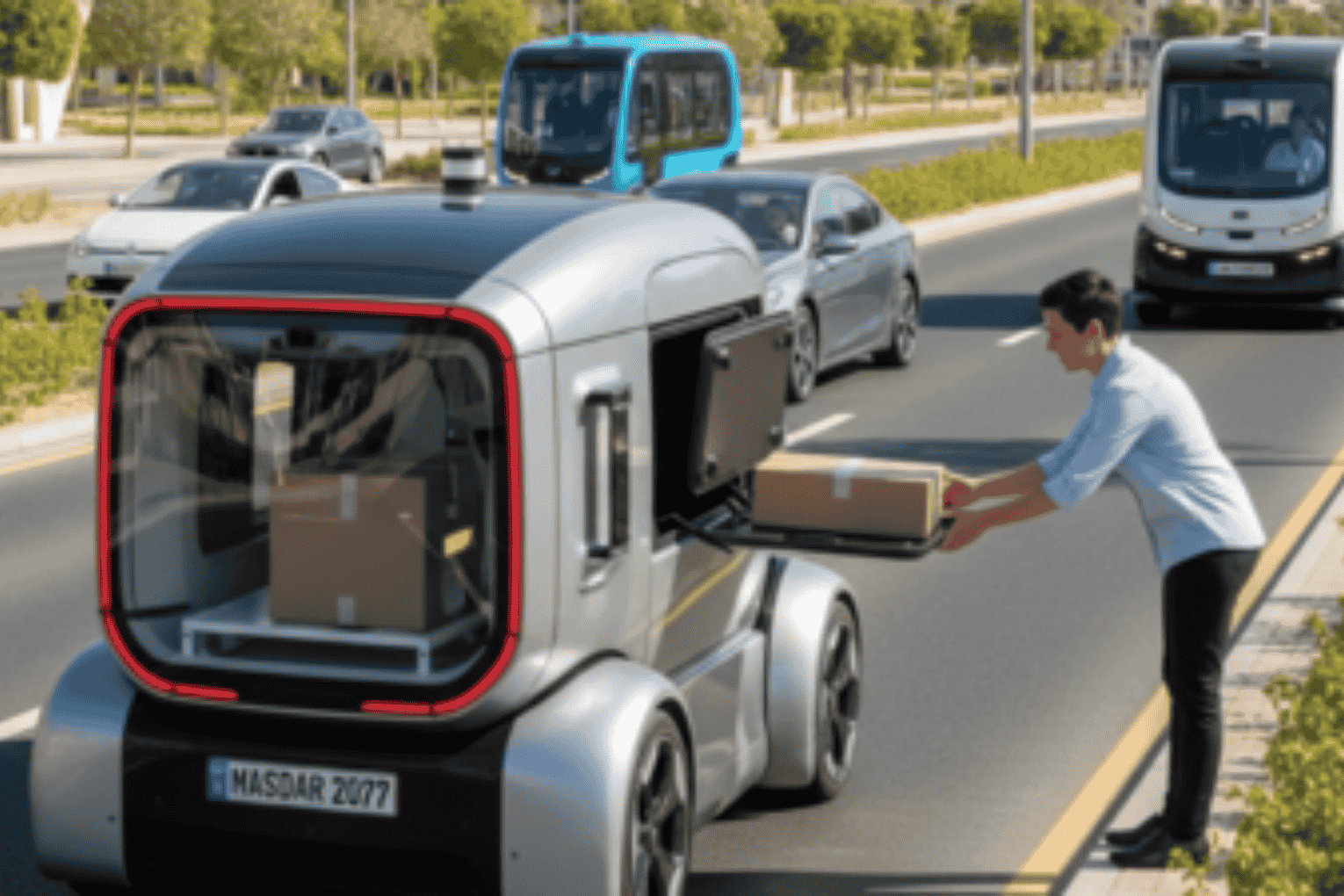
Abu Dhabi has marked a major milestone in its smart mobility roadmap by debuting its first officially licensed driverless delivery vehicles in Masdar City. This move aligns with the UAE’s long-term vision for integrating artificial intelligence (AI), sustainability, and advanced logistics into everyday life. Launched as part of a pilot program, the initiative is not just a technological showcase it is a signal of the UAE’s intent to take a leadership position in autonomous urban logistics.
Masdar City, known globally as one of the most sustainable urban developments, has once again become the testing ground for futuristic technology. Through this project, Abu Dhabi has taken a concrete step in transitioning from experimental models to regulated, operational deployments in real-world settings.
A First for Abu Dhabi: Official Plates for Autonomous Delivery
One of the most notable aspects of this launch is the issuance of an official license plate to the driverless delivery vehicle. This is the first time such a plate has been granted in the emirate for an autonomous vehicle operating in public space.
Developed by Autogo, a subsidiary of K2, the vehicle is the result of collaboration between key public and private entities, including the Integrated Transport Centre (ITC), 7X’s logistics arm EMX, the Abu Dhabi Investment Office (ADIO), and the Smart and Autonomous Systems Council (SASC). The vehicle is fully electric, powered by AI navigation systems, and designed for low-speed, last-mile deliveries in controlled urban areas.
According to reporting by the Times of India, the vehicles are expected to transform delivery models across the region, reducing traffic congestion, emissions, and human operational costs.
Sustainability and Smart Cities: Why Masdar?
Masdar City was not chosen randomly for this initiative. It represents the UAE’s commitment to green development and clean tech. As a planned city powered primarily by renewable energy, Masdar offers the ideal infrastructure for testing clean autonomous vehicles.
The autonomous pods are part of a wider push to reduce the environmental impact of last-mile deliveries a segment known for its disproportionate carbon footprint. Because they are small, electric, and programmed for efficiency, these pods serve both environmental and economic purposes.
Moreover, Masdar has long served as a hub for pilot programs, including solar-powered transit, autonomous shuttles, and drone deliveries. The city is a living lab, and this new deployment fits squarely within its ethos.
Objectives of the Pilot Program
The pilot is not just about testing vehicles; it’s about gathering deep insights into how driverless delivery can fit into a modern, growing city. Objectives include:
-
Validating navigation in mixed traffic conditions, including interactions with human drivers and pedestrians.
-
Testing vehicle response to unexpected changes in urban environments, including construction detours or erratic human behavior.
-
Analyzing environmental data, such as how much energy is saved or emissions are reduced compared to conventional delivery vehicles.
-
Monitoring logistics KPIs, such as delivery speed, route optimization, and reliability.
The pilot is set to run for several months, with real-time data collection being used to fine-tune operations and evaluate long-term viability.
From Pilot to Expansion: What Comes Next?
If successful, the program could quickly scale to other parts of Abu Dhabi and the broader UAE. Residential communities, university campuses, hospitals, and commercial zones are all candidates for the next phase.
Tariq Al Wahedi, Group CEO of 7X, emphasized that the project supports the emirate’s broader goal of developing a green economy. He noted that the pilot allows stakeholders to refine not only the technology but also the policy and legal frameworks needed to scale such solutions responsibly.
The Abu Dhabi Investment Office (ADIO) has also backed the project as part of its ongoing investment in next-generation mobility and AI-led solutions. The hope is that with adequate support, the UAE can become a global exporter of smart logistics technologies.
Integration with AI and Urban Infrastructure
These pods are not simply remote-controlled vehicles; they are fully autonomous systems. They rely on real-time data, machine learning algorithms, LIDAR, and computer vision to navigate urban environments. They are capable of:
-
Detecting road signs, traffic lights, and obstacles.
-
Making route adjustments on the fly in response to traffic or weather conditions.
-
Communicating with central control systems to optimize delivery schedules.
-
Ensuring customer notification via mobile apps upon arrival.
This level of automation requires robust digital infrastructure, which Abu Dhabi has been investing in heavily. Integration with 5G networks, city-wide IoT sensors, and digital identity systems makes this level of autonomy possible.
Global Context: A Race Toward Autonomous Urban Logistics
Cities around the world are racing to adopt autonomous last-mile delivery. In the U.S., companies like Nuro have deployed driverless pods in select cities. In China, JD.com and Meituan have been testing robotic couriers for years. However, few of these programs have official licensing from traffic authorities.
That’s where Abu Dhabi’s project stands out. By granting an official license plate and integrating these vehicles into its regulated traffic system, Abu Dhabi is moving faster than many of its Western and Asian counterparts.
As noted in a 2024 report by Gulf News, the UAE has invested billions into autonomous vehicle tech, with Masdar and Yas Island serving as key innovation hubs. With the successful rollout of these pods, Abu Dhabi moves closer to becoming a leader not only in autonomous transportation but in intelligent urban systems overall.
Legal, Ethical, and Societal Considerations
The move to autonomous delivery raises important questions that Abu Dhabi authorities are already considering:
-
Who is liable in the event of an accident?
-
What data is collected, and how is privacy protected?
-
How are jobs affected, especially for workers in delivery and logistics?
Authorities are working on regulatory frameworks that aim to address these challenges proactively, with a focus on safety, transparency, and ethical data use.
Final Thoughts: A Smart Future on the Move
Abu Dhabi’s introduction of licensed, driverless delivery vehicles in Masdar City is a testament to the UAE’s bold vision for the future of urban life. This is not merely a tech showcase; it’s a carefully planned initiative aimed at aligning mobility, sustainability, and digital innovation.
As cities globally wrestle with traffic congestion, environmental impact, and logistics inefficiencies, Abu Dhabi may offer a model for how governments and private companies can collaborate to build smarter, greener urban environments.
The pilot will serve as a valuable case study not only for the UAE, but for cities worldwide watching to see if the future of urban delivery has, in fact, arrived.