
UAE Russia Trade Agreement Takes Effect, Boosting Services and Investment

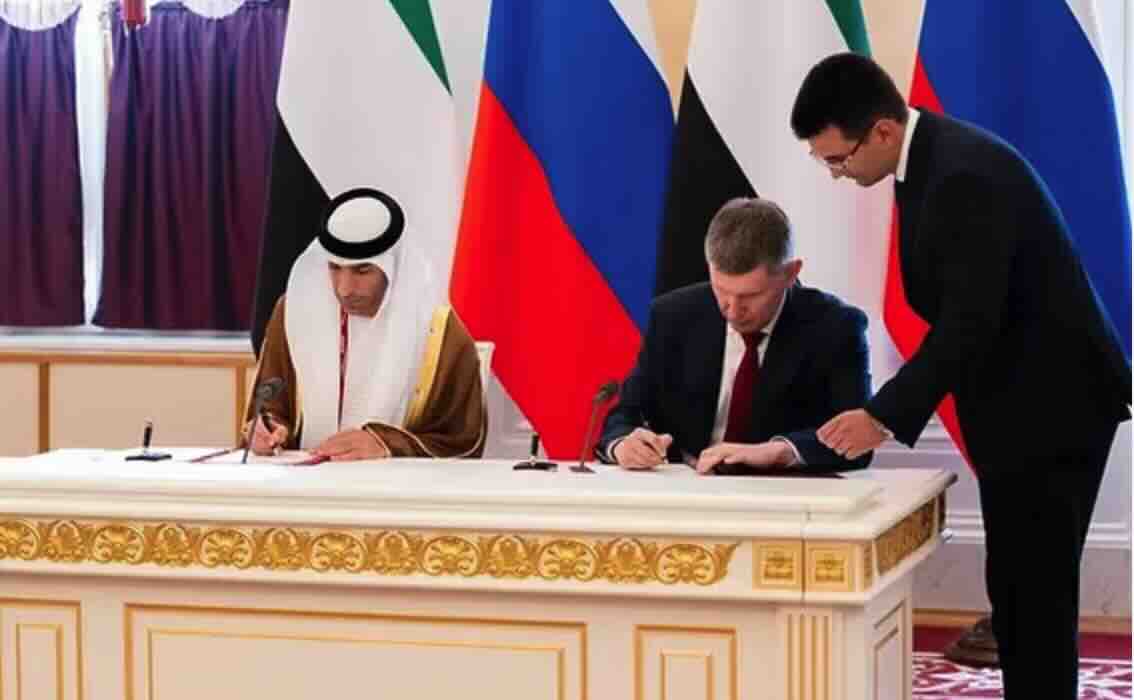
The UAE Russia trade agreement, the new framework lowers market-entry barriers and strengthens investment protections across fintech, healthcare, logistics and professional services.
The UAE Russia trade agreement on services and investment has officially entered into force, creating a new framework designed to make cross-border business easier between the two countries.
The Trade in Services and Investment Agreement, known as TISIA, introduces clearer rules for market access, investment protection and professional services while targeting sectors with strong growth potential.
The agreement is expected to support companies operating across areas including fintech, healthcare, transport, logistics and corporate services.
It also strengthens the UAE’s broader strategy of expanding trade relationships beyond goods and positioning the country as a global hub for services, investment and international business.
Lower Barriers for Cross-Border Services
One of the central objectives of the UAE Russia trade agreement is to reduce regulatory barriers for companies entering each other’s markets.
The framework provides greater legal clarity for service providers and investors while simplifying some professional licensing requirements.
For companies operating internationally, these changes can reduce uncertainty and lower the administrative burden associated with market entry.
The agreement is particularly relevant for sectors where regulatory approvals and professional recognition can significantly affect expansion.
By creating a more predictable legal environment, the two countries aim to encourage greater participation from private-sector companies and investors.
Fintech and Digital Services Among Priority Sectors
Digital finance is among the sectors expected to benefit from the new framework.
The UAE has developed into one of the Middle East’s most active fintech and digital services markets, supported by financial centres, free zones and an increasingly sophisticated regulatory environment.
Closer services cooperation with Russia could create additional opportunities for payment companies, financial technology providers and business-to-business digital platforms.
For E-commerce companies, improvements in financial services, payments and professional support can also strengthen the wider infrastructure required for international expansion.
The agreement therefore has implications beyond traditional services trade.
It could also contribute to the development of stronger digital commercial links between the UAE, Russia and the wider Eurasian market.
Logistics and Transport Could Gain From Agreement
Transport and freight logistics are another major focus.
The UAE has positioned itself as an international logistics hub connecting Asia, Europe, Africa and the Middle East.
Lower regulatory friction in services trade could support increased use of UAE ports, airports, free zones and logistics infrastructure by companies trading with Russia and Eurasia.
This could be particularly relevant for businesses using the UAE as a regional distribution or re-export hub.
Improved commercial links between service providers may also create opportunities in freight forwarding, warehousing, supply-chain management and transport technology.
For E-commerce operators, logistics efficiency remains one of the most important factors determining the viability of cross-border sales.
UAE-Russia Non-Oil Trade Reaches $20.4 Billion
The agreement comes against the backdrop of significant growth in economic ties between the UAE and Russia.
Non-oil bilateral trade reached $20.4 billion last year, highlighting the scale of commercial activity between the two markets.
The UAE has increasingly sought to diversify its international trade relationships through bilateral and regional agreements covering goods, services and investment.
The TISIA framework adds another layer to that strategy by focusing specifically on sectors where market access often depends on regulatory cooperation rather than tariffs alone.
Investment Protections Aim to Increase Business Confidence
The agreement also includes provisions designed to protect cross-border investments.
Clearer investment rules can provide businesses with greater confidence when entering new markets, particularly when establishing long-term operations, partnerships or joint ventures.
For both Emirati and Russian companies, greater predictability could encourage new investment in areas such as financial services, healthcare, logistics and professional consulting.
It could also facilitate partnerships between companies seeking to combine regional expertise, capital and international market access.
UAE Strengthens Eurasian Trade Links
The bilateral agreement also complements the UAE’s broader trade relationship with the Eurasian Economic Union.
The five-member bloc includes Russia, Armenia, Belarus, Kazakhstan and Kyrgyzstan.
Stronger commercial links with Russia can therefore support the UAE’s wider ambition to deepen trade and investment ties across Eurasia.
For international businesses, the UAE increasingly serves as a gateway connecting Gulf markets to Central Asia, Europe, and emerging Eurasian economies.
The country’s logistics infrastructure, financial centres and free-zone ecosystem make it particularly attractive for companies seeking a regional base for international operations.
Services Trade Becomes More Important
Global trade agreements have traditionally focused heavily on physical goods and tariffs.
However, services are becoming an increasingly important component of international commerce.
Digital platforms, financial services, consulting, logistics, healthcare and technology are all playing larger roles in cross-border economic activity.
As economies become more digital, regulatory compatibility can become as important as tariff reductions.
Agreements covering services, professional recognition and investment therefore have growing strategic importance.
The UAE Russia trade agreement reflects this shift by focusing on the regulatory environment businesses need to operate across borders.
The UAE Russia Trade Agreement Supports UAE Trade Ambitions
The UAE has set ambitious targets for expanding its non-oil foreign trade over the coming years.
The country aims to increase total non-oil foreign trade to $1.1 trillion by 2031.
Expanding international trade agreements is a major part of that strategy.
In addition to reducing barriers for goods, the UAE is increasingly developing frameworks that support investment, services and digital commerce.
These agreements can help UAE-based companies expand internationally while also encouraging foreign businesses to use the country as a base for regional operations.
Business Forums Expected to Follow
The implementation phase is expected to include greater engagement between the private sectors of both countries.
Government trade authorities are expected to support business forums and commercial meetings connecting Emirati and Russian companies.
These initiatives could help businesses identify partnership opportunities and better understand the new regulatory framework.
Companies operating across the two markets are also expected to review their compliance, investment and licensing structures to take advantage of the agreement.
UAE Expands Role as Global Trade Gateway
The activation of the UAE Russia trade agreement strengthens the UAE’s position as a commercial bridge between the Gulf, Russia and the wider Eurasian region.
By reducing regulatory barriers and improving investment protections, the framework could make it easier for companies to expand services and establish cross-border partnerships.
The UAE Russia trade agreement will ultimately depend on how quickly businesses make use of the new opportunities.
However, the agreement reflects a broader change in global trade strategy: growth is increasingly being driven not only by goods, but also by services, digital platforms, investment and professional expertise.
For the UAE, expanding these connections is becoming a central part of its ambition to remain one of the world’s leading international trade and business hubs.